

Study dream interpretation in 12 recorded lessons on dream structure, characters, symbols, colors, animals and self-reflection.
Course Overview
Jia Ni’s recorded training course lists ten numbered dream-interpretation lessons plus two bonus lessons. Its directory moves from dream settings and characters to structural analysis, colors, tastes, animals and the dreamer’s own awareness. This page translates the verified lesson list into English and treats interpretations as reflective possibilities rather than universal symbol meanings.
What You Will Learn
- Identify recurring characters, settings and emotional cues in a dream record
- Break a dream into scenes without assuming one fixed symbol dictionary
- Compare colors, animal images and everyday objects as personal associations
- Keep self-reflection separate from diagnosis, therapy or predictions
Course Contents: 12 Recorded Video Lessons
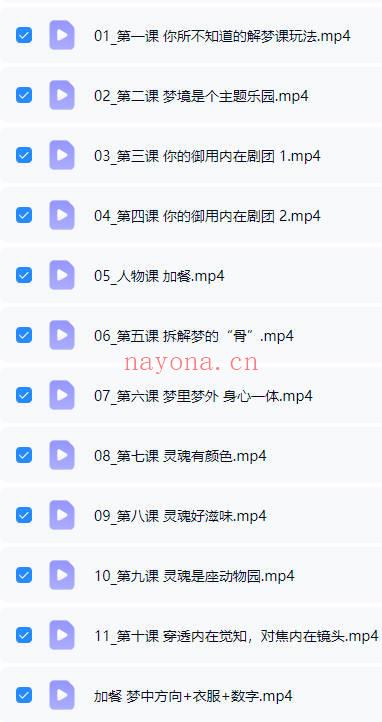
- Getting started with the dream-interpretation course
- Dreams as a themed landscape
- An inner cast of dream characters, part one
- An inner cast of dream characters, part two
- Bonus lesson: interpreting dream characters
- Breaking down a dream's structural framework
- Dreams and waking life: body and mind
- Color imagery in dreams
- Food and taste imagery in dreams
- Animal imagery in dreams
- Focusing on inner awareness and the dreamer's perspective
- Bonus lesson: directions, clothing and numbers in dreams
Course Material Images
The original course images are displayed in their recorded order for visual reference.




Who This Course Is For
Adult learners interested in dream journals, symbolic interpretation and self-observation. It is not a substitute for qualified mental-health care or sleep assessment.
Learning Format and Digital Delivery
Virtual, downloadable video-course listing; no physical shipping. Digital files are not yet attached. Purchasing is available. Automated digital files are not yet attached; contact support to confirm delivery before ordering.
Frequently Asked Questions
How many lessons are listed?
Twelve recorded files: ten numbered lessons and two bonus lessons.
Does a symbol have one universal meaning?
No. Meanings depend on personal context, emotion and culture; the course introduces interpretive methods rather than a guaranteed decoder.
Is this personal therapy or a dream report?
No. This is a recorded learning course, not an individualized consultation or clinical service.
Editorial Note
Karma Kismet translated and organized the listed curriculum for English-speaking learners. Claims about guaranteed accuracy, healing or professional credentials are not adopted without evidence.
Related Dream Courses and Guides
- Dream Interpretation Courses
- Dream Meaning Basics
- Common Dream Guides
- Nightmares and Recurring Dreams
- Contact Karma Kismet
Disclaimer
For cultural and educational study only. Dream interpretations do not diagnose conditions, predict events or replace licensed care.
Following the Dream from Scene to Interpretation
The twelve listed recordings give a learner several different ways to approach the same dream. Settings, characters, structural transitions, colors, tastes, and animals are distinct features of a remembered experience. Keeping them separate at first can make a reading more precise. Instead of asking immediately what the entire dream means, begin by describing what happened, where it happened, and what changed. An interpretation can then be compared with the actual record rather than replacing it.
For this course, a useful study companion is a notebook divided into three spaces: the dream as remembered, observations about its structure, and possible associations. The first space preserves the account. The second helps you notice details without yet assigning a meaning. The third holds tentative ideas, including alternatives that do not fit your first impression. This arrangement is a suggested way to review the material, rather than an additional lesson or promised course feature.
Setting Is More Than Background
A dream landscape may be familiar, unfamiliar, or a mixture of both. In your notes, distinguish what you recognized during the dream from what you inferred after waking. A building that felt like home may not resemble your actual home. That difference can be worth recording without deciding that the building represents a specific person or event. Also note whether the setting remained stable or changed abruptly between scenes.
When studying the lesson on dreams as themed landscapes, try identifying the relationship between setting and action. Was the dreamer searching, waiting, arriving, or leaving? Did the same activity continue after the location changed? These questions preserve the movement of the dream. They also prevent a striking object from receiving all the attention while the rest of the scene is overlooked.
Characters and the Dreamer’s Perspective
The two lessons on an inner cast of characters and the bonus character lesson invite repeated comparison. A recognizable person, an unnamed figure, and a changing character need not be approached in exactly the same way. Write down what the figure actually did before adding descriptions such as friendly, threatening, or wise. Those labels can express the dreamer’s reaction, but they should not silently become facts about a real person.
A dream involving a friend does not establish that friend’s private intentions. For reflective study, it is more useful to ask what qualities or memories you associate with the figure and whether those associations match the scene. You may find more than one plausible reading. Leaving an interpretation open is preferable to forcing a conclusion that the recorded details cannot support.
Working with Structure and Sensory Details
The structural-framework lesson can be paired with a simple scene outline. Give each scene a short descriptive heading, such as waiting beside a closed door or speaking with an unfamiliar passenger. Mark transitions, changes of viewpoint, and unresolved endings. Avoid turning this outline into a polished story: hesitation, missing sections, and uncertainty are part of the record too.
After making the outline, ask which detail changed the direction of the dream. It might be an arrival, a spoken sentence, a shift in color, or an action by the dreamer. This does not make that detail a universal key. It identifies something that matters within this particular account. Reviewing the outline after a lesson may show you a transition you missed during the first reading.
Color, Food, Taste, and Animals
The separate lessons on color and on food or taste encourage attention to different kinds of imagery. Record a remembered color as accurately as possible, while allowing for uncertainty. Then distinguish the color itself from your personal response to it. A color associated with celebration in one setting might feel ordinary or uncomfortable in another. Cultural associations can inform reflection, but they do not settle an individual dream’s meaning.
Food imagery can likewise be described through action and context: preparing, offering, sharing, refusing, or searching for something. If taste was remembered, note whether it was pleasant, unpleasant, or difficult to name. Do not add a sensory detail simply because it would make the interpretation more vivid. An absent detail should remain absent.
For the animal-imagery lesson, begin with the animal’s behavior in the scene. Watching a resting animal differs from following a moving one, even when the species is the same. Your familiarity with that animal also matters to personal association. A childhood memory, a recent photograph, and a traditional symbolic meaning are different sources of interpretation and can be labeled separately.
Turning Lesson Notes into Careful Reflection
Choose one short dream record for an initial review, then return to it after several lessons. Keep the original interpretation dated rather than overwriting it. This allows you to see how your questions changed. A later reading may be more detailed without being more certain. The value of the comparison lies in showing how you reasoned from the material.
The bonus topics of directions, clothing, and numbers can be added to the same notebook. Describe where a direction appeared, who wore an item, or how a number entered the scene. Avoid treating every number as a prediction or every garment as a fixed identity. The surrounding action gives these details their place in the dream account.
Questions for Independent Review
Must every image receive an interpretation? No. Some details may remain unclear or simply be recorded without further analysis. A selective, well-supported observation is more useful than an elaborate explanation for every object.
Can two interpretations remain possible? Yes. Write down what supports each one and what does not fit. Keeping alternatives visible reduces the temptation to treat the first appealing idea as established truth.
How can I tell whether my notes are becoming too speculative? Check whether each statement refers back to something actually remembered or explicitly identifies itself as an association. If a conclusion requires several invented details, return to the original account and narrow the question.
What should a review session produce? A clearer description, a few carefully framed questions, and a record of uncertainty are worthwhile outcomes. The exercise does not need to deliver a diagnosis, prediction, or final explanation of the dreamer.

