Build and interpret a personal life-number chart with annual-cycle reference methods and structured study guidance.
Course Overview
This English product guide organizes the available curriculum into a clear learning path for adult students of numerology and number symbolism. It combines definitions, calculation or observation methods, examples and responsible interpretation guidance.
What You Will Learn
- Core terminology and the calculation or observation method used in this resource
- How to organize number meanings without relying on isolated keywords
- How to compare patterns with context, examples and written notes
- How to separate symbolic reflection from factual or scientific claims
Curriculum and Study Notes
System Overview
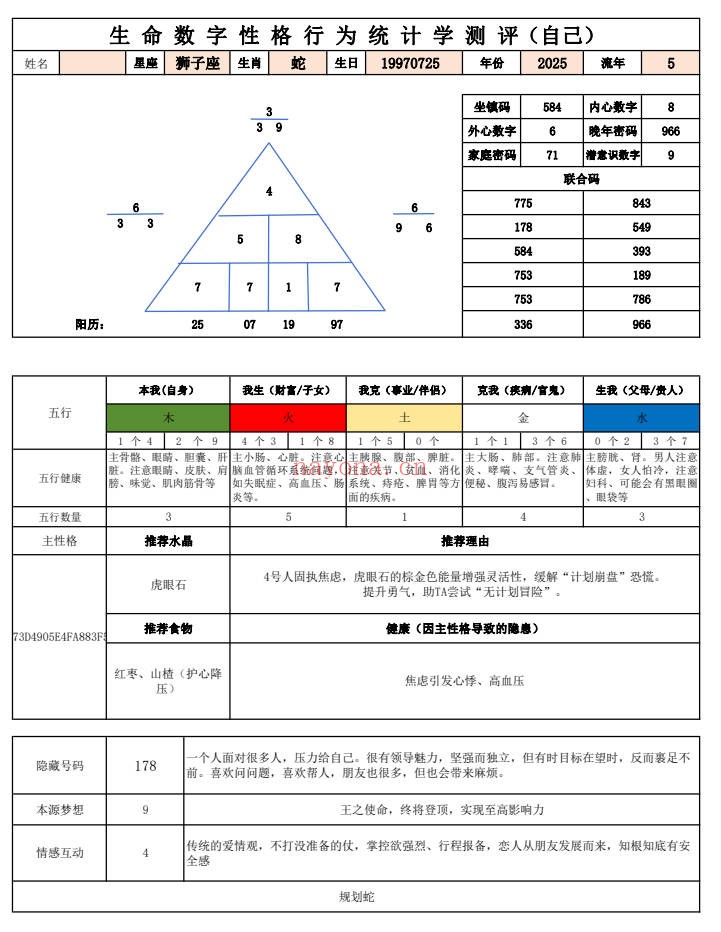
This personal life-number chart system is a spreadsheet-based learning and reporting tool. It accepts a date in a standardized format, performs the supplied calculations and organizes the resulting number themes into a structured report.
Included Workflow
Enter a Gregorian birth date in the required numeric format
Review automatically calculated life-number fields
Examine the supplied explanations and chart sections
Add observation notes and verify input accuracy
Export a completed study report as a PDF when needed
The system is intended for adult education, chart practice and symbolic reflection. Automated output should be reviewed by the learner and should not be presented as scientific, medical, legal or financial advice.
Course Material Preview
These original course-record images help learners identify the supplied study material and its structure.

Who This Course Is For
This resource is suitable for adult beginners, returning students and practitioners who want a structured reference for numerology study. Start with the calculation rules and definitions, complete the examples, and record uncertainties instead of forcing a conclusion.
Digital Course Format
- Virtual and downloadable educational product
- No physical shipment
- Study materials and access details are supplied after purchase
- Use the curriculum for personal learning and reference
Responsible Interpretation
Numerology is presented as a cultural and symbolic interpretive tradition. It is not scientifically validated and must not replace medical, psychological, legal or financial advice. The course does not guarantee predictions or outcomes.
Frequently Asked Questions
Is this a physical product?
No. This is a virtual, downloadable course resource.
Do I need previous experience?
No. The page identifies the recommended starting method and provides a structured learning sequence.
Does the course guarantee accurate predictions?
No. The material is intended for education, cultural study and personal reflection.
Is personal consultation included?
No, unless the product description explicitly states otherwise.
Continue Your Numerology Learning
Use these related resources to build a broader study path:
- Complete Life Number Energy Foundation Course
- Advanced Life Number Energy Training Course
- Yang Zhenwei Name Numerology and Digital BaZi Course
- Life Number Combinations and Relationship Compatibility Guide
- Wu Yuxin Life Number Holistic Reading Course
- Life Path Numbers: Calculation, Growth and Meditation Course
- Practical Life Number Foundations: Level One Course
- Angel Numbers 101: Repeating Number Meanings Guide
Reading context and study practice
This listing describes a spreadsheet-based life-number system rather than a recorded video course. The source specifies WPS as the working environment and gives a Gregorian birth-date input example in an eight-digit form. Studying such a tool requires two separate reviews: whether its inputs and output behave as expected, and how its symbolic text should be understood.
Input format
The example 19880108 represents a year, month, and day in a compact numeric string. Leading zeros matter in this kind of entry. Check the system’s own instructions before inserting separators or changing the cell format. A valid date in ordinary conversation is not necessarily a valid input for a particular spreadsheet, and an accepted entry still deserves a visible verification.
Calendar assumptions
The source asks for a Gregorian birthday. Do not substitute a lunar date merely because other Chinese metaphysical systems use a different calendar. Keep any calendar conversion outside the working entry until its basis has been checked. The goal is to understand the supplied calculation process, which depends on following its stated input convention consistently.
Automatic calculations
Automated calculation can make repetitive arithmetic easier, but it does not establish the truth of an interpretation. Where the formulas or working are visible, compare a small example with a manual calculation based on the documented rule. If the working is not accessible, describe that limitation. A polished report is not an independent validation of the method behind it.
Optional zodiac input
The source describes zodiac selection as optional. Treat it as a separate field with its own instructions. Do not assume that selecting an animal changes every life-number result, or invent a rule connecting the two systems. Observe what the supplied sheet actually changes, and record that behavior without promoting the resulting associations as facts about the user.
Annual-cycle wording
An annual-cycle heading may organize symbolic themes by year. Keep the year label visible and distinguish it from a birth-date calculation. If the system supplies future-oriented statements, read them as the tool’s interpretive text rather than established forecasts. A change in a calendar field can change a report without showing that real events will follow its description.
Review before exporting
The source advises generating the PDF after the complete content is displayed. Before export, inspect every report section for truncated text, stale example data, incorrect dates, and inconsistent names. These are document-quality checks. Correcting them improves the reliability of the saved record while leaving the symbolic status of the underlying interpretation exactly as it was.
Privacy in reports
A birth date and a named report can identify someone. For practice, use fictional examples or information shared with permission. Consider whether a file name needs a full name, and avoid placing personal reports in public folders. A symbolic study record can still contain ordinary private information, so its handling deserves the same care as any other personal document.
A tool review notebook
Maintain separate notes for environment requirements, input conventions, calculation behavior, report wording, and export quality. The source does not establish universal compatibility with every spreadsheet application. If your environment differs from WPS, verify the available behavior rather than assuming an equivalent result. Record observations precisely enough that you can distinguish a software issue from an interpretive disagreement.
A controlled input check
Use a fictional valid date to learn the input field before entering someone’s personal details. Record exactly what you typed and what the sheet displays afterward. If a leading zero disappears, check whether the instruction expects a number, text, or a formatted date; do not assume the resulting display is harmless. A second fictional entry can show whether the calculation refreshes or retains earlier output. These are observations about the supplied spreadsheet’s behavior. They do not require interpreting the personal themes and do not establish that the program can detect genuine characteristics from a date.
Stale output and mixed records
An automated report can contain remnants of a previous example if fields are not refreshed together. Before saving, inspect both the input area and the report area. Make sure any optional zodiac selection belongs to the current exercise and that no previous name or date remains in headings. If the report has several pages, check the later pages as well. A correct first screen is not proof that the complete export is consistent. This is especially relevant when the source advises waiting until the full content is displayed before producing a PDF. Treat the finished export as a document requiring its own review.
Software instructions and scope
The WPS requirement is a source fact worth preserving. It does not prove that every version of WPS will behave identically or that another application will reproduce the calculations. If you try a different environment, record the environment and the observable result. Avoid enabling unexplained features merely to make a report appear. A file’s ability to open is only one part of compatibility; formulas, fonts, page breaks, and export behavior can differ. Separate those practical questions from the traditional symbolism. A layout problem can be corrected without making any stronger claim about the meaning of the generated numbers.
Reading automated prose
Automatically generated text often sounds individualized because the report places a name and date above it. Read each paragraph to determine whether it is a general description associated with a result or a claim based on other information. The source does not make the report a scientific assessment. If a paragraph discusses work, relationships, or personal tendencies, distinguish the system’s template language from facts the person has actually shared. An attractive page design and a personalized heading are document features. They should not cause the learner to overlook how broad the underlying symbolic statements may be.
Export and retention
After saving a PDF, open it and compare the date, headings, section order, and visible text with the completed sheet. Use a file name that identifies your study exercise without revealing unnecessary personal information. If you correct an input afterward, make a new clearly marked export so that an older report is not mistaken for the current one. Decide where the editable sheet and final report should be kept and who needs access. This modest recordkeeping practice supports accurate learning and privacy; it does not imply that the tool supplies a secure client database, cloud account, or ongoing reporting service.