
A 10-video professional class on traditional Chinese auspicious date selection with related Five Elements study materials.
Course Overview
This English guide organizes the supplied traditional Chinese learning material around a clear course sequence. The underlying recorded lessons or documents may be in Chinese; review the stated format and curriculum before purchase.
What You Will Study
- Foundations of traditional date selection
- Five Elements considerations
- Recorded examples and practice references
Course Scope and Format
A 10-video professional class on traditional Chinese auspicious date selection with related Five Elements study materials. The course title and description identify the lesson count or page length when stated in the supplied curriculum. This is a digital educational product; no physical item is shipped.
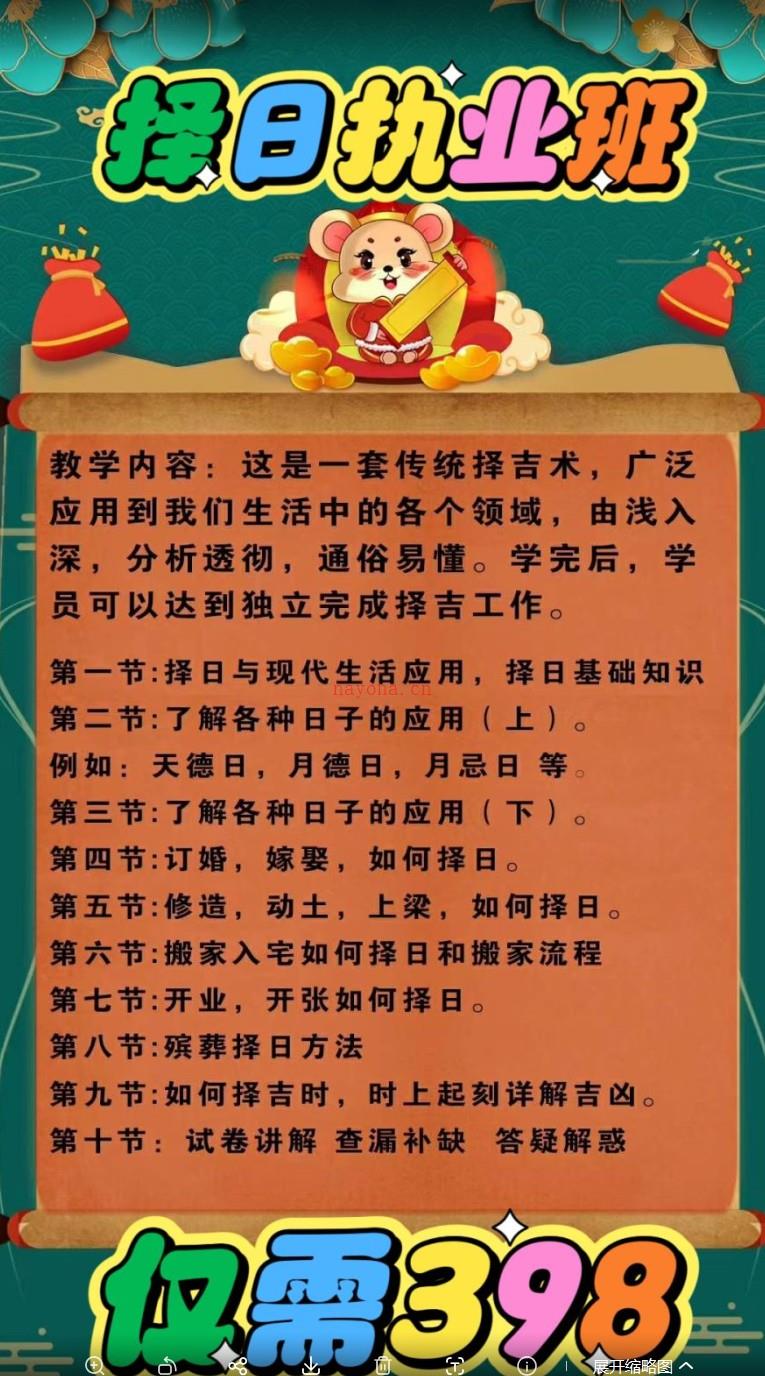
Original Course Preview Images
These images come from the original course listing and help show the supplied material.
Who This Resource Is For
This resource is for learners of traditional Chinese metaphysics who want to study the named method and compare the recorded examples with the stated rules. Beginners should start with terminology and basic procedures before moving to advanced cases.
Study Approach
Follow the lessons in order, keep a glossary of Chinese terms, and document the steps used in every example. Distinguish a traditional interpretation from an evidence-based claim or a guaranteed personal outcome.
Digital Delivery
This product is virtual and downloadable. No physical shipment is required. Check the product and order details for the available delivery format.
Frequently Asked Questions
Is the material in English?
The product guide is in English. Original lessons and documents may be in Chinese.
Is this a physical product?
No. It is a digital study resource.
Does the method guarantee a result?
No. Traditional interpretations are presented for cultural and educational study, not as guaranteed predictions or professional advice.
Related Learning
Browse the Chinese Auspicious Date Selection Courses collection and the full course library.
For course questions, contact Karma Kismet.
Understanding the Purpose of Date Selection Study
Chinese auspicious date selection examines how traditional systems assign significance to times chosen for an activity. This professional course listing identifies ten recorded video lessons and related Five Elements study materials. Its subject is a method of traditional interpretation, not proof that a chosen date will cause an event to succeed. A careful learner can study how a rule is stated, how a date is evaluated under that rule and how an example is explained without treating the result as a guarantee.
The word professional in the course title describes the source course’s orientation. It does not, by itself, establish a credential, license, certification or recognized professional standing for a student. Someone considering the resource should view it as material for structured study and judge any real-world service or decision by the standards applicable to that setting.
What the Available Record Establishes
The supplied source record names a ten-video class associated with Zhao Hongshan and lists numbered recordings from lesson one through lesson ten. It also refers to Zheng Wu Xing, often rendered as Orthodox Five Elements, in connection with related learning material. The record does not give a dependable topic-by-topic syllabus for all ten lessons. For that reason, the most useful preparation is to understand the subject area and arrive with questions, while allowing the recordings themselves to establish their actual sequence and examples.
The source page includes many unrelated recommendations and promotional phrases. Those surrounding references do not define this course’s contents. A title of another book, a search phrase or a suggested resource is not evidence that it is included in these ten lessons. Keep the numbered course recordings and the stated related materials distinct from items merely mentioned nearby.
Concepts to Clarify Before Applying an Example
Date selection methods often connect a proposed activity, a calendar date and a set of traditional interpretive rules. Five Elements language supplies one vocabulary for describing relationships within those rules. Before trying to follow a worked example, identify what the example is selecting a date for, what information it starts with and what steps lead to its conclusion. A date cannot be assessed meaningfully in the abstract if the method requires a purpose or other inputs that have not been stated.
Terms translated into English can have several renderings. Keep a small glossary that records the Chinese term used in the lesson, your provisional translation and the context in which it appears. If an English phrase seems to carry a modern scientific meaning, check whether the instructor is using it as a traditional category instead. The Five Elements are part of a symbolic framework; they should not be confused with chemical elements or with an evidence-based model of physical cause.
Distinguish a rule from an example. A rule describes how the method is supposed to work. An example shows one application under particular conditions. The fact that an example reaches a clear answer does not mean every future case will be equally clear or that all schools of date selection would agree. Write down exceptions, missing inputs and points where the instructor exercises judgment.
A Notebook Format for the Ten Recordings
- Identify the recording by its number and summarize its main question in one sentence after watching it.
- List unfamiliar terms in the instructor’s wording before choosing English equivalents.
- Record every input used in an example, including the activity or circumstance if one is stated.
- Write the procedure as a sequence of steps, leaving a blank where the explanation is unclear.
- Separate the calculated or selected result from the instructor’s broader interpretation of that result.
- Revisit an earlier lesson when a later one uses a term or rule in a more complex way.
This format encourages active learning without pretending that the listing supplies a complete transcript. It also makes gaps visible. If a lesson relies on background knowledge, you can identify the precise concept to research instead of guessing at a missing rule.
Working With Five Elements Material
The phrase Five Elements can appear in different Chinese traditions, including date selection and other forms of metaphysical study. The relationship between categories matters more for learning than memorizing a single English word for each one. Ask which relationships the course uses, how those relationships are applied to a date and whether the instructor treats a particular relationship as favorable, unfavorable or dependent on context.
A useful exercise is to take one stated rule and test whether you can apply it consistently to a second example from the lesson. If you cannot, the reason may be an omitted condition, an unfamiliar term or a difference between an introductory rule and a later refinement. Note that uncertainty rather than filling it with an invented procedure. Repeated checks help you understand the method as taught.
Traditional date selection is sometimes discussed alongside Feng Shui. The overlap in vocabulary does not make the subjects interchangeable. This course is listed within Chinese Auspicious Date Selection Courses; use its date-selection focus as your guide. References to housing, other practitioners or unrelated titles on the source page should be treated as background links unless the recordings themselves address them.
Who May Benefit From This Resource
A learner already familiar with basic Chinese calendar terms may find the ten-part format helpful for following a sustained explanation. A beginner can also use it, provided they are willing to pause frequently, define terminology and avoid rushing into complex cases. Someone interested in comparing traditional systems may value the course as an example of how one instructor presents date selection and Five Elements considerations.
It is a poor substitute for an individual assessment of a high-stakes event. Wedding plans, construction work, business launches, medical procedures and legal deadlines can involve practical constraints that a traditional date-selection lesson cannot resolve. Availability, safety requirements, contractual terms, personal needs and qualified advice should guide those decisions. A symbolic date preference can be considered as a cultural practice only within those real constraints.
When sharing a conclusion with another person, say which method and assumptions produced it. Avoid presenting one traditional interpretation as a universal rule or pressuring someone who does not share the practice. Responsible study includes understanding the limits of a method and respecting the choices of people affected by a proposed date.
How to Evaluate Your Progress
Completing ten recordings is different from understanding their procedure. After each lesson, try to explain its central idea without looking at your notes. Then check the recording to see what you left out. If a worked example is available, reproduce its sequence on paper before comparing your result with the instructor’s explanation. A discrepancy is a useful signal to review terminology or assumptions.
You can also compare two examples that appear similar. Identify every input that differs and ask which difference changes the interpretation. This is more informative than collecting a list of supposedly favorable days without knowing why they were selected. Keep source claims in the course’s own context, especially when a term may have more than one translation.
Because the available description does not establish the language of every recording or document, check the product material relevant to your needs. The English guide explains the subject, while the underlying recordings may require comfort with Chinese terminology. A learner who needs English instruction throughout should confirm that point before relying on the course as a primary resource.
Questions About This Date Selection Course
Are all ten lesson topics listed in the source record?
No. The record identifies ten numbered video files, but it does not provide a reliable detailed syllabus for each one. The recordings themselves are the place to verify their specific contents.
Does the professional title award a qualification?
The supplied description does not establish a qualification or certification. The title identifies the class’s stated level or orientation, not a documented outcome for a learner.
How do the Five Elements relate to date selection here?
The listing connects related Five Elements material with the date-selection course. A learner can use that connection to study traditional categories and their role in the method, while checking the recordings for the precise rules actually taught.
Can a selected date ensure that a plan goes well?
No. A traditional selection is an interpretation within a cultural system. Outcomes also depend on circumstances, preparation, other people and factors outside any calendar method.
Should I use an example from the course for my own event?
First establish whether your situation matches the example’s stated inputs and whether practical requirements have been met. An example can teach a procedure, but it does not establish that the same conclusion applies to a different event.


Reviews
There are no reviews yet.