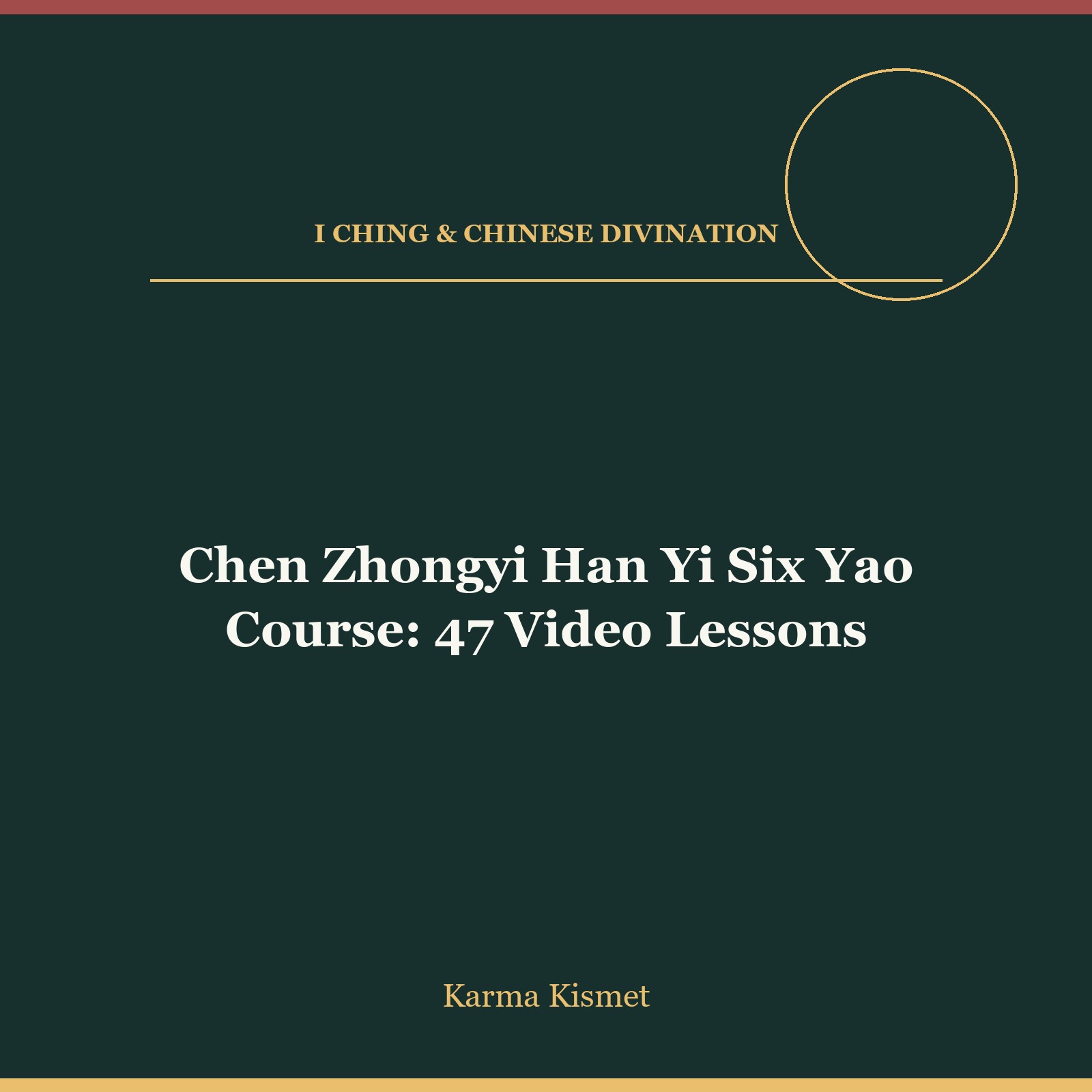
A 47-lesson video course in Chen Zhongyi's Han Yi approach to Six Yao divination, with a stated sequence of instructional videos.
Course at a Glance
This digital learning resource presents the course named above. Its original lessons and study materials are in Chinese; this English page helps readers understand the subject and listed scope before choosing to study it. No physical item is shipped.
What the Course Covers
- Six Yao foundations and hexagram structure
- Building a methodical reading process
- Applying the Han Yi system to practice
How to Study This Material
Begin with the terminology, then follow the source lesson sequence and compare each worked example with the method being taught. Keep a record of the symbols, assumptions and steps used in each interpretation. Traditional divination is presented here as a cultural study method, not as a guaranteed prediction or substitute for professional advice.
Original Course Preview Images
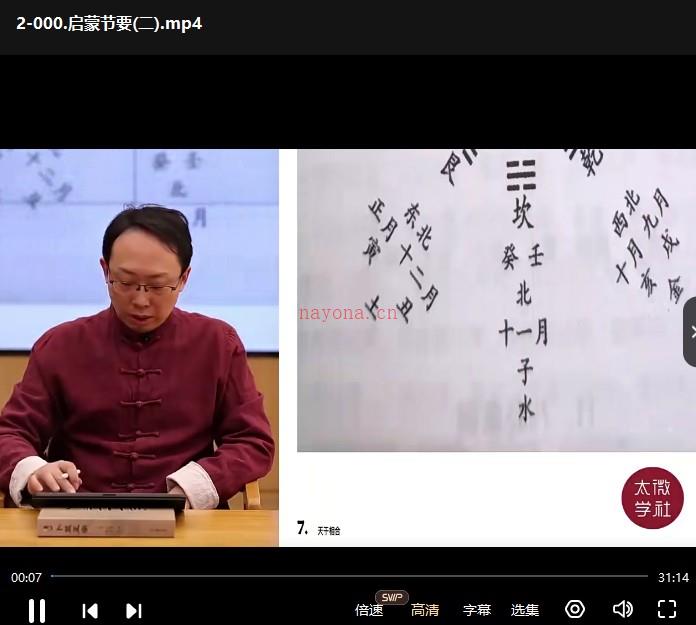
The following images are retained from the original course listing.
Before You Buy
This is a virtual learning product. The page describes the course or reference material; the original video or PDF content is not translated into English. Review the lesson count and format in the title and description. Digital delivery details are provided with your order; no physical shipment is included.
Related Learning
Explore the Six Yao & Plum Blossom Courses collection, all I Ching and divination resources, or contact Karma Kismet with course questions.
Related Courses
- Plum Blossom Numerology and Trigram Practice: 89 Lessons
- Qingfeng I Ching Foundations: 21 Video Lessons
- Shen Qinghe Plum Blossom I Ching Practice Course: 169 Video Lessons
Studying the Han Yi Six Yao Sequence
This 47-video listing presents Chen Zhongyi’s Han Yi approach to Six Yao through a sequence of Chinese-language lessons. Its source inventory is unusually specific about lesson names. It includes introductory material, stems and branches, five-element relationships, trigram order, methods of forming a hexagram, and named rules used later in interpretation. Those names are useful landmarks for study, although they do not tell you how fully a topic is covered until you watch the relevant video.
The inventory also contains a practical caution: the numbered sequence reaches 48 while the listing identifies 47 videos, and the source notes possible gaps. It reports uneven video lengths. Approach the collection with that uncertainty in mind. If a later lesson assumes a step you have not seen, do not assume you overlooked it or reconstruct it as though it were present. Record the missing explanation and use the available lessons to understand what can be established.
Start With the Structure of Six Yao
Six Yao study asks a learner to track a hexagram’s lines and the conventions applied to them. In this course, the early lesson titles point toward a vocabulary of heavenly stems, earthly branches, trigrams, hexagram names, and relationships among the five elements and six kinship categories. These are components of a traditional method, not independent facts about an event. Learn what each component represents within the lesson before trying to combine them.
The list also names coin-in-place-of-yarrow instruction and lessons on arranging a hexagram. For study purposes, separate the way a figure is generated from the way it is labeled and interpreted. A learner who skips that distinction may memorize a conclusion but be unable to reproduce the construction behind it. Draw a blank six-line figure in your notebook and annotate it only as each relevant step is explained by the course.
A Layered Note-Taking Method
- Create a lesson index that matches the available file names, including any numbering irregularities.
- Give each technical term an entry with its Chinese wording and the lesson where it appears.
- For a procedural lesson, list the actions in order and cite the video point where each action is explained.
- For a mnemonic verse, write what the lesson says it helps remember before attempting to apply it.
- For an example, separate the initial figure, added labels, stated relationships, and interpretive conclusion.
- Mark any transition that requires a lesson or definition you cannot locate.
The source titles mention verses and formulas for topics such as Na Jia arrangement, placing Shi and Ying, three-combination structures, hidden and visible relationships, and moving or still lines. These names can look like a dense wall of terminology. Resist the urge to learn them as one list. A mnemonic is helpful only when you know which task it supports and what conditions limit its use. Give each named rule its own worked example from the material when one is available.
Compare the Stated Rule With Its Use
When a lesson introduces a relationship such as generating, restraining, combining, or clashing, first write the rule in the form taught. Then find the moment when it is used in a figure. Ask what labels were already in place and whether another relationship was also considered. This slows down interpretation, but it reveals the dependency between the preparatory steps and the final reading.
The course’s later titles include rules concerning Shi and Ying, empty states, movement, hidden factors, and caution about relying rigidly on particular markers. You need not infer the content of those lessons from their titles. Instead, use the titles as questions: What does the instructor define? What example is given? Is the conclusion required by the stated rule or presented as a judgment? Where does the instructor warn against a mechanical reading? Answers should come from the videos you can actually review.
Managing the Uneven Lesson Set
Because the source flags a possible missing recording and varied lengths, measure progress by concepts understood rather than video numbers completed. A short clip may introduce a narrow term, while a longer lesson may involve several steps. If a file name repeats a topic, compare the two recordings before deciding whether they are duplicates or separate explanations. The source list alone cannot settle that question.
Build a personal map of prerequisites. For example, if a later explanation uses trigram order, place a link in your notes back to the trigram lesson. If an example uses a verse that you have not yet studied, pause and locate it. This creates a route through the material that responds to what the course actually teaches. It also helps distinguish a genuine gap in the available sequence from a topic introduced elsewhere under a different title.
Who May Benefit From This Course
Learners interested in a systematic, terminology-rich presentation of Six Yao may find the named progression useful. A newcomer can begin with the introductory videos but may need extra time to learn Chinese technical vocabulary. A reader who already knows basic hexagram structure may focus on how the Han Yi presentation organizes its labels and rules. Anyone who requires a perfectly continuous, uniformly timed set of lessons should consider the source’s stated sequence uncertainty.
The title identifies a named approach and instructor; it does not establish credentials, certification, or a standardized curriculum. Completion of the videos is not a professional qualification. More importantly, being able to recite a mnemonic is different from understanding when the course uses it. Test your learning by explaining a worked example step by step, with references to the actual lessons, rather than by asserting mastery after viewing the set.
Interpretive Limits
Six Yao is presented here as traditional divination study. An internally consistent reading is still an interpretation within a symbolic framework, not proof that an event will happen. Treat examples concerning health, finances, legal matters, or safety with particular care. Real decisions in those areas call for relevant evidence and qualified advice. If a line of reasoning depends on a lesson that appears unavailable, say so plainly instead of claiming a conclusion the collection cannot support.
It is possible to study a tradition respectfully while questioning a particular inference. Write down what the instructor states, what you can reproduce, and what remains unclear. That habit makes conversations about the material more accurate and keeps your own notes useful when you revisit the course later.
Questions About the 47-Video Course
Why does the file numbering appear to reach 48?
The original source notes that the listed set contains 47 videos while the sequence reaches 48 and may have a gap. The numbering alone cannot identify exactly what explanation, if any, is missing.
Do I need to memorize every verse first?
It is more useful to learn the task each verse serves, then practice it with an example from a relevant lesson. Memorization without context can lead to applying a rule where it does not belong.
Can I begin without prior Six Yao experience?
The set includes introductory topics. A beginner should expect to spend time on the structure of a hexagram and the course’s vocabulary before following later interpretive rules.
What should I do when a later video assumes an unexplained step?
Check the lesson index and nearby videos, then mark the step as unresolved if you cannot find it. Avoid presenting an outside explanation as though it came from this course.
Does a completed reading establish what will happen?
No. It demonstrates how an interpretation was constructed within the method being studied. It should not be used as a guaranteed forecast or as a substitute for evidence in consequential decisions.