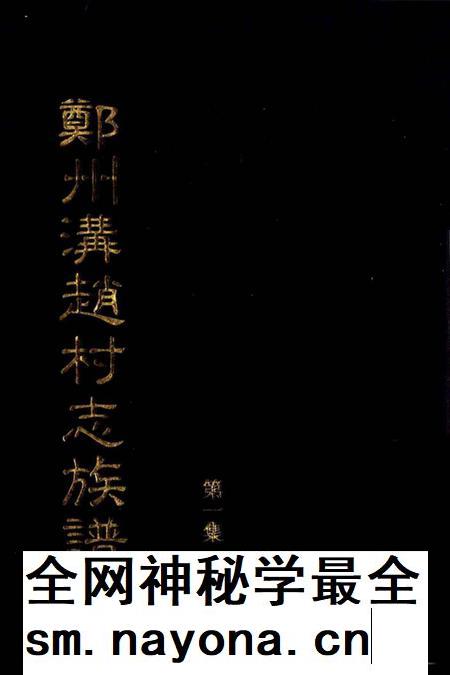
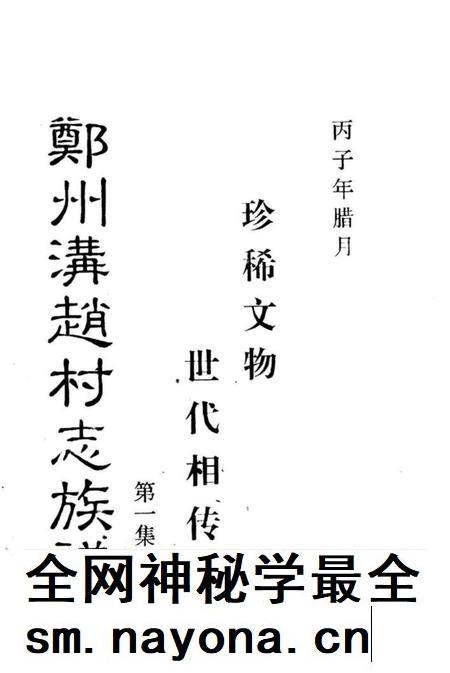
Volume one of a Gouzhao village genealogy and village history from Zhengzhou. It is a local family-history record, not a universal genealogy guide.
Resource Overview
Zhengzhou Gouzhao Village Genealogy: Volume One is a digital learning resource about Chinese Genealogy. The English description summarizes the available source listing; the underlying recordings or books are in Chinese. An English translation of the full material is not confirmed.
What You Will Learn
Use the sequence and preview material below to identify the course’s scope, terminology and teaching approach. Check each topic against the original lesson rather than treating a short listing as a complete transcript.
Course Contents
- Gouzhao village
- Local genealogy
- Volume-one record
Original Course Images
Who This Resource Is For
This resource is for readers or learners who can use Chinese-language materials and want a named resource on Chinese Genealogy. Compare the stated scope and previews before ordering; a fixed level of prior experience is not assumed unless the source directory says so.
Learning Format and Digital Delivery
Chinese-language digital village genealogy Virtual and downloadable; there is no physical shipment. Price: USD 9.00. A file link is not yet attached to this product. Please contact Karma Kismet before ordering to confirm delivery arrangements; immediate automated access is not promised.
Frequently Asked Questions
Is the full material in English?
No English edition, recording or subtitle track is confirmed. The source material is Chinese-language.
Is a personal consultation included?
No individual consultation is listed with this resource.
Does this resource guarantee an outcome?
No. It is for educational and cultural study, not a guaranteed result or substitute for professional advice.
Editorial Note
Karma Kismet translated and organized the course facts and original previews for English readers. Lesson counts and formats follow the available source listing; unspecified contents, certificates and instructor credentials are not asserted.
Related Courses
Browse Chinese Genealogy and read digital delivery information.
Context for reading and study
The named resource is the first volume of a Gouzhao village history and genealogy associated with Zhengzhou. The available article offers broad discussion of genealogy and local memory rather than a verified detailed register. The title identifies a village context; it should not be used to assume that every resident belongs to one surname or that the volume proves a reader’s ancestry.
Village history and family history
The combined title brings local history and genealogy together, but these are different kinds of inquiry. A village narrative concerns a place and selected events; a genealogical record concerns stated relationships among people. Begin by identifying which section you are reading and what evidence it supplies. Do not treat a local event as proof of a family connection or a family entry as a complete account of the village. The compilation can connect those subjects, but the connection should be shown in the text. Its title alone does not establish the social composition of the locality.
The place name is not a surname proof
Gouzhao is part of the named village identity. It does not establish that every person in the volume has the surname Zhao, nor that any person with that surname is related to the village’s recorded families. Preserve actual surnames and relationship statements from the entries you examine. A broad source article may use simplified language about the village, but ancestry requires specific evidence. If a name resembles one in your own family, record it as a possible research lead rather than a confirmed connection. Similar spelling is not a sufficient basis for merging people or lineages.
Names and identity matching
A genealogical entry may include more than one form of a name, such as a personal name and another recorded designation. Verify the actual convention in the volume before assuming that two names refer to two people or one person. Keep the characters, relationship context, and date information together. A repeated name can occur in different generations or branches. Identity matching should therefore use several independent details where available. If the evidence remains ambiguous, leave separate entries. A plausible match is a question for further research, not a fact that should be added silently to a family tree.
Generations and branch structure
When a record uses generation or branch markers, learn the volume’s notation before drawing a tree. A visual line or sequence may encode a relationship that is not obvious from a quick glance. Preserve the source order and any stated distinction among branches. Do not invent a missing link because it makes the diagram look complete. A useful tree can contain an explicitly unknown connection. The aim is to represent what the source claims faithfully, including uncertainty. This is different from assuming that the genealogy has been independently verified or that its structure covers every person associated with the village.
Dates and calendar conventions
Dates in a historical genealogy may require careful reading of the convention used. Record the original expression before converting it. Do not turn an incomplete date into a precise modern date without a stated basis. If an entry gives age rather than a birth date, preserve that difference. A later copy or compilation may also introduce another dating layer. Keeping the original wording and the proposed interpretation side by side makes correction possible. The source article does not establish a complete set of verified dates, so this English guide should not imply that all chronological questions are already resolved.
Narratives and evidence of relationship
A family story can provide context and memory without proving every link it recounts. Distinguish an attributed narrative from a register entry, a dated document, or an editorial inference. If the volume explains how information was collected, preserve that explanation. The article’s broad account of compilation should not be treated as verified evidence that every entry underwent the same process. A careful reader can value oral memory while noting its source and limits. Genealogical confidence should follow the specific evidence for a relationship, not the emotional force or moral tone of a story.
Notable people and selection
A village genealogy may emphasize people considered notable by its compilers. Verify the actual entries and the criteria the text states. A selection of biographies is not a complete account of everyone’s contributions, and omission does not show that a person was absent from the community. When summarizing a biography, separate recorded actions from praise or evaluation. This allows the volume to be read both for particular details and for the values reflected in its selection. It avoids turning a compiler’s emphasis into a universal judgment about the worth of individuals or families.
Migration and locality
If an entry describes a move, record the place names and the direction of movement as written. Historical names may not map neatly onto current administrative labels. Do not replace them with modern names without documenting the basis. A migration statement can help form a research question, but it does not prove a connection to every family in the destination. Keep the person, branch, date, and source together. This makes the local-history context useful while preserving the difference between a recorded move and a broader narrative about the village’s population or cultural identity.
Privacy in family research
A genealogical project may include information about living people as well as historical figures. When sharing notes, consider whether identifiable details are necessary and whether the people concerned expect them to be public. A printed or digital record does not make every detail appropriate for unrestricted repetition. Use permission-based information for contemporary additions and distinguish those additions from the historical volume. This is a practical way to keep research respectful. The listing identifies a study resource, not a service that verifies living people’s relationships or authorizes publication of a private family history.
A first-volume research record
For one entry or branch, write the source title, volume number, printed page, digital location, exact name, stated relationship, and unresolved questions. Do not assume that later volumes are included or that the first volume supplies every missing connection. Compare a possible link with additional evidence where available and retain disagreement rather than smoothing it away. The attainable use is careful reading of a named Chinese-language genealogy and village-history resource. It does not guarantee a complete ancestry search, an English translation, authenticated family membership, or a ready-made tree that can be adopted without checking the underlying records.
A link that remains open
An unresolved family connection does not make a research note useless. Record the possible link, the details that support it, and the detail that would be needed to confirm it. Keep alternative matches separate. This makes the genealogy a source for inquiry rather than a shortcut to a predetermined ancestry, and it allows later evidence to correct the record without obscuring how the first possibility arose.