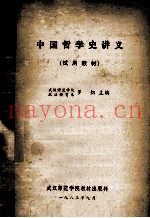
A trial teaching text titled Lectures on the History of Chinese Philosophy. It is a book resource, not a filmed course.
Resource Overview
Lectures on the History of Chinese Philosophy: Trial Textbook is a digital learning resource about Chinese Philosophy. The English description summarizes the available source listing; the underlying recordings or books are in Chinese. An English translation of the full material is not confirmed.
What You Will Learn
Use the sequence and preview material below to identify the course’s scope, terminology and teaching approach. Check each topic against the original lesson rather than treating a short listing as a complete transcript.
Course Contents
- Chinese philosophical history
- Textbook format
- Historical study scope
Original Course Images
Who This Resource Is For
This resource is for readers or learners who can use Chinese-language materials and want a named resource on Chinese Philosophy. Compare the stated scope and previews before ordering; a fixed level of prior experience is not assumed unless the source directory says so.
Learning Format and Digital Delivery
Chinese-language digital textbook; file type not confirmed Virtual and downloadable; there is no physical shipment. Price: USD 9.00. A file link is not yet attached to this product. Please contact Karma Kismet before ordering to confirm delivery arrangements; immediate automated access is not promised.
Frequently Asked Questions
Is the full material in English?
No English edition, recording or subtitle track is confirmed. The source material is Chinese-language.
Is a personal consultation included?
No individual consultation is listed with this resource.
Does this resource guarantee an outcome?
No. It is for educational and cultural study, not a guaranteed result or substitute for professional advice.
Editorial Note
Karma Kismet translated and organized the course facts and original previews for English readers. Lesson counts and formats follow the available source listing; unspecified contents, certificates and instructor credentials are not asserted.
Related Courses
Browse Chinese Philosophy and read digital delivery information.
A philosophy textbook with an explicit historical framework
This resource is a 419-page Chinese PDF of Lectures on the History of Chinese Philosophy: Trial Textbook, edited by Luo Chi and published in 1983 by Wuhan Normal College’s textbook publishing department. Its introduction explicitly proposes a Marxist view of Chinese philosophical history. That declaration is central to reading the book: its historical categories and judgments are elements of an editorial framework, not neutral labels accepted by every historian. The book can be studied both for the thinkers and questions it presents and for the way a particular educational account organizes them. Keeping those two purposes separate makes the trial textbook’s character much clearer.
What the introduction asks a reader to notice
The visible introduction names the object and scope of Chinese philosophical history, characteristics of Chinese philosophy, its developmental trajectory, its relationship with politics and critical inheritance of philosophical heritage. These headings invite methodological questions before the reader reaches individual thinkers. What counts as a philosophical problem in this account? How does the editor connect ideas with social institutions? What does critical inheritance mean when applied to an older argument? Rather than answering from general knowledge, locate the editor’s explanation of each question. The result will be a description of this textbook’s method, which can later be compared with another historian’s approach.
The word development deserves particular attention. A chronological sequence tells the reader that one discussion follows another in time; a developmental argument explains why the transition matters. Those are different claims. On a first pass through the introduction, underline statements that merely establish order and mark separately statements that propose an explanatory relation. If the editor links a philosophical position with political change, identify both sides of the connection. This practice makes a large account easier to assess because the reader no longer has to accept or reject an entire historical framework at once. Specific links can be examined with specific evidence.
The six broad divisions
The directory organizes the book into six broad lectures. After the introduction, it treats the emergence of ideas in the Xia through Western Zhou period, development during the Spring and Autumn and Warring States periods, Han through Tang thought, Song through Qing thought and the period from the Opium War to the Xinhai Revolution. These divisions supply an overview of the editorial chronology. Make a simple timeline, but preserve the wording of the book’s period labels when summarizing its argument. A modern substitute for a label may unintentionally remove the assumptions the editor uses to connect social history and intellectual history.
A timeline alone can make every thinker seem like a station on a single road. To counter that effect, choose one philosophical question that is actually discussed and follow the changing answers across two periods. The question may concern knowledge, social order, human conduct or the relation between the world and its explanation. Do not assume that similar vocabulary means a continuing identical problem. A later thinker may borrow a word while changing the controversy in which it operates. This question-based reading works alongside the book’s historical sequence and helps the reader discover where a large period category is useful and where it obscures differences.
Early conceptual vocabulary
The directory’s early section names the emergence of discussions involving the five phases, yin and yang and the eight trigrams. Within this textbook those appear in a history of philosophical thought. Reading them here does not turn the volume into a divination instruction manual or establish modern scientific claims about their operation. Ask how the editor characterizes the concepts and what kind of explanation they are said to offer. Distinguish the historical existence of a vocabulary from the truth of every later interpretation associated with it. This distinction is especially helpful when a cultural term now circulates in many unrelated practical and commercial settings.
Comparing named thinkers without reducing them to labels
The visible directory proceeds to Confucius, Laozi and Mozi among other early thinkers. In the Confucius section it names concerns involving ren, knowledge and the mean; the Laozi section includes non-action, the generation of things and historical evaluation; the Mozi section includes standards of argument and contrasting ideas about effort, fate and moral relations. Use these headings as pointers to passages, not as complete summaries of the thinkers. Select one argument from a section and reconstruct the steps through which it reaches a conclusion. Only after doing that should you ask whether an evaluative label in the textbook adequately describes the argument.
One comparison might examine how two arguments justify a proposed course of conduct. Does the passage appeal to a model person, a standard of testing, an account of the world or a description of consequences? Make that comparison using passages you have actually found. It is more informative than assigning one thinker to a favorable category and another to an unfavorable category before reading. If the textbook’s commentary evaluates an idea through its stated historical framework, preserve the attribution. Write that the editor interprets the passage in a particular way, then explain whether the quoted evidence supports the interpretation you have described.
Political history and philosophical explanation
The introduction’s relationship between philosophy and politics can be investigated through a concrete case. Choose a paragraph where a political condition is used to explain a philosophical concern. Identify the condition, the concern and the proposed mechanism connecting them. A claim that two things occurred together is weaker than a demonstration that one shaped the other. Ask what additional evidence the book supplies: institutional change, a thinker’s stated purpose, a conflict between schools or another documented connection. This exercise keeps historical interpretation from becoming an automatic formula in which an idea is treated as nothing more than a reflection of its assigned period.
Reading a trial textbook as an educational artifact
The trial-textbook designation and 1983 publication date also make the book an example of historical educational writing. Its selection, order and evaluations can be examined as features of a teaching project. Observe how a section introduces a problem, which concepts receive detailed explanation and what kind of judgment concludes the discussion. A teaching text necessarily compresses complex debates, so the reader should distinguish a useful orientation from a claim to settle every scholarly dispute. The aim is not to dismiss the book because it has a declared approach. It is to read that approach actively and understand what it allows the editor to see.
After finishing one broad lecture, prepare two short summaries. The first should explain the philosophical arguments presented; the second should explain the textbook’s method of organizing and evaluating them. If the two summaries become indistinguishable, return to the passages and separate the thinker’s position from the editor’s commentary. That separation permits a fair comparison with another history without pretending that either account speaks from no standpoint. It also gives the learner a durable result: an understanding of a particular set of arguments, together with an awareness of how philosophical history is constructed for an educational audience.