
Course Overview
This Xuan Kong Nine Stars course is an advanced Feng Shui resource for learners who want to study star meanings, flying-star combinations, and time-space interpretation. The source listing describes 17 video lessons with supporting documents and multiple course images.
Source-Based Course Details
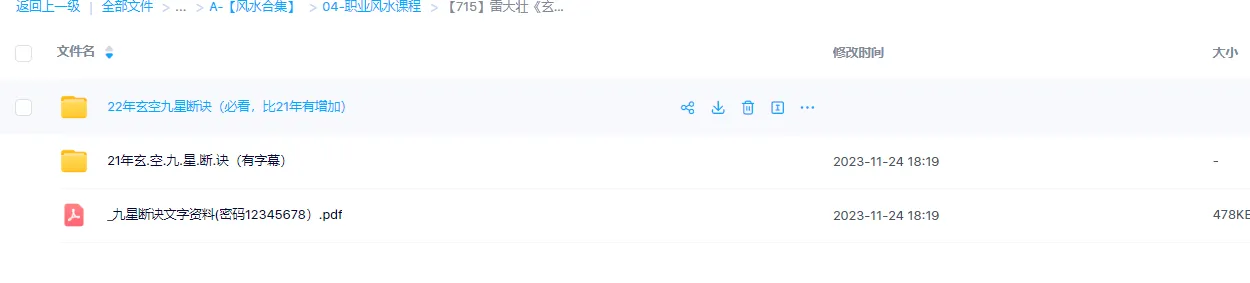
This page is an English educational adaptation based on the richer nayona.cn course record: 雷大壮《玄空九星断诀》视频17集+文档. The original source images are preserved below, and the English structure adds search-friendly sections for course discovery, comparison, and digital delivery.
What You Will Learn
- Core concepts of Xuan Kong and Nine Stars Feng Shui.
- How star meanings and combinations are organized for study.
- How Flying Star Feng Shui connects time, direction, and spatial reading.
- How to review the 17-lesson course with source images and supporting documents.
Course Contents
- 17 video lessons listed in the original source record.
- Supporting documents mentioned by the nayona.cn course listing.
- Seven source images preserved as course reference material.
Original Course Images


Who This Course Is For
This digital resource is suitable for Feng Shui learners, Chinese metaphysics students, course collectors, and practitioners who want a structured reference for independent study. Beginners should start with foundation and Form School material before moving into Xuan Kong, Li Qi, or date selection.
Learning Format and Digital Delivery
This is a virtual and downloadable course product. The product page summarizes the course scope, original course imagery, and learning structure. Access instructions are provided through the digital delivery process after purchase.
Related Lei Dazhuang Courses
- Lei Dazhuang Urban Housing Feng Shui Course
- Lei Dazhuang Yi Xue Foundation Course
- Lei Dazhuang Form School Feng Shui Course
- Lei Dazhuang Date Selection Feng Shui Course
- Lei Dazhuang Feng Shui Qi and Xuan Kong Course Collection
Frequently Asked Questions
Is this a physical product?
No. This is a digital learning resource.
Are the original course images changed?
No. The body images are preserved from the nayona.cn source material so learners can recognize the original course package.
Does this guarantee a Feng Shui result?
No. Karma Kismet presents this material for cultural, educational, and research purposes. It should not replace professional architectural, legal, financial, health, or safety advice.
Editorial Note
Karma Kismet rewrites course introductions in English for search clarity, topic organization, and user understanding while keeping source course images and factual course details intact.
Studying the Nine Stars as a System
Lei Dazhuang’s Xuan Kong Nine Stars course is described as a seventeen-video resource with supporting documents. Its stated focus includes star meanings, combinations, timing and chart analysis. Those topics require a different kind of attention from simply noticing the visible shape of a building. The learner follows a symbolic framework that connects spatial position with a time-based reading, then examines how the instructor interprets the resulting pattern.
The Nine Stars should be approached as terms within a traditional Feng Shui system. A star label in this context is part of an interpretive chart; it is not a claim that a celestial object is physically acting on a room. Clear terminology makes the lessons easier to understand and keeps cultural study separate from scientific explanations of buildings or health.
Start With the Chart’s Inputs
A chart can look authoritative because it is orderly. Before interpreting one, identify what information was used to produce it. Note the time reference, the direction or spatial reference, and any other stated condition in the lesson. If a needed input is missing from your notes, you cannot reliably reproduce the chart. Avoid copying a completed diagram as though it explains itself.
Next, distinguish the chart from its reading. The placement of a number or star belongs to the construction of the chart. The meaning assigned to that placement belongs to interpretation. A learner may understand one stage before the other. Working through them separately makes it easier to find where a disagreement or error begins.
How to Read a Combination Carefully
The course overview names flying-star combinations as a subject. A combination is more than two labels placed side by side. Its interpretation may depend on their positions, the period or time being considered and the surrounding rules used by the instructor. Write down which part of the explanation comes from a stated rule and which part is a judgment about the specific case.
Do not assume that a short phrase attached to one star retains the same meaning in every chart. Traditional systems often rely on relationships among several elements of a reading. A useful study question is, What changed between this example and the previous one? The answer may involve position, timing, another star or a qualification introduced later in the course.
When the explanation seems to jump from a chart to a definite outcome, slow down. Ask what the lesson actually supports within its symbolic framework and whether the outcome is being presented as an illustration, a possibility or a firm assertion. A recorded interpretation cannot establish that an individual event will occur. Preserve the instructor’s reasoning in your notes without adopting certainty that the evidence does not justify.
A Chart-Study Routine
- Write the lesson number and the question the example is meant to answer.
- Record all stated inputs before looking at the completed chart.
- Reconstruct the chart step by step if the lesson supplies the method.
- Check the placement of each relevant star against the instructor’s version.
- List the rules invoked to interpret the combination.
- Summarize the conclusion with its assumptions and unanswered questions.
Reconstruction is a stronger check than recognition. It is easy to feel familiar with a diagram while being unable to explain how it was formed. If a lesson assumes a step you do not know, mark the gap and review earlier material or an appropriate foundation resource. Guessing can make later examples harder to follow.
Timing and Spatial Context
Xuan Kong study brings time into a spatial reading. For a beginner, that can be the most difficult feature of the subject: a chart may be discussed as relevant to a particular temporal context, while a room or building appears physically unchanged. Treat the time component as part of the traditional model being studied. Ask how the course defines it and how it affects the chart, rather than importing an unstated rule from another source.
Direction also requires care. If a lesson uses a directional reading, note exactly what is being oriented and how the instructor establishes that orientation. A casual glance at a plan may not provide the same information as the example assumes. The available page does not supply a full technical manual for determining every input, so rely on the recordings for their stated method and record uncertainty where a step is unclear.
The seven preserved source images can help a learner recognize course material, but an image should be interpreted within its caption or lesson context. It may illustrate a term, show a chart or simply identify the course package. Do not infer a detailed rule from an image alone when the accompanying explanation is absent.
Building Understanding Across Seventeen Lessons
With seventeen recordings, it is useful to keep a cumulative glossary rather than starting fresh with each lesson. Define a term when it first appears, then add notes when later examples refine its use. If two explanations seem inconsistent, check whether their inputs differ. This practice is particularly helpful for star meanings: a brief introductory description may not capture how a term is used in a complex combination.
At intervals, review one earlier chart without the instructor’s conclusion in front of you. Explain the sequence aloud or in writing, then compare your account with the recording. Where your reading differs, identify whether the issue was chart construction, vocabulary, timing or interpretation. Naming the type of difficulty gives you a specific next step.
Supporting documents may provide another way to revisit a concept, but their detailed contents are not established in the available description. Use them as companion material where they match a recorded lesson. If you use outside references, label them separately so that an idea from another author is not accidentally attributed to this course.
Appropriate Uses and Limits
This course may suit learners who already know some Feng Shui vocabulary and want to examine the Nine Stars approach in more depth. It may also serve someone comparing how chart-based interpretation differs from observation of visible forms. A new learner can begin here, but should expect to pause often for foundational terms and chart procedures.
A chart reading is not a substitute for building inspection, medical care, financial planning or other specialized advice. If a lesson uses language about prosperity, health or risk, understand it as traditional interpretation. Real decisions need facts about the particular situation and, when appropriate, qualified professionals. The course’s educational use does not depend on accepting a guaranteed outcome.
When discussing a reading with others, explain the method and its limits. A chart may be meaningful to someone studying the tradition, but it should not be used to frighten people or make categorical claims about their home or future. Respectful use leaves space for different beliefs and for practical priorities.
Questions About the Nine Stars Course
Is this the same as a Form School course?
No. This listing emphasizes Xuan Kong, Nine Stars, chart analysis and timing. Visible surroundings may still provide context, but the stated study focus is the chart-based framework.
Why does the course discuss star combinations?
Combinations are part of how the listed subject organizes interpretation. Study the stated inputs, placements and rules before summarizing what a combination is said to mean in a particular example.
Can I reuse a chart without checking its time context?
That would omit a central feature of the method as described. Record the temporal assumptions attached to a chart and verify how the lesson uses them before comparing it with another case.
Do seventeen lessons make this a certification program?
The available description establishes a lesson count, not an award or qualification. Completion and demonstrated understanding are also different things; practice reconstructing and explaining examples to assess your learning.
Can a Nine Stars reading predict a definite personal result?
No definite personal result follows from the course description. The material can be studied as a traditional interpretive system, while consequential choices should be grounded in relevant real-world evidence.



Reviews
There are no reviews yet.