A seven-file PDF study collection attributed to Yue Bangding, with notes and reference texts on Six Yao and Eight Trigrams methods.
Course at a Glance
This digital learning resource presents the course named above. Its original lessons and study materials are in Chinese; this English page helps readers understand the subject and listed scope before choosing to study it. No physical item is shipped.
What the Course Covers
- Six Yao classroom notes and study materials
- Eight Trigrams reference texts
- Comparing interpretations across the seven listed PDFs
How to Study This Material
Begin with the terminology, then follow the source lesson sequence and compare each worked example with the method being taught. Keep a record of the symbols, assumptions and steps used in each interpretation. Traditional divination is presented here as a cultural study method, not as a guaranteed prediction or substitute for professional advice.
Original Course Preview Images
The following images are retained from the original course listing.
Before You Buy
This is a virtual learning product. The page describes the course or reference material; the original video or PDF content is not translated into English. Review the lesson count and format in the title and description. Digital delivery details are provided with your order; no physical shipment is included.
Related Learning
Explore the I Ching Digital Study Resources collection, all I Ching and divination resources, or contact Karma Kismet with course questions.
Related Courses
- I Ching Eight Trigrams Beginner PDF Study Guide
- Xingchen Applied I Ching Course: 93 Videos and Five Study Texts
- Li Munan Six Yao Case Studies and Zeng Shan Bian: 42 Lessons
Reading a Seven-Text Six Yao Collection
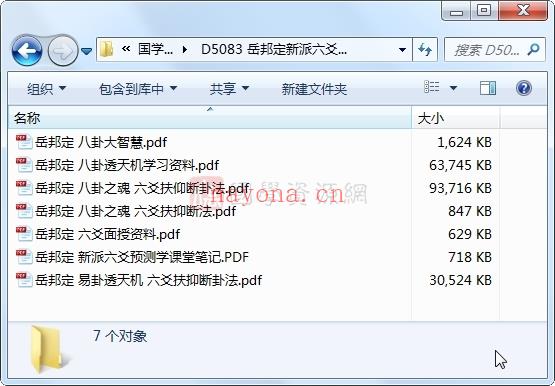
This collection is presented as seven PDF study texts attributed to Yue Bangding. The file titles point toward Eight Trigrams, Six Yao, classroom notes, and an approach described with the Chinese term fu yi, often rendered in English as support and restraint. Because these are documents rather than a sequenced video course, the reader can build a route through them according to existing knowledge. The first task is to understand what each text is trying to explain, then compare related passages without assuming that similar titles contain identical material.
The Eight Trigrams provide a symbolic vocabulary for constructing and discussing hexagrams. Six Yao adds attention to individual lines and their relationships within a question. A study text may begin with a broad account of trigram ideas, while another may focus on a particular procedure for assessing a six-line configuration. Their different emphases make the collection useful for comparison, provided the reader keeps track of which document supplies each rule.
Make a map of the documents
Before reading closely, open each PDF and record its visible title, contents or section headings if present, and the terms it introduces. The listed names include Eight Trigrams titles, a classroom notes file, a face-to-face teaching reference, and several titles concerning Six Yao support and restraint. This inventory is a reading aid; it does not require treating any file as a more complete or authoritative version without examining it.
Build a short index of recurring concepts. For example, note where a document defines a line role, where it explains the relationship between a question and a selected factor, and where it presents a worked example. Put the PDF title and page number beside every note. That small citation habit becomes valuable when two texts use the same word differently or when one offers a fuller explanation of a point mentioned briefly elsewhere.
A digital PDF can be searched, but search results should be read in context. A technical term might appear in a heading, a definition, an example, or a critique. Copying a single sentence from a result may obscure the conditions attached to it. Read the surrounding paragraph and any diagram before making a general rule in your notes.
Working with Support and Restraint Concepts
Several file titles refer to a support-and-restraint method of Six Yao judgment. At the level of study, this signals an interest in how factors are considered in relation to one another. A learner should not assume the phrase alone explains the method. Look for the text’s own definitions, the order in which it evaluates factors, and the examples used to demonstrate that order. Keep those details tied to the particular PDF in which they appear.
When a worked example uses language such as strong, weak, supported, or restrained, ask what has been classified and according to which rule. Is the description attached to a line, a relationship, a time condition, or the whole hexagram? Does another document in the set apply the same term in the same way? These questions reveal the method’s structure more clearly than memorizing an isolated conclusion.
It helps to reproduce a sample diagram on paper and annotate it only with information the text explicitly provides. Place uncertain assignments in a separate margin. If a rule requires prior knowledge that the document does not explain, consult an introductory reference to understand the terminology, then return to the document’s own usage. Do not silently import a rule from another school and attribute it to this collection.
Comparing similar titles carefully
Three listed titles appear to concern related Six Yao support-and-restraint discussions. Their wording suggests overlap, but a title alone cannot tell you whether they duplicate, revise, summarize, or complement one another. Compare the introductions, headings, and one shared topic. Record any clear differences in terminology or examples. If the files are substantially similar, a single set of notes with cross-references may be enough. If they develop different points, keep separate summaries.
The classroom notes file may have a different reading rhythm from a polished text. Notes often depend on context supplied during teaching. Treat a brief statement as a prompt for careful interpretation, not as permission to fill in missing context with certainty. If a point cannot be resolved from the available pages, say so in your own study record.
A Practical Reading Sequence
Readers already familiar with hexagram notation might begin with the broad Eight Trigrams titles to establish the collection’s vocabulary, then move to the more specialized Six Yao PDFs. A beginner may first need a separate primer on solid and broken lines, the construction of trigrams, and how six lines form a hexagram. Once those basics are clear, the seven texts can be read in short sessions rather than as one continuous book.
- Survey all seven PDFs and list their visible sections.
- Choose one broad title and define its recurring terms in your own words.
- Read one specialized Six Yao discussion and trace a single worked example.
- Find the same concept in a second PDF and compare definitions and conditions.
- Write a brief synthesis that identifies agreement, difference, and unresolved points.
Use diagrams whenever the prose becomes dense. A six-line sketch can clarify references to positions and movement that are hard to hold in memory. If a text includes a chart, redraw it rather than relying only on visual recognition. This exposes mistakes in line order or labels before they affect later notes.
Who may find these PDFs useful
The collection may appeal to a reader who prefers written reference material, wants to compare several treatments of related ideas, or already studies Six Yao and is interested in a particular named approach. The PDFs may be less approachable for someone who wants guided spoken demonstrations from the beginning. Their original language and technical vocabulary also matter. A translated title gives orientation, but it does not supply an English translation of every passage.
Because these are seven separate files, do not assume they form a single graded curriculum. Let the documents’ actual structure guide your reading. A learner can still create a personal sequence, but should distinguish that sequence from any order explicitly stated by the texts.
Interpretive Limits and Responsible Study
The language of traditional divination describes relationships within a symbolic framework. It does not establish the cause of an illness, the reliability of an investment, a person’s intentions, or the outcome of a dispute. When a PDF presents an example on a serious topic, examine its terms and reasoning as cultural material. For real decisions, use direct evidence and qualified medical, financial, or legal advice where appropriate.
A careful reader can also note where a document states a rule confidently and where it demonstrates a judgment without explaining every intermediate step. That difference is useful for evaluating the text as a study resource. It does not require either dismissing the tradition or accepting its claims as fact. Precision about what the page actually says is the soundest starting point.
Questions About the Seven Yue Bangding PDFs
Are these seven volumes of one book?
The listing identifies seven PDF files with related but distinct titles. It does not establish that they are seven sequential volumes. Survey each file’s headings and introduction before deciding how to group them for study.
What does the support-and-restraint wording tell me?
It identifies a theme named in several titles. To understand the method, read the definitions and examples in those PDFs. The phrase by itself is too brief to specify every rule or the order in which the author applies them.
Can a beginner use the collection?
Yes, with preparation. Learn the basic notation for trigrams and six-line hexagrams first, then begin with a broad text and work through one example at a time. A written glossary and page references will help with the technical vocabulary.
How should I deal with apparently repeated material?
Compare the relevant sections directly. Similar file names do not prove that the contents are identical. Note whether a later discussion adds a condition, gives a different example, or merely restates a point in other words.
Can I use a PDF example to decide a real-life issue?
A worked example can teach you how its author reasons within a tradition. It cannot verify facts about a new situation or replace appropriate evidence and professional advice. Keep that boundary clear when discussing the material with others.