A four-volume historical edition of the Book of Later Han attributed to Fan Ye, based on a named Song-period printed edition.
Resource Overview
Book of Later Han: Four-Volume Historical Edition is a digital learning resource about Historical Records. The English description summarizes the available source listing; the underlying recordings or books are in Chinese. An English translation of the full material is not confirmed.
What You Will Learn
Use the sequence and preview material below to identify the course’s scope, terminology and teaching approach. Check each topic against the original lesson rather than treating a short listing as a complete transcript.
Course Contents
- Book of Later Han
- Fan Ye attribution
- Edition and volume context
Original Course Images
Who This Resource Is For
This resource is for readers or learners who can use Chinese-language materials and want a named resource on Historical Records. Compare the stated scope and previews before ordering; a fixed level of prior experience is not assumed unless the source directory says so.
Learning Format and Digital Delivery
Four Chinese-language volumes according to the source title Virtual and downloadable; there is no physical shipment. Price: USD 9.00. A file link is not yet attached to this product. Please contact Karma Kismet before ordering to confirm delivery arrangements; immediate automated access is not promised.
Frequently Asked Questions
Is the full material in English?
No English edition, recording or subtitle track is confirmed. The source material is Chinese-language.
Is a personal consultation included?
No individual consultation is listed with this resource.
Does this resource guarantee an outcome?
No. It is for educational and cultural study, not a guaranteed result or substitute for professional advice.
Editorial Note
Karma Kismet translated and organized the course facts and original previews for English readers. Lesson counts and formats follow the available source listing; unspecified contents, certificates and instructor credentials are not asserted.
Related Courses
Browse Historical Records and read digital delivery information.
A Later Han history in a particular printed witness
The resource is a four-volume digital edition of the Book of Later Han attributed to Fan Ye. The source identifies a Southern Song Qingyuan-period printing associated with Huang Shanfu and later Liu Yuanqi, and describes the surviving copy as held by Japan’s National Museum of Japanese History. This gives the edition two histories: the Eastern Han world narrated in the work and the later life of its printed text. Keeping those histories separate is essential. The events described are not dated to the printing period, while details of the printed witness should not be assumed to belong to the original act of historical compilation.
Four volumes and one hundred twenty juan
The source describes ten chronicle juan, eighty biography juan and thirty treatise juan, totaling one hundred twenty. Those internal divisions are distributed within four listed digital volumes. A learner should not call the work a four-chapter history. Start by finding the contents and locating the section needed for a question. Record both its internal juan and the page in the digital copy. This small bibliographic discipline matters because another edition may divide the same material into a different number of physical books. Internal references remain meaningful when a folder’s numbering no longer matches the copy a researcher is using.
The narrated time span
The source places the account from the first Jianwu year of Emperor Guangwu through the twenty-fifth Jian’an year under Emperor Xian. These named reign periods define the source’s stated historical span. Preserve the reign designation when taking notes even if you also supply a modern calendar equivalent from a reliable reference. A reign year is more than a number: it identifies the chronological language through which the account locates an event. Before assembling a timeline, check whether an entry reports the event itself, an earlier background episode or a later retrospective explanation. Narrative position and event date are not always identical.
An approachable first task is to locate one dated action in a chronicle and follow one person associated with it into a biography. The chronicle may establish the sequence; the biography may organize the action within a career. Compare what each account says about cause, intention and outcome. If a biography reaches back to earlier events, place them on the timeline without confusing the order of narration with chronology. The exercise makes the dynastic history’s structure visible and shows why following one person alone can produce a different understanding from reading the same period through the ruler’s record.
Names, offices and relationships
A biography often becomes difficult because many names and offices appear in compressed prose. Build a small list only for the passage being read. For each person, note the role established by the text and the relation to other named participants. Do not infer kinship or political alignment from a shared surname alone. An office title should be retained in Chinese when an English equivalent is approximate. The aim is to follow the action accurately, not to create a universal glossary of Han administration in advance. A focused name-and-role list reduces confusion without introducing facts the selected passage does not establish.
Once the participants are clear, examine the verbs used to describe their actions. Does the passage report a proposal, an appointment, a refusal, a judgment or a later assessment? These distinctions can alter the meaning of an apparent policy change. A recommendation is not proof that a measure was implemented; a statement of intent is not proof of its result. A careful reader can summarize the sequence using precise verbs and leave the larger conclusion open until the supporting evidence is found. This is particularly useful in a historical narrative where formal actions and evaluative comments may be placed close together.
Reading the printed page
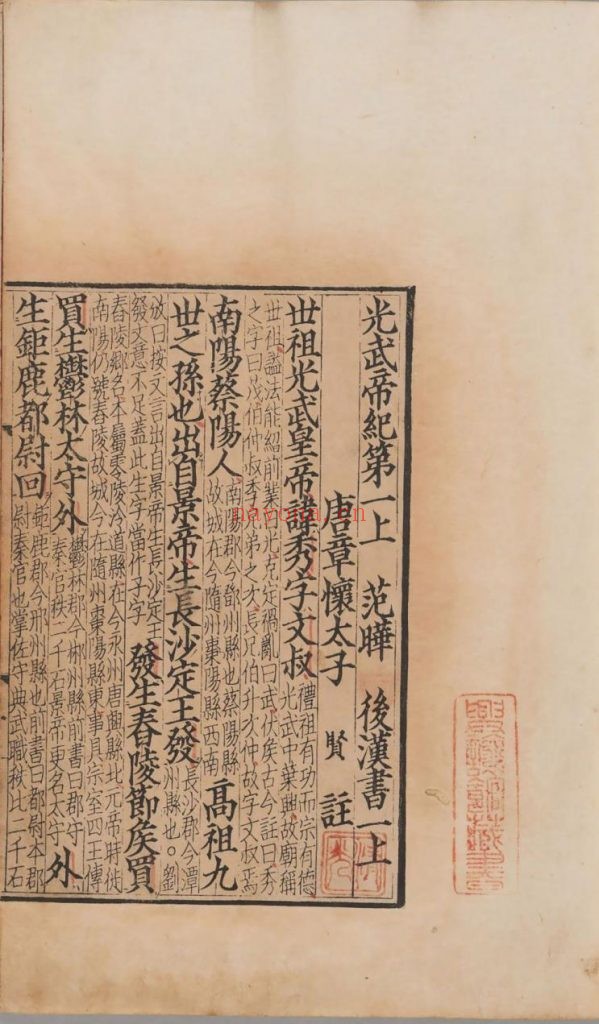
The source notes features of the Song-period printing and its relation to earlier collation. A scan preserves a page as an image, so the learner should inspect layout as well as wording. Identify which text is the main account and which material is annotation or a collation remark before copying a passage. Differences in size, placement or heading can carry editorial significance. If the reproduction is unclear, mark the uncertain character rather than silently supplying a plausible replacement. A guessed character may produce a smooth paraphrase while changing the historical claim. The original image remains the checkpoint for any transcription.
Printed witnesses can preserve evidence about the transmission of a work. The source states that the directory for this edition is located at the opening of the paired Book of Han and mentions a printing notice there. This is a useful reminder that a digital title may not contain all bibliographic information needed to understand its witness. Keep the association as a source-described edition relationship, while distinguishing the two historical works. A provenance note should explain which book or page supplies the information. It should not turn an association between printed copies into an assumption that their contents are interchangeable.
Interpretation and evaluation in historical prose
A historical account can describe an action and guide the reader’s judgment of it. Look for the difference between a reported event and language that evaluates a person. Moral emphasis may be a central feature of the narrative, but it should be identified rather than unconsciously absorbed into a modern summary. Choose a paragraph and write two versions of your notes: one listing actions and one describing the evaluation attached to them. The gap between the versions can reveal how characterization is built. Neither version replaces the original, but together they make the account’s historical and rhetorical work easier to understand.
A comparison with the Book of Han
The paired edition offers an opportunity for bibliographic and structural comparison with the Book of Han. Begin with the distinction in historical subject: the Book of Later Han is a separate dynastic account, not merely a later printed volume of the same work. Compare the visible internal divisions and the presentation of a selected passage before making larger claims about continuity. If you investigate an institution across the two, specify the periods and sources used. Similar terminology can conceal changing circumstances, so the comparison should explain both the continuity of a word and the evidence for continuity or change in the thing it describes.
At the end of an initial reading project, assemble a small reference sheet containing the work’s identity, the printed witness described by the source, the section studied and a short chronological outline. Add one observation about page layout and one uncertainty requiring further checking. This combines textual history with historical reading in a manageable form. The four-volume resource is best used as a witness to a particular classical history, not as a promise that every question about Eastern Han society can be answered from a single passage or that a digital reproduction removes the need for careful comparison.