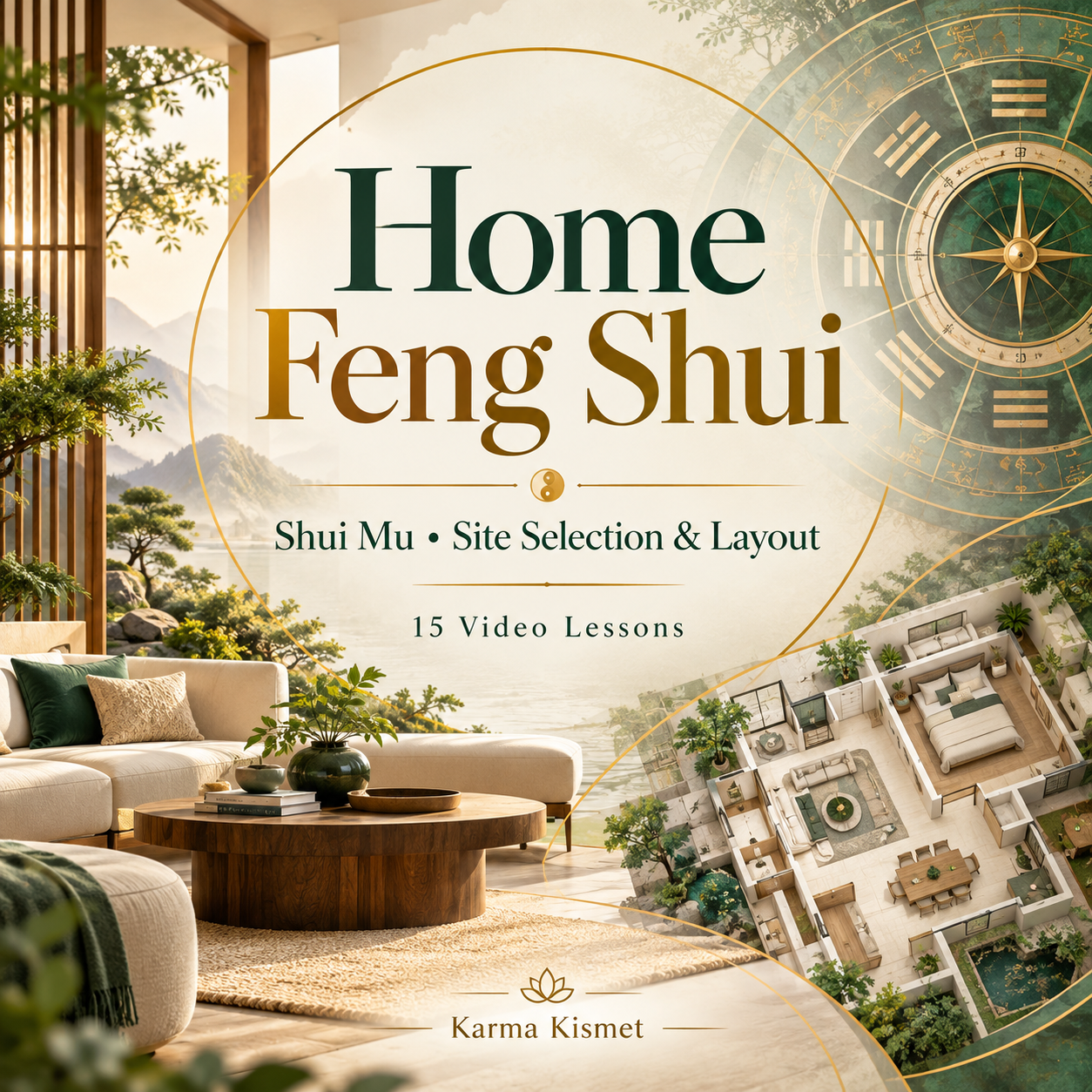
Home Feng Shui presents Shui Mu’s Home Feng Shui Site Selection and Layout course, a Chinese-language collection of 15 video lessons. The documented syllabus moves from choosing a dwelling to arranging its entrance, bedroom, kitchen, living room, dining room and bathroom. It closes with traditional moving-in rituals and associated customs. This course is intended for learners who want an organized introduction to residential Feng Shui rather than a promise of health, wealth or other personal results.
Course Overview
The original listing describes a beginner-oriented approach combining theory with examples. Its strongest verifiable detail is the complete list of fifteen MP4 lessons, which provides a clear way to assess the scope before purchase. Site selection occupies the opening part of the syllabus; individual rooms form the middle sequence; moving into a new home provides the final topic. This sequence lets students follow a dwelling from the decision to select it through the discussion of its internal arrangement.
Traditional Feng Shui uses symbolic frameworks to interpret relationships between a building and its environment. This page presents that material as cultural education. Ordinary considerations such as structural safety, ventilation, accessible movement, fire protection and local building requirements still need independent assessment. A favorable traditional interpretation does not establish that a property is safe, legally suitable or financially appropriate.
This English presentation translates the documented curriculum and adds an editorial study framework. It does not claim that the videos have English narration or subtitles. The source does not establish lesson durations, an English transcript, instructor accreditation, an examination or a completion certificate. These omissions matter when deciding whether this resource matches your language ability and learning needs.
What You Will Learn
- Recognize the difference between external site selection and the internal arrangement of a dwelling.
- Identify the residential topics covered by the documented fifteen-lesson syllabus.
- Study the traditional Four Symbols approach to selecting a home in its stated course context.
- Follow paired lessons on entrance, bedroom and kitchen arrangement in their original order.
- Compare room-specific discussions across the living room, dining room and bathroom.
- Distinguish traditional moving-in customs from requirements for safe occupation of a property.
These describe documented subject areas, not guaranteed competencies or outcomes. The listing does not provide a graded assessment. A useful personal goal is to build a glossary and a set of questions about each topic, then compare those questions with the corresponding lesson. This approach keeps progress tied to what is recorded.
Course Contents: All 15 Recorded Lessons
- Course introduction.
- Homes to avoid: external surroundings.
- Homes to avoid: internal arrangements.
- Selecting a home using the Four Symbols method.
- Entrance arrangement, part one.
- Entrance arrangement, part two.
- Bedroom arrangement, part one.
- Bedroom arrangement, part two.
- Kitchen arrangement, part one.
- Kitchen arrangement, part two.
- Living room arrangement.
- Dining room arrangement.
- Bathroom arrangement.
- Moving into a new home: traditional entry rituals.
- Moving into a new home: traditional auspicious customs and taboos.
The source directory lists MP4 files. They appear here in numerical order rather than the alphabetical order of its file display. No additional lessons have been inferred. The wording of the final lesson reflects traditional claims in its name; it should not be understood as evidence that a ritual will change a person’s luck. This page makes no promise about the effectiveness of such customs.
Original Course Images


How to Work Through the Course
Begin with the documented sequence
Watch the introduction before moving into the external and internal selection lessons. Keep two columns in your notes: one for an observation about a place and another for the teacher’s interpretation. The presence of a doorway is observable, while the symbolic meaning assigned to its position belongs to an interpretive framework. Separating these categories helps you remember the explanation without treating every interpretation as a measured physical property.
This note-taking method is editorial guidance from Karma Kismet, not an additional lesson attributed to Shui Mu. Use it to identify where you understand the terminology and where you need to replay a passage. If a technical expression is unfamiliar, record its Chinese wording when possible and avoid choosing an English equivalent solely because it sounds similar. Consistency in a personal glossary is more useful than accumulating several unexplained translations.
Keep paired room lessons together
The entrance, bedroom and kitchen each have two recorded lessons. Study both parts before drawing a conclusion about the teacher’s treatment of that room. A first part may introduce an idea whose qualifications become clearer in the second. The source does not provide detailed transcripts, so this page cannot specify where an individual rule is explained or how the instructor qualifies it.
When reviewing a room, prepare a simple sketch for your own study. Mark features you can observe and write down questions raised by the video. A sketch is a learning aid, not a professional survey. Do not infer compass bearings, structural dimensions or legal boundaries from an approximate drawing. If the course leads you to consider changing a fixture or wall, consult an appropriate qualified professional before acting.
Read the moving-in lessons as cultural material
The last two lessons concern entry rituals and traditional auspicious customs. Their place in the syllabus makes them part of the course’s cultural scope. Students can compare terminology, stated symbolism and activities without assuming participation is necessary or that a practice guarantees an outcome. Families may have different traditions, preferences or religious commitments.
Practical move-in preparations require a separate checklist: functioning locks, safe utilities, working alarms, ventilation and appropriate accessibility. These examples are ordinary considerations supplied by this editorial page; they are not a claim that the videos teach a safety inspection. Cultural practices can be studied alongside practical preparation, but they should never displace it.
Who This Course Is For
The source describes the course as suitable for learners starting from zero. Its room-by-room structure may interest readers comparing residential Feng Shui teaching approaches. Chinese-language listening ability is particularly relevant because an English description does not translate the videos. Someone seeking an English-taught qualification, a scientific environmental assessment or a personal property consultation should verify those requirements separately rather than assume they are included.
For an existing learner, the directory is the best starting point for deciding whether the material fills a gap. Consider whether you want a course centered on home selection and room arrangement or one devoted to a different specialist method. This listing does not establish a comprehensive Flying Star, San He or luopan training program. Related subjects elsewhere in the shop should not be treated as undocumented components of this collection.
Learning Format and Digital Delivery
This is a virtual, downloadable learning-resource product with no physical shipment. The source records fifteen MP4 video lessons. An English subtitle track, supplementary workbook and printable certificate are not verified. The current listing does not provide a verified automatic download URL; contact Karma Kismet to confirm access arrangements and applicable support before relying on immediate access. No invented file link is supplied.
The resource is presented at the store’s standard course price of USD 9.00. There is no claim that this establishes the instructor’s original retail price or the value of a professional service. Questions about access, file compatibility or the applicable digital-product policy should be resolved through the contact page. This educational listing does not include a personalized Feng Shui assessment of your home.
Frequently Asked Questions
Is this an English-language video course?
The verified source is a Chinese-language course listing. The explanation and curriculum translation are in English, but English narration and subtitles have not been established. Confirm your language requirements before purchasing. Do not infer the teaching language from the language of this page.
How many videos are documented?
The directory names fifteen MP4 lessons, including paired entrance, bedroom and kitchen sections. Their full list appears above. The source does not establish the combined running time, so this page does not convert the file count into an estimated number of teaching hours.
Does it cover selecting a property as well as arranging rooms?
Yes. The opening topics include external surroundings, internal arrangements and the Four Symbols method of selecting a home. Later topics address individual rooms. This scope comes from the lesson names; this page does not invent more detailed subtopics inside the videos.
Does it guarantee better luck or financial results?
No. Some lesson names use traditional auspicious language, retained as a description of their cultural subject matter. Neither that wording nor the presence of a course in the shop demonstrates a reliable effect on wealth, health, relationships or other outcomes.
Is personal consulting included?
The source records a video collection, not an individual consultation. A property-specific assessment, feedback on your floor plan and ongoing mentoring are not verified components. If you need a separate service, ask what is available and agree its scope independently.
Related Courses and Resources
- Home Feng Shui Courses
- Feng Shui for Beginners
- Qin Genlin Zero-Basis Residential Feng Shui Course: 41 Videos
- Contact Karma Kismet
Editorial Source and Disclaimer
Karma Kismet organized this English presentation from matching nayona.cn records dated October 19, 2023, February 21, 2024, and March 2, 2024. The complete fifteen-lesson curriculum and the original course images are retained. Instructor identity is retained as Shui Mu. The complete Chinese course name is 水沐老师《家居风水选址与布局》精品课程视频15集. Study suggestions on this page are editorial additions rather than claims about undocumented lesson content. No instructor biography, accreditation, reviews or student results have been invented.
Feng Shui is presented for cultural and educational study. This resource does not replace architectural, engineering, medical, legal or financial advice. Respect building regulations and other people’s consent when considering changes to shared spaces. The course does not guarantee a particular outcome. Assess the source’s language, curriculum and access arrangements against your needs before making a purchase decision.