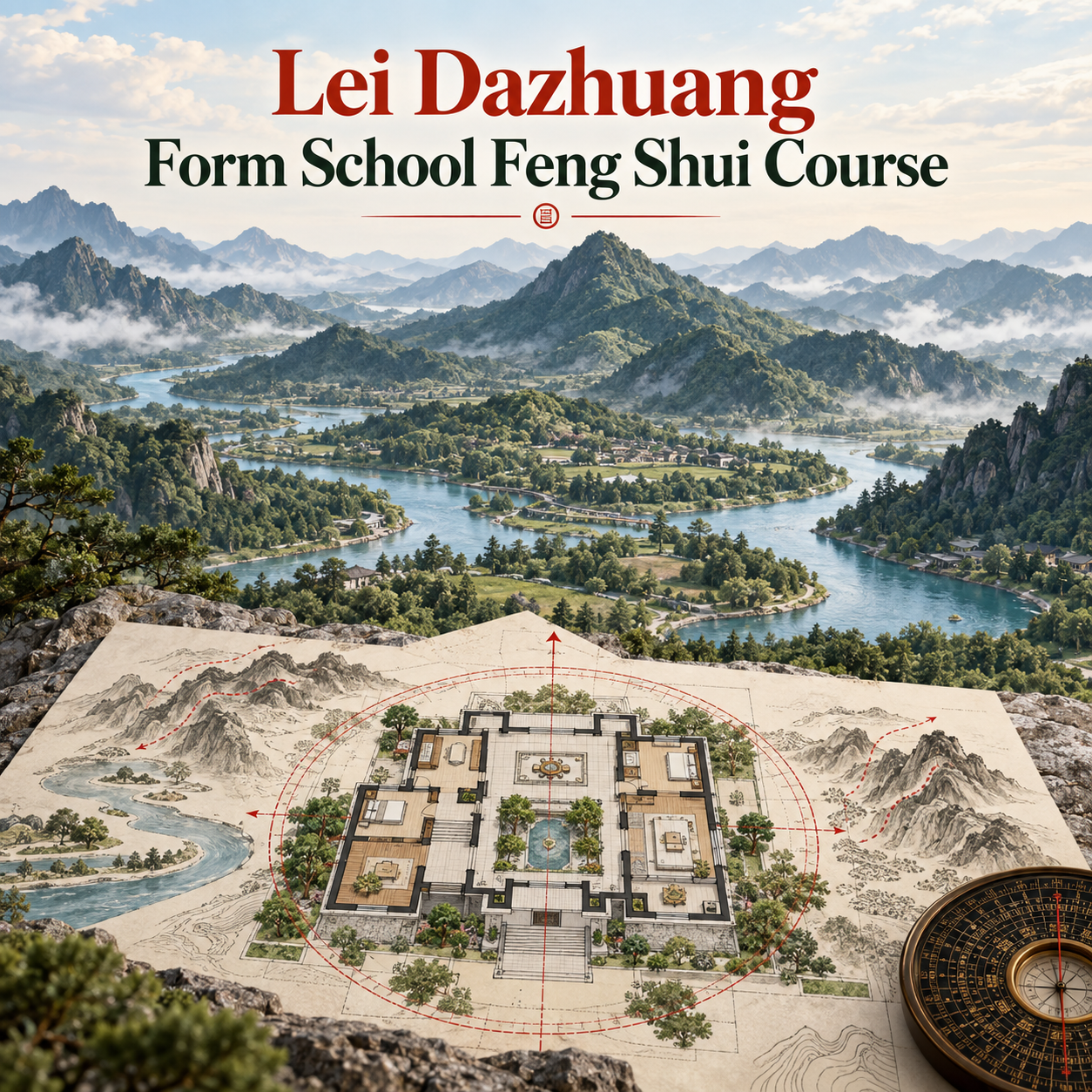
This Yuan Xing school course progresses from dragon and landscape vocabulary to site assessment, water forms and residential examples. Its numbered directory makes clear that it includes both yin-site and yang-residence discussions.
Course Overview
Teacher Liu Yuan Xing Form School Feng Shui: 56 Videos is a digital study resource in the Form School Feng Shui collection. This English product guide explains the listed material; the original recordings and documents are in Chinese. English subtitles or translated full lessons are not included unless separately stated.
Course Contents and Learning Focus
- Lessons 1-17: landforms, incoming dragon and flatland concepts
- Lessons 18-25: site criteria, selection methods and cautions
- Lessons 26-35: sand features and bright-hall forms
- Lessons 36-40: water and flatland methods
- Lessons 41-47: household divisions and residential examples
- Lessons 48-56: staff-placement methods, five-element tailoring and traditional remedies
What You Will Learn
Use the listed topics to identify the scope of this resource, follow its recorded sequence and compare the original diagrams with your study notes. Where individual lesson names are not supplied, the preview images are provided instead of an invented syllabus.
Original Course Previews


Who This Course Is For
For learners who can follow Chinese-language material and want to study Form School Feng Shui. Check the format and previews before buying. Intermediate or continuation courses assume familiarity with the relevant foundations and do not imply that prerequisite courses are included.
Learning Format and Digital Delivery
Format: 56 recorded video lessons. Price: USD 9.00. This is a virtual, downloadable product; no physical shipment is required. The download link has not yet been attached to this listing and will be added by the store. Contact us before ordering if you need to confirm delivery timing; immediate automatic file access is not promised.
Frequently Asked Questions
Is the course taught in English?
No English-language recording or subtitle track is confirmed. This description is in English; the underlying course material is Chinese.
What is included?
56 recorded video lessons. Review the course contents and original previews for the stated scope.
Will a physical item be shipped?
No. This is a digital learning resource.
Is a certificate or personal consultation included?
No certificate, accreditation or individual consultation is promised by this listing.
Editorial Note and Disclaimer
Karma Kismet has organized the course listing and available directory into this English guide. Lesson counts refer to the supplied listing, not an independent review of every recording. For traditional and cultural study, not guaranteed predictions, financial advice or assured personal outcomes.
Related Courses
- Yi Qinglan Form School Feng Shui: 45 Video Lessons
- Qingyuan Eight Mansions Feng Shui: 12 Lessons
- Huo Yixun Eight Mansions Feng Shui: 10 Videos
- Wang Yajun San He Feng Shui: 47 Videos
Browse Form School Feng Shui, review course and delivery questions, or learn about Karma Kismet.
Study the Yuan Xing Form School Directory as a Sequence
The 56-video directory attributed to Teacher Liu Yuan Xing gives this collection an unusually visible path through traditional form vocabulary. It starts with dragon terminology, proceeds to the identification of sites and surrounding features, addresses water forms and level-land settings, and later includes both Yinzhai and Yangzhai discussions. Reading those groups in order helps prevent a term from being lifted out of its own setting.
In this tradition, a dragon is a way of describing the course and character of landscape features. It is a specialist metaphor, not an animal or a claim about a physical energy that a learner has measured. The opening titles distinguish an incoming dragon from its approach to a site and list classifications of shape and apparent strength. When reviewing them, sketch the feature being discussed and write the presenter’s definition beside it. A sketch can reveal whether two similar expressions describe the same segment of terrain or different parts of an example.
From Landscape Language to Site Language
The directory then moves to the idea of an acupuncture point or site, including forms, selection methods, checks, and cautions. These titles should be read as a record of traditional site-assessment concepts. They do not make a location suitable for construction, burial, or any other use. Legal permissions, ground conditions, drainage, accessibility, and environmental effects require their own assessment. Keep the course’s symbolic criteria in one column of your notes and directly verifiable site conditions in another.
The lessons on sha and ming tang introduce the features around a focal site and the space before it. Rather than learning a favorable or unfavorable label alone, ask what shape, distance, enclosure, or viewpoint the presenter is discussing. A feature can look different in a cropped image and at the site itself. For a classroom exercise, choose a public landscape photograph and describe only what is visible. List everything that the photograph cannot establish, including the full surroundings and changes over time.
Water, Level Ground, and Residential Examples
Three listed water-method videos follow the surrounding-feature lessons. Later titles address level-land Feng Shui, the use of sand and water concepts, and differences between Yin and Yang sites. This progression signals that a term developed for one setting may need qualification in another. When a lesson uses a diagram of water, identify the direction shown, the viewpoint, and whether the diagram represents an actual stream, a path, or an abstract rule. Do not assume those are equivalent unless the instruction explains the relationship.
The directory’s Yangzhai section concerns residences. Its appearance after extensive landscape and site terminology does not mean every earlier site method applies unchanged to an apartment or urban building. A practical study question is: which features can be observed at the scale of a home, and which depend on a larger landscape? Keep the answer tied to the examples actually supplied. For everyday decisions about a residence, direct concerns such as safe access, moisture, ventilation, daylight, maintenance, and occupants’ preferences remain essential.
A Method for Working Through 56 Recordings
- Create an index using the numbered directory. Group lessons by dragon, site, surrounding features, water, residential examples, and later methods.
- Watch a small group of related recordings, then define its key terms in your own words without looking at the notes.
- Return to the relevant recording and correct any definition that became broader than the example supports.
- For every case, separate the observed form, the traditional classification, and the stated conclusion.
- Mark terms that appear again in later groups. Check whether their meaning or scale changes.
- At the end, describe one example from beginning to end while identifying assumptions you cannot independently verify.
The later directory names Twelve Dao Zhang site methods, Five Elements trimming methods, and traditional remedial methods. These labels identify the material’s subject matter, but the listing alone does not explain how a technique is performed or whether it is appropriate in a real place. Avoid turning a brief title into an instruction. If a proposed action affects land, a building, or another person, consult the relevant owner and qualified professionals before doing anything physical.
Learning Context and Limits
This series may appeal to readers who want a long, numbered progression through Form School language rather than a brief overview. Familiarity with Chinese terms will help because translations of dragon, sha, and point can sound more literal in English than they are within Kanyu discourse. Beginners can start by identifying shapes and viewpoints; experienced readers can compare how the Yuan Xing presentation defines them against other traditions. Comparison should preserve each system’s own vocabulary instead of combining rules merely because their names sound alike.
A recorded example can show how a teacher reaches a conclusion, yet it cannot establish that the same conclusion applies to a new location. Site images may omit scale, seasonal change, surrounding development, or the teacher’s complete observations. Traditional interpretations also should not be used to promise health, wealth, safety, or other outcomes. Their value here is as material for careful cultural and methodological study.
Questions About Teacher Liu Yuan Xing’s 56 Videos
Why does the directory spend so long on dragon terminology?
Those early titles establish landscape distinctions used by later site lessons. Learning what each expression points to makes the subsequent examples easier to follow.
Does the residential section cover the entire course?
No. Yangzhai appears later in a directory that also contains landscape, site, water, and Yinzhai subjects. Use the numbered list to locate the part relevant to your interest.
Can I apply a site-selection diagram directly to my home?
Not on the basis of the diagram alone. First determine the setting, scale, and assumptions of the example. A home’s physical conditions require separate inspection.
What should I do when two lessons seem to classify one feature differently?
Check the viewpoint and the portion of the landscape each lesson describes. Record the difference rather than forcing an immediate single answer.
Are traditional remedial titles instructions to alter a property?
No. A directory title states a topic. It does not supply enough context to justify construction, excavation, or another material change.
By the end of the sequence, the strongest study result is an account of how the instructor moves from observation to interpretation, including where the available evidence stops. That is a more durable skill than remembering an isolated favorable form.