
The Three Facial Regions in Chinese Face Reading: Lesson 2
Chinese face reading divides the face into an upper, middle, and lower region. In the traditional framework discussed in Lesson 2, these regions are used as a way to organize observation, not as a scientific test of personality, health, or fate. This guide translates and reorganizes the supplied Chinese lesson transcript for English-speaking readers.
What Does Lesson 2 Cover?
The lesson moves from a brief history of xiang xue (traditional physiognomy) into two foundations: Yin and Yang as complementary categories, and the san ting, or three facial regions. The instructor repeatedly reminds learners that a single feature should not be read in isolation. This article keeps those teaching points while removing spoken repetitions and clearly separating historical interpretation from verifiable claims.

Traditional Background: What Is Xiang Xue?
The transcript describes xiang xue as a historical practice of observing appearance, expression, posture, and demeanor. It mentions classical chronicles, later manuals, and the development of different interpretive schools. These references explain the cultural setting of the lesson; they do not establish that facial shape predicts character or life events.
The useful study question is therefore: How did practitioners organize what they observed? The instructor’s answer begins with broad categories, then moves to facial landmarks. Learning this vocabulary helps a reader understand a traditional text without treating its predictions as established facts.
Yin and Yang in the Lesson
Before teaching the three regions, the instructor introduces Yin and Yang as paired, interdependent concepts. Day and night are the transcript’s simple example: each term is understood in relation to the other. The lesson also uses the familiar Taiji image to show that the pair is represented as a relationship rather than two isolated boxes.
In this context, Yin and Yang are part of a traditional interpretive vocabulary. The transcript also gives examples involving clothing colors and gender roles. Those examples reflect the speaker’s cultural framework; they should not be used to infer a person’s temperament, relationship prospects, or worth from appearance or gender expression.
Where Are the Three Facial Regions?
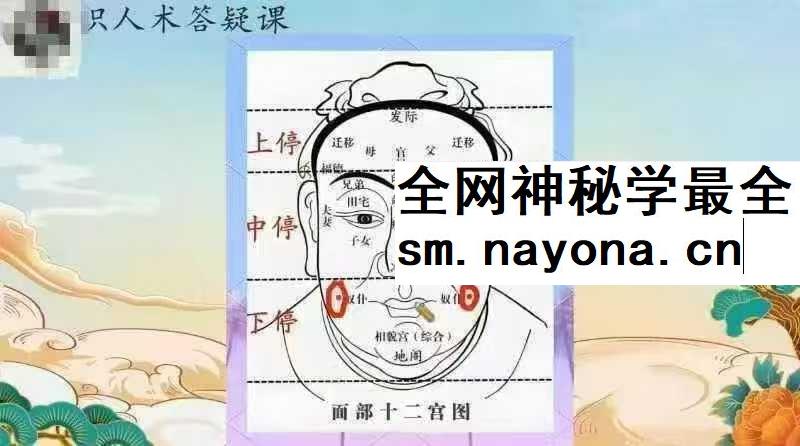
The san ting divide the face vertically into three approximate sections. Boundaries differ slightly across schools and illustrations, so use the landmarks below as a learning map rather than a precise measuring instrument.
| Region | Approximate landmarks | Traditional association in this lesson |
|---|---|---|
| Upper region (shang ting) | Hairline to the upper brow area | Early life, upbringing, and learning |
| Middle region (zhong ting) | Brow area to the base of the nose | Adult work, relationships, and responsibilities |
| Lower region (xia ting) | Base of the nose to the chin | Later life and family support |
The teacher roughly maps these sections to ages 15-30, 31-50, and 51 onward. These age ranges are a mnemonic used inside the traditional system, not a timeline that can be read from a person’s face.

How the Instructor Explains Each Region
The upper region
The upper region runs from the hairline toward the brows. In the lesson, it is linked to early life and the influence of family and education. The instructor discusses forehead breadth, contour, and visible marks as examples of features considered by traditional readers. Such features cannot reliably reveal a person’s childhood, parents, intelligence, or future success.
The middle region
The middle region centers on the brow-to-nose area. Traditional readings in the transcript associate it with the period of adult work and social relationships. The nose and nearby contours receive particular attention. Descriptions of prosperity or marital outcomes here should be understood as historical claims within the method, not as facts about an individual.
The lower region
The lower region extends from the nose base to the chin and includes the mouth and jaw area. The lesson links this section to later life and family circumstances. It also presents traditional sayings about balance among the three sections. These can be studied as concepts in the course without using them to predict finances, fertility, illness, or longevity.
Why the Lesson Warns Against One-Feature Judgments
A recurring phrase in the lecture is xiang bu du lun: do not interpret an appearance feature on its own. Within the traditional system, practitioners compare overall proportions, expression, context, and multiple features rather than making a claim from one mark or one measurement. For modern readers, an even stronger safeguard applies: external appearance is not a sound basis for judging a person’s abilities, morality, health, or life prospects.
The lesson favors a broadly balanced three-part face rather than an unusually long or short section. It also mentions measuring with one’s own fingers. These are classroom conventions of the source tradition; human facial proportions vary naturally, and there is no single ideal that determines an individual’s outcome.
A Practical Study Exercise
- On a neutral drawing of a face, mark the hairline, brows, base of the nose, and chin.
- Label the upper, middle, and lower regions. Note that the boundaries are approximate.
- Compare the lesson’s traditional associations with another introductory account of Chinese face reading.
- Write down which statements describe the historical method and which would require independent evidence to verify.
This exercise is about reading a cultural source carefully. Do not use a photograph of another person to make health, hiring, relationship, or financial decisions about them.
Key Terms
- Xiang xue: traditional study of physiognomy or appearance-based interpretation.
- San ting: the three facial regions.
- Shang ting / zhong ting / xia ting: upper, middle, and lower regions.
- Yin and Yang: a traditional pair used to describe contrasting yet interdependent qualities.
- Xiang bu du lun: a reminder, within the tradition, not to judge a single feature in isolation.
Frequently Asked Questions
Can the three facial regions predict a person’s future?
No reliable scientific method establishes that these facial regions predict wealth, relationships, health, or lifespan. This page explains what the source lesson teaches as a traditional cultural system.
Is this the complete 24-lesson course?
No. This article is an edited English learning guide to the supplied transcript of Lesson 2 only. It does not claim to translate or supply the remaining lessons.
Where should a beginner start?
Start with the Face Reading for Beginners guide, then review the broader Chinese Face Reading overview before comparing specific traditional methods.
Related Learning
For broader course study, see the separate Li Xiujuan Chinese Face Reading Course and Ma Yi Chinese Face Reading Course and Study Collection. These are related learning resources, not the same 24-lesson series described in this transcript. You can also browse the Chinese Face Reading Courses category.
Editorial Note
Karma Kismet translated and reorganized a supplied Chinese transcript titled “Face Reading, Lesson 2” and used three preview images from the associated 24-lesson course listing. Spoken fillers and repeated examples were condensed; traditional claims are labeled as such. The article is for cultural and educational study, not diagnosis, psychological assessment, employment screening, or personal forecasting.
A Closer Reading Exercise for Lesson Two
The three-region map can be studied without applying it to a real person’s life. Begin with the landmarks already named in this lesson: hairline, brow area, base of the nose, and chin. On a plain drawing, mark the spaces between them and label the upper, middle, and lower regions. The point is to understand how the transcript divides its subject. It is not to measure an ideal face or decide that a variation implies a favorable or unfavorable future.
Keep the Map and the Associations Separate
Make two short notes for each region. The first should describe its approximate location. The second should begin with the words, in this lesson’s traditional framework, before recording the life-stage association. That phrasing preserves the source’s meaning and its status as a traditional claim. If you later read a different account with different boundaries or age ranges, add it as a separate source. Do not silently change your first note to create an agreement that the sources do not actually show.
This distinction also helps with the lesson’s discussion of balance. A teaching preference for roughly balanced sections belongs to the interpretive system being explained. It does not establish an objective standard of human value or a reliable relation between facial proportions and life outcomes. In a summary, describe the preference as part of the lesson rather than using it to rank photographs. The same care applies to finger-based measurement: recording that a method is mentioned is different from endorsing its predictive use.
Read the Warning Against Isolated Features Precisely
The phrase xiang bu du lun is important because it shows a rule internal to the method: the instructor discourages conclusions from one feature alone. However, combining several appearance-based claims does not automatically make them reliable. A useful written response can therefore contain both points. First explain the teacher’s preference for considering a broader arrangement. Then explain that a person’s character, health, or prospects still cannot be established by that arrangement. This preserves the teaching accurately without giving it more evidential weight than it has.
Check What Your Summary Actually Covers
Finish by writing three sentences: one about the traditional background, one about the three-region map, and one about the limits of interpretation. Check each against this article. If a sentence introduces a new technique, a teacher biography, or a claim about another lesson, remove it unless you have a separate source. This page concerns Lesson Two of the referenced series. Related course listings may support further study, but they do not establish the contents of the remaining lessons or belong to this transcript simply because they concern the same subject.
Preserve that distinction whenever you compare related learning materials.