The original listing describes a 46-video course covering Waite and Marseille Tarot, with later sections on career and relationship readings.
Resource Overview
Long Nu Tarot 2022: Career and Relationship Reading is a digital learning resource about Career & Decision Tarot. The English description summarizes the available source listing; the underlying recordings or books are in Chinese. An English translation of the full material is not confirmed.
What You Will Learn
Use the sequence and preview material below to identify the course’s scope, terminology and teaching approach. Check each topic against the original lesson rather than treating a short listing as a complete transcript.
Course Contents
- Waite and Marseille Tarot
- Career-focused readings
- Relationship-focused readings
Original Course Images
Who This Resource Is For
This resource is for readers or learners who can use Chinese-language materials and want a named resource on Career & Decision Tarot. Compare the stated scope and previews before ordering; a fixed level of prior experience is not assumed unless the source directory says so.
Learning Format and Digital Delivery
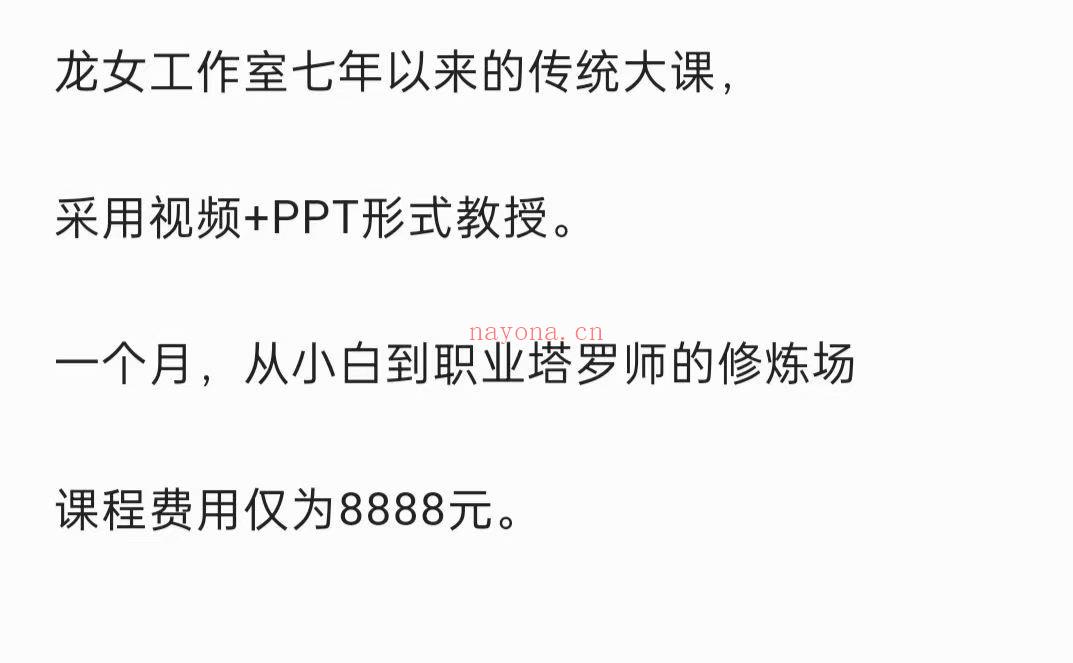
46 Chinese-language videos; no course notes listed Virtual and downloadable; there is no physical shipment. Price: USD 9.00. A file link is not yet attached to this product. Please contact Karma Kismet before ordering to confirm delivery arrangements; immediate automated access is not promised.
Frequently Asked Questions
Is the full material in English?
No English edition, recording or subtitle track is confirmed. The source material is Chinese-language.
Is a personal consultation included?
No individual consultation is listed with this resource.
Does this resource guarantee an outcome?
No. It is for educational and cultural study, not a guaranteed result or substitute for professional advice.
Editorial Note
Karma Kismet translated and organized the course facts and original previews for English readers. Lesson counts and formats follow the available source listing; unspecified contents, certificates and instructor credentials are not asserted.
Related Courses
Browse Career & Decision Tarot and read digital delivery information.
Two Tarot Traditions Within a Thematic Resource
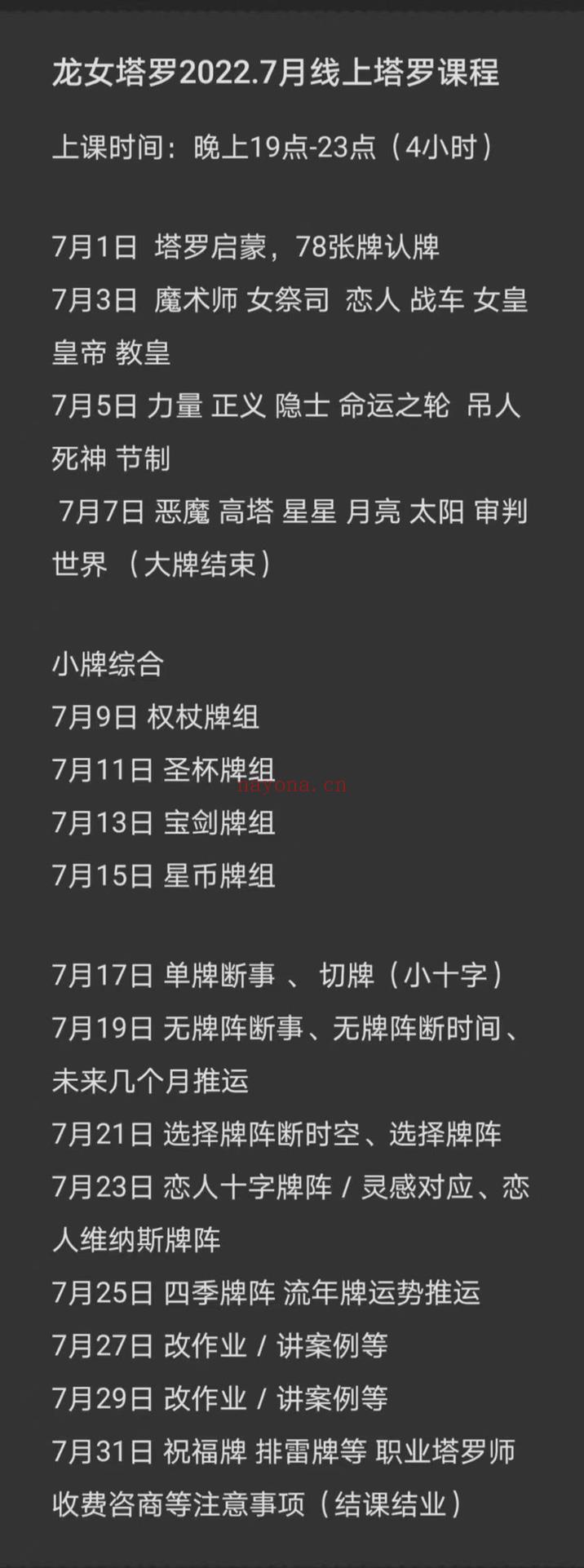
The available listing describes Long Nu’s 2022 course as a forty six video collection involving Waite Tarot and Marseille Tarot, with later attention to career and relationship readings. It also states that course notes are not provided. These are broad listing details rather than a verified file by file curriculum. They give a learner an outline of the intended subject, but they do not establish which card appears in a particular lesson or how the forty six recordings divide between the two traditions. The year identifies the listed version and should not be treated as proof of a new teaching method.
The distinction between Waite and Marseille is useful for organizing study. Rather than assume that one explanation applies unchanged to both, record which deck or image is being discussed whenever the recording makes that clear. A course that includes more than one tradition can provide opportunities for comparison, but the comparison needs to be grounded in the actual examples. If a deck reference is unclear, mark it as uncertain in your notes. Avoid supplying a tradition from memory merely because a card name sounds familiar.
Making Your Own Notes When None Are Listed
The absence of listed course notes makes a personal index especially valuable. Begin each entry with the recording’s filename or number, the topic discussed, and a short list of terms you need to review. Write the Chinese term next to a provisional English translation rather than relying on translation alone. This helps when a familiar English word is used differently in the course. A timestamp can make a useful explanation easier to find later, particularly when the public description does not supply a detailed lesson directory.
Separate three kinds of note: what the card visibly depicts, the meaning attributed to it in the recording, and the application to the example being discussed. The separation prevents a contextual interpretation from becoming an absolute card definition. It also makes comparisons between Waite and Marseille material more precise. If your own association differs from the teacher’s, record the difference as an observation to investigate. A notebook is most useful when it preserves the reasoning and its limits, rather than presenting every explanation as a single final keyword.
Comparing Images Before Comparing Answers
An independent comparison exercise can begin with two images that the course identifies as belonging to different traditions. Describe their composition before interpreting them. Note the figures, objects, arrangement, and text that are actually visible. Then ask which details the teacher emphasizes and whether that emphasis changes between examples. This avoids a common shortcut in symbolic study: deciding that two cards have identical meanings simply because they share a title. It also leaves room for differences in artwork that may matter to the method being demonstrated.
If you use your own decks alongside the videos, verify that their images match the examples closely enough for the comparison you are making. A modern adaptation may alter visual details or accompanying language. The collection’s inclusion of Waite and Marseille does not mean that every deck using those names is interchangeable in every exercise. You can still compare adaptations, but label that work as your own extension. Keep the original demonstration intact so that later notes distinguish what came from the course from what came from a different source.
Career Questions Need Practical Context
The later career focus is best studied through the questions asked and the reasoning used. A career question may concern a choice, an interaction, a goal, or a period of uncertainty. Before summarizing an example, record which of these is actually being discussed. Then identify the known circumstances and the interpretations proposed. This gives a more faithful account than reducing the reading to a promise of success or failure. The broad listing does not verify any particular workplace scenario, so examples in your own notebook should be clearly identified as independent practice.
For a self directed exercise, you could examine a decision about taking on a new responsibility. Write down the known workload, the skills involved, and the information you still need. A symbolic reading might prompt reflection on priorities or confidence, while a practical decision would still require those real conditions to be checked. Keep these roles distinct. The course title’s career language does not make the recordings a source of verified employment forecasts, employer intentions, or guaranteed outcomes. A thoughtful study record asks how the interpretation is constructed and what it leaves unresolved.
Relationship Readings and Another Person’s Perspective
The relationship focus can be approached by observing how a question is framed and whose experience is being described. A participant can report their own feelings and interactions. A card interpretation cannot confirm an absent person’s thoughts. When taking notes, identify any transition from a reported fact to a symbolic suggestion. That transition may be central to the reading method, but it should remain visible in your summary. A tentative statement about a relationship should not become an absolute claim about loyalty, attraction, or a future reconciliation.
An independent reflection exercise can focus on communication and boundaries. Ask what has been said directly, what is being assumed, and what the person asking can choose to do. These prompts help keep the reading connected to the participant’s agency. They do not guarantee that a conversation will resolve the issue or that a particular interpretation will be accepted. If you compare your own reading with a recorded example, preserve the original question and context. Otherwise, different answers may reflect different questions rather than different levels of reading ability.
Spiritual Themes in the Listing
The source description also mentions past and present life themes. That language belongs to a spiritual or interpretive frame. It does not establish that a reading can recover a factual previous life or verify an explanation for present circumstances. If the material discusses such themes, note the beliefs and symbolic associations being used, and keep them separate from historical or personal facts. A narrative generated through cards can be studied as a narrative without treating it as a memory, diagnosis, or evidence about another person’s experience.
Reviewing a Long Collection Without Rushing
Forty six listed videos suggest a collection that benefits from an index and repeated review rather than a race through the file count. A practical study rhythm is to watch a manageable segment, write a short account of the explanation, and revisit the point that remains unclear. This is a suggested approach, not an official course schedule. Because supplied notes are not listed, your own summaries should be concise enough to use later and detailed enough to locate the original reasoning. Keep unanswered questions visible; finishing the videos and understanding every idea are different achievements.
A final comparison page can draw together the course’s three broad aspects: deck tradition, consultation subject, and communication style. For each example, ask which tradition is identified, what question is addressed, and how uncertainty is expressed. This can help you study the relationship between images and context without inventing a complete syllabus from the listing. The resulting notebook is a record of your learning, not a qualification or a promise of predictive accuracy. Its usefulness comes from traceable examples, careful terminology, and an honest account of what the material does and does not establish.