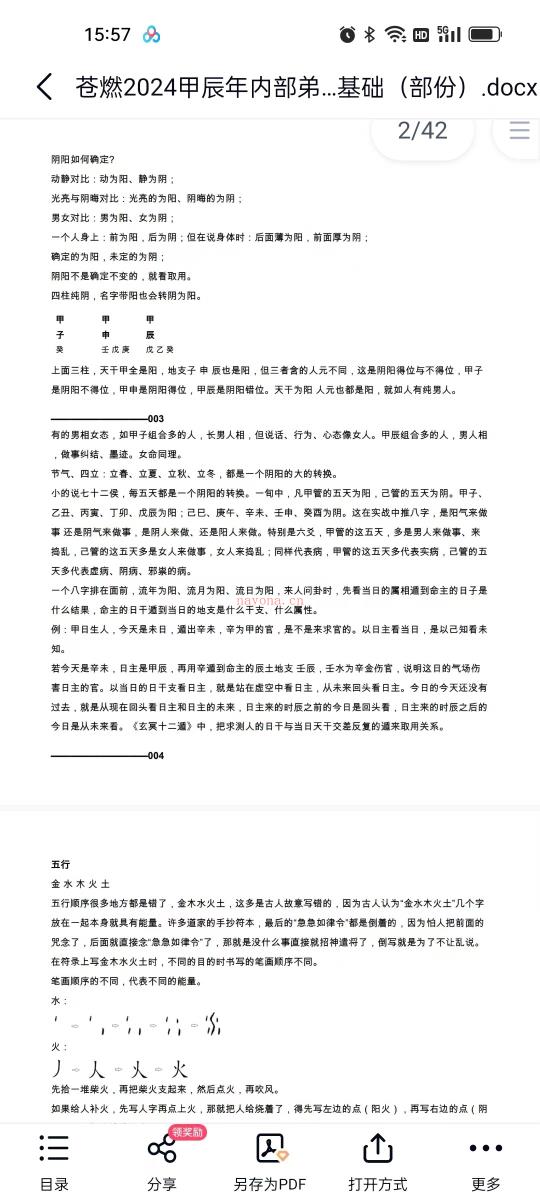
Pan Zhaoyou's directory moves from yin-yang and five-element foundations to hidden stems, strength examples and individual Heavenly Stems. Traditional body associations are historical interpretive categories, not medical diagnoses.
Course Overview
Pan Zhaoyou Heavenly Stems and Earthly Branches: 15 Lessons is a digital study resource in the Heavenly Stems & Earthly Branches collection. This English product guide explains the listed material; the original recordings and documents are in Chinese. English subtitles or translated full lessons are not included unless separately stated.
Course Contents and Learning Focus
- Lessons 1-3: yin-yang, five elements and the twelve branches
- Lessons 4-7: month command, hidden stems and element relationships
- Lesson 8: fetal origin, life palace and strength-stage tables
- Lessons 9-10: strength examples
- Lessons 11-14: Jia, Yi, Bing, Ding, Wu, Ji, Geng, Xin, Ren and Gui
- Lesson 15: traditional preferences and avoidances
What You Will Learn
Use the listed topics to identify the scope of this resource, follow its recorded sequence and compare the original diagrams with your study notes. Where individual lesson names are not supplied, the preview images are provided instead of an invented syllabus.
Original Course Previews
Who This Course Is For
For learners who can follow Chinese-language material and want to study Heavenly Stems & Earthly Branches. Check the format and previews before buying. Intermediate or continuation courses assume familiarity with the relevant foundations and do not imply that prerequisite courses are included.
Learning Format and Digital Delivery
Format: 15 recorded video lessons. Price: USD 9.00. This is a virtual, downloadable product; no physical shipment is required. The download link has not yet been attached to this listing and will be added by the store. Contact us before ordering if you need to confirm delivery timing; immediate automatic file access is not promised.
Frequently Asked Questions
Is the course taught in English?
No English-language recording or subtitle track is confirmed. This description is in English; the underlying course material is Chinese.
What is included?
15 recorded video lessons. Review the course contents and original previews for the stated scope.
Will a physical item be shipped?
No. This is a digital learning resource.
Is a certificate or personal consultation included?
No certificate, accreditation or individual consultation is promised by this listing.
Editorial Note and Disclaimer
Karma Kismet has organized the course listing and available directory into this English guide. Lesson counts refer to the supplied listing, not an independent review of every recording. For traditional and cultural study, not guaranteed predictions, financial advice or assured personal outcomes.
Related Courses
- Shanyang Blind School BaZi: 20 Lessons
- Cangran Dongze Blind School BaZi: 2024 Disciple Course
- Sanfeng Xuanzi Zi Ping Patterns: Intermediate Course
- Zeng Yong BaZi Pattern Method: Volume Two
- BaZi Stem and Branch Information: 33 Videos
Browse Heavenly Stems & Earthly Branches, review course and delivery questions, or learn about Karma Kismet.
Pan Zhaoyou's fifteen-part Gan Zhi route
The source identifies this collection under the reference F5618 and provides fifteen named MP4 entries. Its progression begins with Yin-Yang, Five Elements, and the stems and branches, then moves through branch classifications, monthly associations, hidden stems, elemental relationships, strength-related examples, and stem preferences. This readable directory gives a concrete route for study. It does not establish English subtitles, a certification, or an independently reviewed predictive method. The English companion helps explain the subject sequence while the original files must supply the detailed teaching.
The final five entries are especially useful for a stem-focused learner. They begin with Jia Wood, group Yi with Bing and Ding, continue with Ding alongside Wu and Ji, then group Geng, Xin, Ren, and Gui, before ending with the use of stem preferences. Preserve those actual groupings in your index. They are not a simple one-video-per-stem sequence. The repeated appearance of Ding and the grouped titles are source details, and a study plan should reflect them rather than silently reorganizing the collection into ten invented individual lessons.
Use the opening concepts to establish notation
Before moving into a thematic interpretation, make sure you can identify the terms used in the first three videos. Record the Chinese stem and branch names alongside consistent English transliterations. Then distinguish the names from the elemental and polarity labels associated with them in the material. A glossary should show those relationships clearly rather than turning each symbol into a list of personality adjectives. This supports later reading because you can check a classification without also accepting the interpretation that may be attached to it.
The second title concerns concepts and interpretation of stems and branches. Use it to ask how the teacher distinguishes notation from meaning. The title alone does not answer that question; your note should come from the actual explanation. If an unfamiliar phrase remains unclear, leave it as a question with a file reference. A precise unresolved question is a useful study result. It is better than supplying a definition from memory and later forgetting that it did not come from Pan Zhaoyou's material.
Monthly and body associations need separate treatment
The fourth video names the twelve branches in relation to months and the human body. These are different kinds of association, and your notes should not merge them. A calendar-related reference can concern the construction or context of a chart. A traditional body association is a symbolic category in the source. It is not a medical diagnosis or evidence that an organ is healthy or unwell. Record the teacher's explanation with that distinction visible so that a familiar branch label does not become an unsupported health conclusion.
If the material uses a body metaphor to explain a relationship, identify it as a metaphor or traditional correspondence. Do not expand it into treatment advice, dietary instructions, or an assurance about illness. The inventory confirms the subject appears, while it does not establish medical expertise or clinical evidence. You can study why the tradition uses bodily language without applying it literally to yourself or another person. Clear attribution allows the cultural explanation to be examined while practical health decisions remain based on appropriate information.
Hidden stems and relationships
The fifth entry joins hidden stems with Five Elements relationships. Keep a separate record of the visible branch and the hidden-stem explanation supplied by the source. This makes the method's layers easier to follow. A beginner can otherwise confuse a printed chart position with an additional classification used in interpretation. Copy the actual notation first, then add the traditional relationship and its conditions. If the material gives a table, note its source location instead of treating an independently remembered table as part of the course.
The next two entries concern elements and favorable or unfavorable interpretations. Translated words such as favorable should remain attached to the conditions in which the teacher uses them. They do not mean that an element is universally good in ordinary life or that its presence ensures success. For a passage you want to understand, write the chart detail, relationship, and conclusion separately. This gives you a way to examine the reasoning without turning a symbolic preference into a practical instruction to acquire objects or change important decisions.
Strength and stages are technical vocabulary
The eighth title names fetal origin, life palace, strength-related movement, and a ten-stem stage table. The following two videos name strength and stage examples. These topics belong to the traditional framework; their English words can be misleading if read as everyday physical descriptions. A chart's strength classification is not a test of bodily strength, resilience, or moral worth. Similarly, a stage label in a traditional table should not be treated as a medical statement about birth, decline, or death merely because the translation uses those words.
Use the examples to see how the teacher applies the terminology. Keep the supplied chart information separate from any biographical background. Then identify which part of the table or relationship is used in the argument. If an example is incomplete, note the gap rather than constructing missing details. The goal is to follow the source's explanation accurately. It is not to make every example look decisive or to extend a technical label into a claim about a person's lifespan, capacity, or future circumstances.
Read preferences with their seasonal context
When studying the later stem entries, compare each explanation with the monthly and elemental discussions that came earlier. Which conditions are retained? Does the teacher introduce a new relationship or qualify a previous description? The inventory's closing use-of-preferences topic gives you a location for review, but the rules must come from the actual teaching. Avoid treating a stem's preference as a universal requirement. Traditional chart language may describe a symbolic relationship under specific conditions rather than a thing a person literally needs to obtain.
For one stem, create a short evidence sheet with the source term, the condition described, the interpretation, and the relevant file reference. Then write a plain English paraphrase that keeps the condition before the conclusion. This exercise is a suggested study method, not a confirmed assignment in the package. It helps you recognize where a translation might otherwise sound too absolute. It also allows you to compare two passages without collapsing their differing contexts into one personality description or one prediction.
A focused review of the fifteen files
Choose one concept that recurs, such as hidden stems or strength-related vocabulary, and trace it through the relevant videos. After the examples, revisit your first definition and refine it with references. Keep a note of what changed in your understanding. This creates a manageable project from the documented sequence and makes progress visible. Watching every video can be a useful goal, but comprehension is better tested by explaining a particular argument and identifying the information it relies on.
Pan Zhaoyou's directory supports a specific learning route from notation to traditional applications, while the actual recordings establish the method. Use the resource for careful cultural study with source-specific terminology and checked references. Claims about favorable conditions, body associations, or life circumstances should remain attributed symbolic interpretations. A useful outcome is understanding how the source connects stems, branches, months, stages, and preferences, without converting those categories into medical conclusions, personal verdicts, or guarantees about future events.