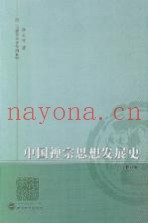
A historical study book by Ma Tianxiang on the development of Chinese Chan thought. The original listing includes a detailed table of contents.
Resource Overview
History of Chinese Chan Thought (PDF Study Book) is a digital learning resource about Zen & Chan Studies. The English description summarizes the available source listing; the underlying recordings or books are in Chinese. An English translation of the full material is not confirmed.
What You Will Learn
Use the sequence and preview material below to identify the course’s scope, terminology and teaching approach. Check each topic against the original lesson rather than treating a short listing as a complete transcript.
Course Contents
- Formation and branches of Chan thought
- Song-dynasty developments
- Later historical interpretations
Original Course Images
Who This Resource Is For
This resource is for readers or learners who can use Chinese-language materials and want a named resource on Zen & Chan Studies. Compare the stated scope and previews before ordering; a fixed level of prior experience is not assumed unless the source directory says so.
Learning Format and Digital Delivery
Chinese-language PDF ebook; 579 pages listed Virtual and downloadable; there is no physical shipment. Price: USD 9.00. A file link is not yet attached to this product. Please contact Karma Kismet before ordering to confirm delivery arrangements; immediate automated access is not promised.
Frequently Asked Questions
Is the full material in English?
No English edition, recording or subtitle track is confirmed. The source material is Chinese-language.
Is a personal consultation included?
No individual consultation is listed with this resource.
Does this resource guarantee an outcome?
No. It is for educational and cultural study, not a guaranteed result or substitute for professional advice.
Editorial Note
Karma Kismet translated and organized the course facts and original previews for English readers. Lesson counts and formats follow the available source listing; unspecified contents, certificates and instructor credentials are not asserted.
Related Courses
Browse Zen & Chan Studies and read digital delivery information.
The five part historical study
Ma Tianxiang’s History of Chinese Chan Thought is identified as a Chinese PDF published by Wuhan University Press in 2007, with ISBN 7307052989 and 579 pages. The detailed directory has twenty chapters arranged in five parts. It begins with formation and differentiation, then examines Song synthesis, Yuan and Ming changes, Qing engagement with the world, and modern research with cross cultural dialogue. This is a substantial historical study of thought, not a thirty lesson video course or a practical initiation. The author’s period labels are part of the interpretation to examine.
The source’s chapter structure gives the reader a clear way to choose a historical question. It also prevents the broad title from being mistaken for an undifferentiated survey of meditation methods. A discussion of a practice in history can concern arguments, institutions, texts, or reception without instructing the reader to undertake it. Keep that distinction visible. The bibliographic page count identifies the edition’s extent, while actual PDF pagination, scan quality, and searchability require checking the delivered file. No English translation or additional course component is confirmed.
Formation and Song developments
The first part includes an inquiry into Chan, its foundations and formation, and its differentiation. The second part opens with a Song overview and turns to synthesis and interaction, including Yanshou’s relation among Chan, Pure Land, and teaching traditions and Qisong’s relation between Confucian and Buddhist thought. These are actual subjects named in the directory. They suggest that the book studies intellectual relationships as well as internal lineage. The precise argument about synthesis should be read rather than assumed to mean that all differences disappear.
Other Song chapters name verses on old cases, the Blue Cliff Record, literary Chan, Dahui Zonggao and phrase observing Chan, Hongzhi Zhengjue and silent illumination, and criticism of those approaches. The directory uses evaluative language about some developments. Treat those labels as the author’s framing and investigate the evidence behind them. A comparison notebook can separate the positions described from the historian’s assessment. This is especially useful when a chapter title makes a strong judgment: the full discussion may qualify, explain, or narrow what the title compresses.
Historical writing and outward influence
The Song part also includes Zanning, Puji, the Five Lamps compilation, lineage controversy, scholar official engagement, Neo Confucian thinkers, and poetry. These subjects show how the study moves beyond a list of religious teachers into historiography and cultural interaction. If a chapter concerns a historical compilation, ask how that text represents lineage and how Ma Tianxiang evaluates it. A traditional lineage record and a modern historical analysis are different layers. Neither should be silently substituted for the other in your notes.
For literary and scholar official topics, identify the particular texts or persons discussed before drawing a conclusion about an entire social group. A heading about poetry does not establish that every poem uses Chan ideas in the same way. A heading about Neo Confucian thought does not imply uniform agreement or opposition. The detailed directory supports focused inquiry, but the argument remains in the chapter. Keep page references and note when a conclusion belongs to the author rather than to a historical participant quoted within the discussion.
Yuan and Ming changes
The third part names Yuan commentary, scholar officials, Quanzhen related interaction, recitation themed Chan, Chan and Pure Land combinations, literary synthesis of the three teachings, Wang Yangming related Chan, and lineage disputes. It includes figures and works associated with Zhongfeng Mingben, Zhuhong, Zhenke, Hanshan Deqing, and others. These entries identify a range of intellectual and cultural questions. They do not establish a single unbroken progression or a recommendation to combine practices. Read how the author explains change and which evidence supports the proposed relationships.
A useful reading path is to trace one question, such as Chan and Pure Land interaction, across the relevant chapters while preserving each period’s setting. Avoid creating a timeless synthesis from passages that discuss different people and circumstances. Alternatively, follow the chapter order to see how the author’s larger interpretation develops. Both are reader choices based on the real contents. No official reading schedule or comparative workbook is confirmed. The point is to use the directory as a map while leaving the actual historical connections to be established through close reading.
Qing debates and later engagement
The fourth part names early Qing disputes, Yongzheng’s involvement, Linji and Caodong figures, Confucian criticism and adaptation, Dai Zhen, Peng Shaosheng, and late Qing or early Republican engagement. It also includes Jing’an’s poetry and Taixu’s reform movement. These topics make debates and social involvement visible subjects in the author’s account. The part’s label about turning toward the world is an interpretive claim to investigate, not a definition of every Qing Chan community. Determine how the author distinguishes continuity from change and what examples carry the argument.
The chapter on Confucian engagement contains both criticism and appreciation in its listed sections. This is a reason to avoid reducing relations between traditions to simple opposition or complete agreement. A reader can compare specific arguments while preserving differences among the thinkers. When taking notes, separate a quoted criticism from Ma Tianxiang’s evaluation of it. Historical writing often places several voices together, and attribution can become unclear in a short summary. Precise notes make the volume more useful for later comparison with another account of the same debate.
Modern research and cross cultural dialogue
The final part includes Hu Shi’s contributions to Chan research, discussion of Indian and Chinese patriarchs, the Platform Sutra, and Chan thought. It then considers Yinshun’s interpretation and method before a chapter comparing Chan and Christian ontological questions. These are confirmed topics, but the listing does not provide the conclusions. A comparative chapter should be read as the author’s specific argument, not as proof that two religious traditions are identical or incompatible in every respect. Pay attention to which concepts and sources the comparison actually uses.
For readers interested in historical method, the Hu Shi and Yinshun chapters can be studied alongside earlier chapters on historical compilations and lineage. Ask what counts as evidence in each discussion and how interpretations are revised. That is an optional research path grounded in the directory. Before ordering, confirm the named author, edition, and PDF if they matter to your work. The resource’s strength is its extensive documented historical scope. It does not imply practical supervision, certification, an English version, or a guaranteed understanding of every Chan tradition after one reading.


