Study Zhao Wanyou's residential Feng Shui course: 82 videos and a 593-page illustrated e-book on Yang Zhai San Yao, bagua, and dwelling analysis.
Course Overview
This digital course presents Zhao Wanyou's residential feng shui case analysis, delivered as 82 video lessons plus one 593-page illustrated e-book. The curriculum centers on the classical Yang Zhai San Yao (Three Essentials of Residential Feng Shui) attributed to Qing dynasty master Zhao Jiufeng, covering the relationship between door, main bedroom, and kitchen, the eight-mansion system, nine-star auspicious and inauspicious judgments, and the Yao Bian dwelling-assessment formulas. Lessons also extend into xing luan landform analysis, san he and tian xing methods, and Yang Gong's twelve staff techniques. The e-book uses modern Chinese explanations with 128 floor-plan diagrams. This is cultural and educational study of traditional feng shui theory and case interpretation, not advice promising wealth, health, relationships, or any guaranteed outcome.
What You Will Learn
- Understand the core Yang Zhai San Yao framework: door, main bedroom, and kitchen relationships
- Apply the eight-mansion system, East/West four dwellings, and the Great Wandering Year song
- Interpret nine-star auspicious and inauspicious combinations for each gate and main dwelling
- Read classical dwelling-assessment formulas from the Yao Bian Fu tradition
- Analyze xing luan landforms such as dragon and tiger sand, case mountains, and noble sand
- Study san he, tian xing, and Yang Gong staff methods as cultural feng shui knowledge
Course Contents
- Yang Zhai San Yao 01: Introduction to door, main dwelling, and kitchen
- Yang Zhai San Yao 02: Hetu, Luoshu, and earlier/later heaven bagua
- Yang Zhai San Yao 03: East and West four dwellings and the Great Wandering Year song
- Yang Zhai San Yao 04: Judging the auspiciousness of the nine stars
- Yang Zhai San Yao 05: Palace-star mutual overcoming judgment method
- Yang Zhai San Yao 06: Descendants transformation image judgment method
- Yang Zhai San Yao 07: Five Ghosts piercing the palace; attributes of auspicious and inauspicious stars
- Yang Zhai San Yao 08: Events and timing of three auspicious and four inauspicious stars
- Yang Zhai San Yao 09: Five elements and illness theory
- Yang Zhai San Yao 10: Three yuan life gua and annual flying stars
- Yang Zhai San Yao 11: Static, moving, changing, and transforming dwellings
- Yang Zhai San Yao 12-13: Two case studies of inauspicious residential dwellings
- Yang Zhai San Yao 14: Two cases of Fire Burning Heaven Gate with differing outcomes
- Yang Zhai San Yao 15-16: Qian gate with eight main dwellings and nine-star judgments
- Yang Zhai San Yao 17-18: Kun gate with eight main dwellings and nine-star judgments
- Yang Zhai San Yao 19-20: Gen gate with eight main dwellings and nine-star judgments
- Yang Zhai San Yao 21-22: Dui gate with eight main dwellings and nine-star judgments
- Yang Zhai San Yao 23-24: Kan gate with eight main dwellings and nine-star judgments
- Yang Zhai San Yao 25-26: Li gate with eight main dwellings and nine-star judgments
- Yang Zhai San Yao 27-28: Zhen gate with eight main dwellings and nine-star judgments
- Yang Zhai San Yao 29-30: Xun gate with eight main dwellings and nine-star judgments
- Xing Luan Feng Shui 1-6: Dragon and tiger sand, case mountains, noble sand, and dragon tower phoenix pavilion
- Ba Zhai Feng Shui: Yao Bian Fu dwelling-assessment formulas 1-3
- San He Feng Shui: Long-life water mouth methods, dragon formation, and qi flow
- Tian Xing Feng Shui: Dragon formation and yin-yang dragon usage
- Yang Gong Twelve Staff Methods: Detailed explanation A, B, and C
- Bagua Feng Shui: Auspicious and inauspicious responses of the eight directions in yin and yang dwellings
- Yin Zhai Feng Shui: Ten unsuitable burial and facing locations in mountain, flat, and plain terrain
- Case Studies: Ancestral grave relocation, plain terrain losses, and inaccurate master site selection
- Illustrated Yang Zhai San Yao e-book: 593 pages with 128 floor-plan diagrams
Original Course Images
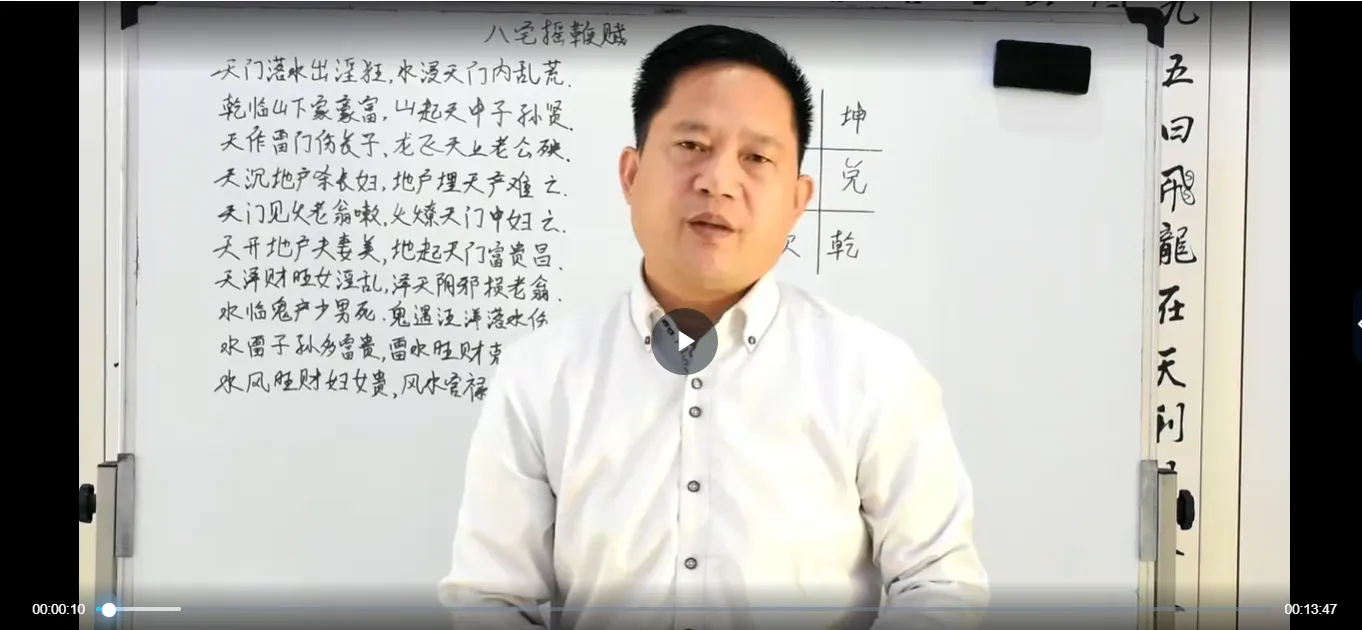
The verified course images are retained in their recorded order for material reference.


Who This Course Is For
This course suits feng shui enthusiasts, students of traditional Chinese metaphysics, and practitioners seeking structured case-based study of residential feng shui. It is appropriate for learners who want to examine classical Yang Zhai San Yao theory, eight-mansion methods, and landform analysis through video lessons and an illustrated reference text. No prior professional credential is required, though basic familiarity with bagua and five-element concepts helps. It is intended for cultural and educational study only.
Learning Format and Digital Delivery
Virtual, downloadable course with no physical shipping. The store administrator will add or confirm the digital delivery link separately.
Frequently Asked Questions
What exactly is included in this course?
The product includes 82 video lessons and one e-book. The e-book is the 593-page Illustrated Yang Zhai San Yao, featuring 128 floor-plan diagrams. Video topics include Yang Zhai San Yao, bagua feng shui, Yao Bian dwelling-assessment formulas, xing luan landforms, san he, tian xing, and Yang Gong's twelve staff methods.
Is this course suitable for beginners?
Yes. The lessons begin with foundational concepts such as door, main dwelling, and kitchen, Hetu and Luoshu, and earlier and later heaven bagua before progressing to nine-star judgments and case analysis. The e-book uses modern Chinese explanations and diagrams to make classical content easier to follow.
Does this course guarantee wealth, health, or relationship results?
No. This is cultural and educational study of traditional feng shui theory and case interpretation. It does not promise wealth, health, relationships, or any guaranteed outcome. Learners should treat the material as historical and cultural knowledge rather than professional advice.
Related Feng Shui Courses and Guides
Editorial Note
Karma Kismet translated and organized the verified course record for English-speaking learners. Traditional Feng Shui is presented as cultural and educational study, not as a promise of wealth, health, relationship or other outcomes.
Disclaimer
For cultural and educational study only. This course does not provide medical, legal, financial or other professional advice and does not guarantee results.
More Feng Shui Courses
- Qin Genlin Zero-Basis Residential Feng Shui Course: 41 Videos
- Zeng Li Interior Feng Shui Advanced Course: 20 Lessons
- Teacher Gao Home Environment Feng Shui Course: 100 Videos
- Ni Ke Office Furniture Feng Shui Course: 52 Videos
- Si Yu Eight Mansions Feng Shui Case Course: 275 Videos
- Zhang Zhengxi Xuan Kong Feng Shui Course: 75 Videos
- Teacher Zhulin Feng Shui Luopan Course: 24 Videos
- Meihua Wubankai Golden Lock Jade Pass Professional Training: 90 Videos
- Chongyang Yang Gong Feng Shui Four-Classics Bundle: 90 Videos
Learning Through Residential Cases
Zhao Wanyou’s 82-video course is especially suited to studying how a traditional rule is used in an example, rather than memorizing a favorable or unfavorable label on its own. The accompanying 593-page illustrated e-book and its 128 floor-plan diagrams provide another way to inspect spatial relationships. As you read a case, first identify what the plan actually shows. Then note which parts of the interpretation come from Yang Zhai San Yao, the eight-mansion system, a landform approach, or another method discussed in the curriculum.
Keep the Three Essentials Visible
Yang Zhai San Yao places the door, main dwelling or bedroom, and kitchen in a defined relationship. On a copied or hand-drawn plan, mark those three features before adding any star names or directional judgments. This creates a stable description you can return to when the explanation becomes complicated. If an example uses a gate or dwelling designation, record how it was assigned; otherwise, later conclusions may appear more certain than the starting information allows.
The videos also discuss East and West four dwellings, nine-star combinations, and Yao Bian assessment formulas. A compact comparison sheet can help: list the method, the inputs it asks for, the step used to classify a case, and any uncertainty in the example. Such a sheet makes differences between methods visible without assuming that one formula automatically validates another.
Using the Illustrated Material Carefully
- Read a floor plan for doors, rooms, and orientation marks before reading its interpretation.
- Write a neutral one-sentence description of the case.
- Follow the lesson’s stated calculation or classification step by step.
- Compare the video explanation with the corresponding diagram when one is available.
- Separate observations, traditional interpretations, and your own questions in your notes.
Some later subjects move beyond room plans into surrounding forms, water methods, and grave-site examples. These deserve their own context. A term used for an outdoor landform should not be silently turned into an indoor design rule. Likewise, a historical case illustrates the reasoning presented by the course; it cannot establish that the same result will follow elsewhere.
Who This Study Path May Suit
A reader drawn to residential plans and worked examples may find this course more approachable than a purely theoretical text. Familiarity with Bagua and Five Elements vocabulary will help with the middle lessons, though the early topics provide a starting point for building that vocabulary. The course may also interest someone comparing classical residential theory with the everyday practical questions of a modern home. Keep accessibility, ventilation, structural safety, and residents’ actual needs central when considering any real space.
Questions About the Case Analysis
What is the role of the e-book alongside the videos?
The illustrated Yang Zhai San Yao e-book offers extended text and floor-plan diagrams. It can serve as a reference while following the video cases, especially when a spatial relationship is hard to retain from narration alone.
Does an unfavorable label in a case predict an outcome for my home?
No. The label belongs to a traditional interpretive system and depends on the case’s stated assumptions. It should not be treated as a reliable prediction about a household.
Should I start with the outdoor landform lessons?
Starting with the door, main dwelling, and kitchen framework may make the residential cases easier to follow. The landform and other specialized sections can then be studied as additional perspectives with their own terms.