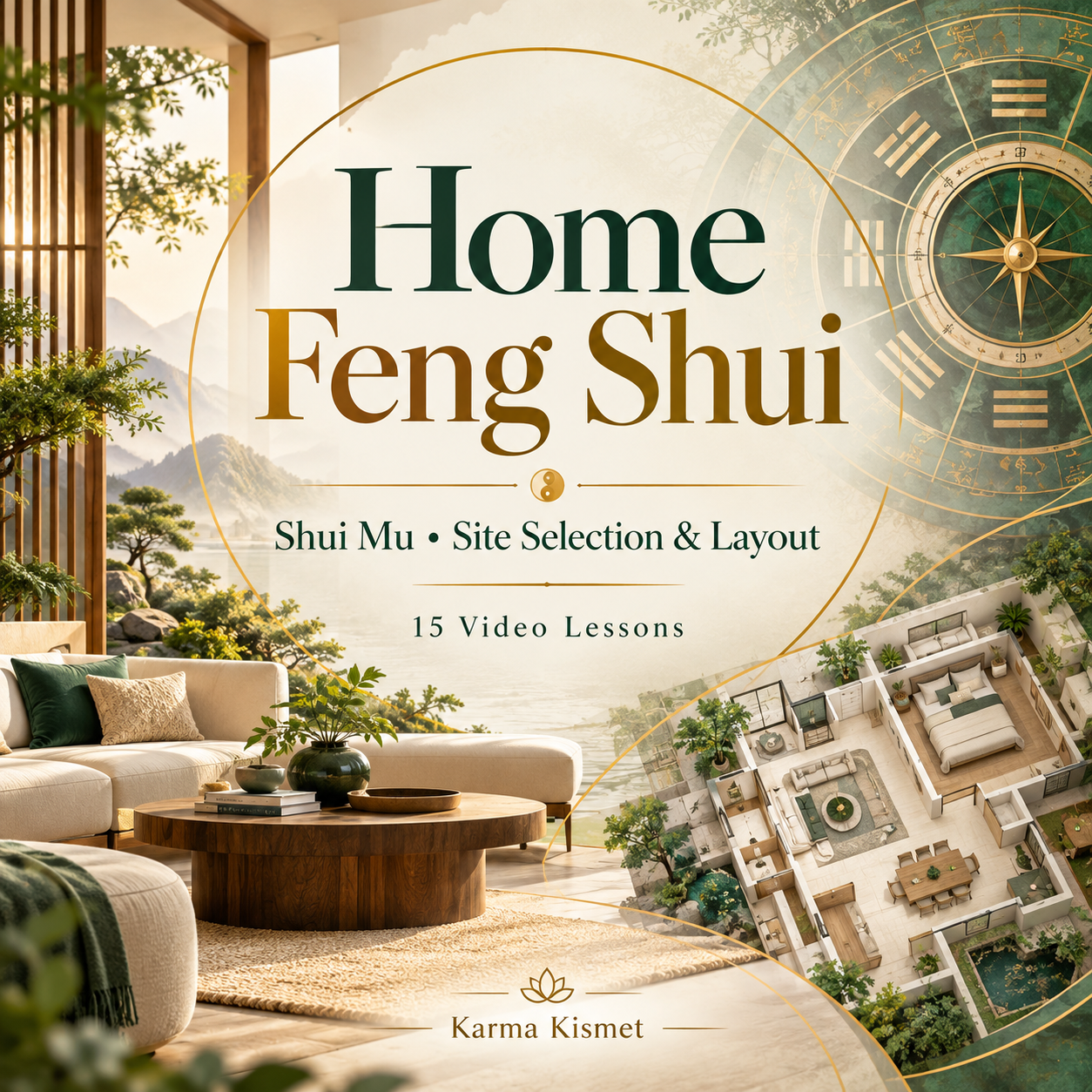
Study home feng shui with Teacher Gao's 100-file video course: 60 core videos, 19.38GB, covering Yangzhai basics, luopan use, liqi methods, and case studies.
Course Overview
This home feng shui course presents Teacher Gao's complete video teaching on traditional Yangzhai (residential) feng shui, delivered as 100 learning files with 60 core videos totaling 19.38GB. The curriculum is organized into two progressive stages: a 50-episode Foundation section covering core principles such as Yin-Yang, the Five Elements, Bagua, Hetu Luoshu, landform and qi observation, luopan use, eight directions and nine palaces, plus basic analysis of key home areas like the entrance, living room, bedroom, kitchen and bathroom. The 50-episode Advanced section explores liqi applications including Xuankong Flying Stars and Eight Mansions, complex layouts and sha remedies, personalized family member arrangements, and full case-study walkthroughs. It is a cultural and educational study of home environment assessment, not a promise of specific outcomes.
What You Will Learn
- Understand foundational feng shui concepts including Yin-Yang, the Five Elements, Bagua, and Hetu Luoshu
- Observe and assess a home's external landform environment and internal qi flow
- Use a luopan and divide a home into the eight directions and nine palaces
- Analyze key functional areas such as the entrance, living room, bedroom, kitchen, and bathroom
- Apply liqi methods such as Xuankong Flying Stars and Eight Mansions to study qi movement
- Recognize common layout issues like missing corners, through-hall sha, and overhead beam pressure, and study adjustment approaches
Course Contents
- Foundation Section: Yangzhai feng shui basics, episodes 1-10
- Foundation Section: Yangzhai feng shui basics, episodes 11-20
- Foundation Section: Yangzhai feng shui basics, episodes 21-30
- Foundation Section: Yangzhai feng shui basics, episodes 31-40
- Foundation Section: Yangzhai feng shui basics, episodes 41-50
- Core principles: Yin-Yang, Five Elements, Bagua, Hetu and Luoshu
- Environment and qi field introduction: external landform and internal qi
- Common forms of sha and basic remedies
- Luopan operation and direction division
- Eight directions and nine-palace grid of the home
- Entrance feng shui essentials and basic layout rules
- Living room feng shui essentials and basic layout rules
- Bedroom feng shui essentials and basic layout rules
- Kitchen feng shui essentials and basic layout rules
- Bathroom feng shui essentials and basic layout rules
- Advanced Section: Yangzhai feng shui advanced topics, episodes 1-10
- Advanced Section: Yangzhai feng shui advanced topics, episodes 11-20
- Advanced Section: Yangzhai feng shui advanced topics, episodes 21-30
- Advanced Section: Yangzhai feng shui advanced topics, episodes 31-40
- Advanced Section: Yangzhai feng shui advanced topics, episodes 41-50
- Liqi deep application: Xuankong Flying Stars and Eight Mansions
- Studying the flow and change of home qi movement
- Layout methods for wealth, descendants, and literary prospects
- Complex layouts and sha remedies: missing corners, through-hall sha, overhead beam pressure
- Personalized layout for family members based on birth data and favorable elements
- Bedroom allocation and individualized arrangement
- Comprehensive case study walkthroughs of real floor plans
- Full-process home environment diagnosis and planning practice
Original Course Images
The verified course images are retained in their recorded order for material reference.


Who This Course Is For
This course suits beginners seeking a structured introduction to traditional Yangzhai feng shui, as well as intermediate learners who want to deepen their understanding of liqi methods and complex layout analysis. It is also suitable for enthusiasts of Chinese cultural and environmental studies, and for learners who prefer video demonstration over text. No prior feng shui background is required for the Foundation section, while the Advanced section assumes familiarity with basic concepts. All content is presented as cultural and educational study of home environment assessment.
Learning Format and Digital Delivery
Virtual, downloadable course with no physical shipping. The store administrator will add or confirm the digital delivery link separately.
Frequently Asked Questions
What is included in this home feng shui course?
The course includes 100 learning files with 60 core videos totaling 19.38GB. It is divided into a 50-episode Foundation section and a 50-episode Advanced section, covering feng shui principles, luopan use, direction division, functional area analysis, liqi methods, sha remedies, personalized layouts, and case studies.
Do I need prior feng shui knowledge to take this course?
No prior knowledge is required for the Foundation section, which starts from basic concepts such as Yin-Yang, the Five Elements, and Bagua. The Advanced section builds on those foundations, so completing the first 50 episodes is recommended before moving on.
Does this course guarantee specific life results?
No. This course is a cultural and educational study of traditional Yangzhai feng shui and home environment assessment. It does not promise wealth, health, relationship outcomes, or any guaranteed results. Learners should treat the material as cultural knowledge and personal study.
Related Feng Shui Courses and Guides
Editorial Note
Karma Kismet translated and organized the verified course record for English-speaking learners. Traditional Feng Shui is presented as cultural and educational study, not as a promise of wealth, health, relationship or other outcomes.
Disclaimer
For cultural and educational study only. This course does not provide medical, legal, financial or other professional advice and does not guarantee results.
More Feng Shui Courses
- Qin Genlin Zero-Basis Residential Feng Shui Course: 41 Videos
- Zeng Li Interior Feng Shui Advanced Course: 20 Lessons
- Ni Ke Office Furniture Feng Shui Course: 52 Videos
- Si Yu Eight Mansions Feng Shui Case Course: 275 Videos
- Zhang Zhengxi Xuan Kong Feng Shui Course: 75 Videos
- Teacher Zhulin Feng Shui Luopan Course: 24 Videos
- Zhao Wanyou Residential Feng Shui Case Analysis: 82 Videos
- Meihua Wubankai Golden Lock Jade Pass Professional Training: 90 Videos
- Chongyang Yang Gong Feng Shui Four-Classics Bundle: 90 Videos
Studying Home Environment at More Than One Scale
Teacher Gao’s course moves between the surroundings of a residence and the arrangement of rooms inside it. That shift in scale is worth tracking. A description of landform outside a building asks different questions from an analysis of an entrance or bedroom. As you study, label each observation as external setting, overall floor plan, directional reading, or room-level arrangement. This keeps several traditional methods from blending into one vague impression of a home.
Building a Foundation for the Later Cases
The Foundation sequence introduces yin-yang, the five elements, Bagua, Hetu and Luoshu, the eight directions, and the nine-palace grid. These systems have their own terms and internal relationships. A glossary can help: define a term, note where it appears in a lesson, and add a small example of how the instructor uses it. Revisit the glossary when the Advanced material discusses liqi, Xuankong Flying Stars, or Eight Mansions. Recognizing a term is only a first step; being able to explain its role in an interpretation shows deeper understanding.
Luopan use and direction division require particular care in note-taking. Record what is being measured or assigned, where the reference point is placed, and how a direction is translated into a section of a plan. If a demonstration does not give enough detail for you to repeat its reasoning, mark the uncertainty rather than filling the gap with an assumption. The goal is to understand the method presented, not to produce an authoritative assessment of someone else’s property.
Using Case Studies as Worked Examples
The later case walkthroughs can be studied like worked problems. Pause before the instructor gives an interpretation and list the visible features of the plan: entry location, room relationships, circulation paths, and any constraints described. Then compare your observations with the instructor’s sequence of decisions. Which conclusion follows from the floor plan? Which depends on a traditional directional system or information about household members? Keeping those sources of reasoning separate makes the case more useful as a learning example.
Discussions of missing corners, through-hall sha, and overhead beams can also be approached this way. These are course terms for interpreting features within a feng shui framework. A beam may also affect how a room feels or where furniture fits, but the traditional interpretation should not be mistaken for proof of a health or financial effect. Where an adjustment is proposed, consider whether it is feasible, comfortable, and appropriate for the people who use the space.
Choosing a Pace Through the Material
The record describes 100 learning files and 60 core videos, with Foundation and Advanced sections identified as 50 episodes each. Those counts refer to different ways the material is described, so use the actual lesson organization when planning your study. A practical rhythm is to cover a small group of foundation topics, summarize them, and only then move to a case that uses those ideas. The Advanced section will be easier to follow when the direction and nine-palace vocabulary is already familiar.
This course may suit learners who enjoy extended video study and want to compare several approaches to residential feng shui. People mainly looking for a quick room arrangement checklist may find the theoretical sections more detailed than they need. For any real home decision, ordinary requirements such as safe access, maintenance, household needs, and professional building guidance still matter. Study the course as a cultural framework for observation and interpretation, without expecting a particular outcome from a layout.
Questions About Teacher Gao’s Course
Where should a newcomer begin? Start with the Foundation material and make sure the basic terms, direction divisions, and room examples are clear before working through advanced liqi cases.
Why do the file, video, and episode counts differ? The course record describes learning files, core videos, and two named episode sequences. They are different descriptions of the collection, so avoid treating any one count as a full inventory of identical video files.
Can I use the cases to assess another person’s home? They are useful examples for learning how the instructor reasons. A case does not establish that the same interpretation applies to a different home, especially when its layout, context, or occupants differ.