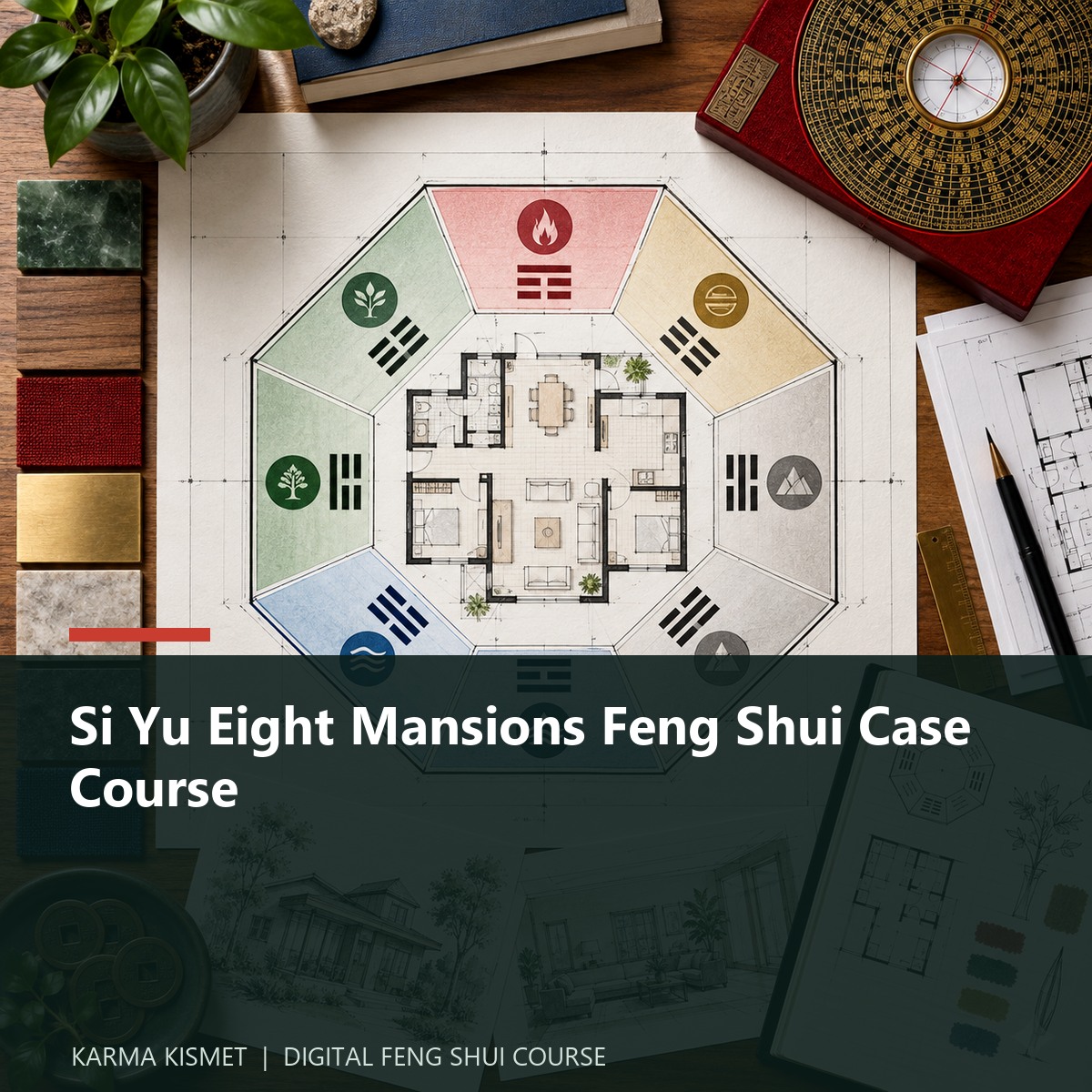

Eight Mansions feng shui course with 275 video lessons on practical case analysis and remedies. Cultural study of Ba Zhai theory for self-paced learning.
Course Overview
This Eight Mansions feng shui course presents 275 video lessons focused on practical case analysis and remedy strategies within the Eight Mansions (Ba Zhai) system. The curriculum begins with foundational opening lessons and progresses through numbered sessions that examine real-world applications and adjustments. Delivered as a large digital collection (approximately 9.98GB), it is intended for cultural and educational study of traditional Chinese feng shui concepts. The course does not promise wealth, health, relationship, or other guaranteed outcomes. It is suitable for learners who want structured, case-based exposure to Eight Mansions theory and its classical interpretive methods.
What You Will Learn
- Understand the core framework of Eight Mansions (Ba Zhai) feng shui as a cultural study.
- Follow a structured sequence of 275 lessons, from opening foundations to advanced case discussions.
- Examine practical case examples and remedy approaches presented throughout the course.
- Study how traditional Eight Mansions concepts are applied in real-world analysis.
- Review the full curriculum through numbered lessons and grouped topic ranges.
- Access a large digital video collection for self-paced cultural learning.
Course Contents
- Lessons 001–009: Opening foundation lessons (including one MP3 lesson).
- Lessons 010–020: Early numbered lessons covering introductory case material.
- Lessons 021–040: Continued foundational and early practical examples.
- Lessons 041–060: Case-based lessons with applied analysis.
- Lessons 061–080: Intermediate case discussions and remedy considerations.
- Lessons 081–100: Progressive practical case lessons.
- Lessons 101–120: Mid-course case analysis and application.
- Lessons 121–140: Continued case studies and interpretive practice.
- Lessons 141–160: Advanced case examples and adjustments.
- Lessons 161–180: Further practical case lessons.
- Lessons 181–200: Deepened case analysis and remedy strategies.
- Lessons 201–220: Advanced application and case review.
- Lessons 221–240: Complex case discussions and solutions.
- Lessons 241–260: Later-stage case lessons and refinements.
- Lessons 261–275: Final lessons, including Lesson 275 as the concluding session.
Original Course Images
The verified course images are retained in their recorded order for material reference.


Who This Course Is For
This course is intended for learners interested in traditional Chinese feng shui as a cultural and educational subject. It suits students who want a long, case-based video curriculum in Eight Mansions theory, as well as those who prefer self-paced study of classical feng shui concepts. It is not a certification program and does not promise professional credentials or guaranteed life outcomes. Prior familiarity with basic feng shui terminology may be helpful but is not required.
Learning Format and Digital Delivery
Virtual, downloadable course with no physical shipping. The store administrator will add or confirm the digital delivery link separately.
Frequently Asked Questions
What is included in this Eight Mansions feng shui course?
The product includes 275 video lessons (with one MP3 lesson among the opening sessions) covering Eight Mansions feng shui case analysis and remedy discussions. The total file size is approximately 9.98GB.
Is this course suitable for beginners?
The course begins with opening foundation lessons and then progresses through numbered case-based sessions. Beginners can follow the sequence, though some familiarity with basic feng shui terms may help.
Does this course guarantee results such as wealth or health?
No. This is a cultural and educational study of traditional feng shui concepts. It does not promise wealth, health, relationships, or any guaranteed outcomes.
Related Feng Shui Courses and Guides
Editorial Note
Karma Kismet translated and organized the verified course record for English-speaking learners. Traditional Feng Shui is presented as cultural and educational study, not as a promise of wealth, health, relationship or other outcomes.
Disclaimer
For cultural and educational study only. This course does not provide medical, legal, financial or other professional advice and does not guarantee results.
More Feng Shui Courses
- Qin Genlin Zero-Basis Residential Feng Shui Course: 41 Videos
- Zeng Li Interior Feng Shui Advanced Course: 20 Lessons
- Teacher Gao Home Environment Feng Shui Course: 100 Videos
- Ni Ke Office Furniture Feng Shui Course: 52 Videos
- Zhang Zhengxi Xuan Kong Feng Shui Course: 75 Videos
- Teacher Zhulin Feng Shui Luopan Course: 24 Videos
- Zhao Wanyou Residential Feng Shui Case Analysis: 82 Videos
- Meihua Wubankai Golden Lock Jade Pass Professional Training: 90 Videos
- Chongyang Yang Gong Feng Shui Four-Classics Bundle: 90 Videos
Learning Eight Mansions Through Repeated Cases
Si Yu’s course is described as a long, numbered collection centered on Eight Mansions feng shui cases and traditional adjustment discussions. Its length changes how best to approach it. Trying to remember every example as a separate rule can quickly become confusing. A better study method is to build a consistent record of the question, the layout information used, the interpretation offered, and any uncertainty that remains. Over many cases, that record can show how the same traditional vocabulary is used in different situations.
Establish the Framework Before Comparing Examples
Eight Mansions, also called Ba Zhai, is a traditional way of organizing spatial interpretation. When the opening lessons introduce its terms, take time to define each one in the language of the course. If a word appears in an English translation, keep the original term alongside it where possible. Different English renderings can make two related ideas look unrelated, or make distinct ideas look the same. Your notes should prioritize what the instructor means in a particular example.
Before starting a new case, review the assumptions it relies on. What information about the building or plan is available? Which directions or room positions are identified? Does the example describe the people using the space? A conclusion based on details that are absent from your own plan should remain a lesson about the example. It should not become a general rule for every home.
A Case Notebook That Stays Useful
A compact case notebook can help you follow the 275-lesson sequence without copying a transcript. For each case, use a few headings of your own: observed features, Eight Mansions terms, steps in the interpretation, proposed adjustment, and questions. In the observed-features section, describe only what the example supplies. In the interpretation section, note where the instructor moves from a feature of the plan to a traditional association. This separation lets you revisit a case later and see how the reasoning developed.
When an adjustment is discussed, ask what exactly it changes. Is it a way of assigning meaning to a position, a suggested use of a room, or a physical rearrangement? Those are different kinds of action. A physical change in a real home must still allow safe movement, suitable use of each room, and the preferences of its occupants. The course’s examples are material for study, not a guarantee that repeating an adjustment will produce the same result elsewhere.
Finding Patterns Without Forcing Agreement
As the collection progresses, compare a few cases that address a similar issue. Identify which features recur and which differ. If two lessons appear to reach different conclusions, check whether they use different starting information, a different orientation, or a different emphasis. If the reason remains unclear, keep both examples in your notes rather than inventing a rule that makes them agree. This is especially important in a case-based course where a short lesson title may reveal little about its actual context.
The record groups the numbered lessons into broad ranges, but those ranges do not provide a detailed topic list for every video. Avoid assuming that a given later lesson covers a specific technique based solely on its number. The opening sessions include one MP3 lesson, so learners who prefer visual demonstrations should also account for an audio component. The approximately 9.98GB collection is substantial; planning short review intervals may be more useful than trying to move through it without reflection.
What This Study Can and Cannot Provide
The course may appeal to learners who already enjoy tracing a method through varied examples, as well as newcomers willing to build a foundation before drawing comparisons. A beginner can focus first on vocabulary and the sequence of reasoning. A more experienced learner can compare cases and note where interpretations depend on specific facts. Neither approach requires treating the tradition as a substitute for practical planning or professional assessment of a property.
Traditional remedy language can sound decisive, but it should be read within its cultural context. The course can show how a practitioner frames a spatial concern and discusses a response. It does not establish that a layout causes illness, financial events, or relationship changes. Avoid making consequential decisions on the basis of a symbolic label alone. For an actual home, the condition of the building, accessibility, comfort, and the needs of residents remain concrete considerations.
A Manageable Review Cycle
- Study the opening foundation material and make a glossary of recurring Eight Mansions terms.
- Work through a small set of cases, pausing to state each case’s known facts.
- Write the instructor’s reasoning in your own words without adding missing details.
- Compare two cases that use a similar term and identify their differences.
- Review unresolved questions before advancing to another set of lessons.
This cycle is deliberately modest. It gives the large collection a structure without claiming that the numbered ranges correspond to fixed stages of mastery. If you are studying with someone else, comparing case notes can expose assumptions that either of you may have overlooked. Respect differences of interpretation while remaining clear about which facts the lesson actually supplies.
Questions About Si Yu’s Case Course
Do I need to complete all 275 lessons before studying a case? No. Start with the opening material, then use individual cases to practice applying the vocabulary. Later cases may make more sense after you have reviewed earlier examples.
Are the proposed remedies instructions for my own home? They are part of the traditional case discussion. A different home may lack the same features, and any real alteration should be judged by its practical effects as well as its cultural meaning.
How can I tell whether I understand a case? Try explaining what information was given, which Eight Mansions concepts were used, and how the interpretation followed. If you cannot identify a step, mark it as a question for review.