A two-part foundation course presented under YOYO and Eddie's names. The source emphasizes an integrated framework and historical context; it does not supply a reliable complete lesson directory.
Resource Overview
Integrated Magic Foundations by YOYO and Eddie is a digital learning resource about Magic & Witchcraft Foundations. The English description summarizes the available source listing; the underlying recordings or books are in Chinese. An English translation of the full material is not confirmed.
What You Will Learn
Use the sequence and preview material below to identify the course’s scope, terminology and teaching approach. Compare each card interpretation with the original lesson rather than treating a short listing as a complete transcript.
Course Contents
- Foundational vocabulary and overall course structure
- Historical and cultural context described by the course
- Symbols and ritual terminology
- Limits of the available source directory
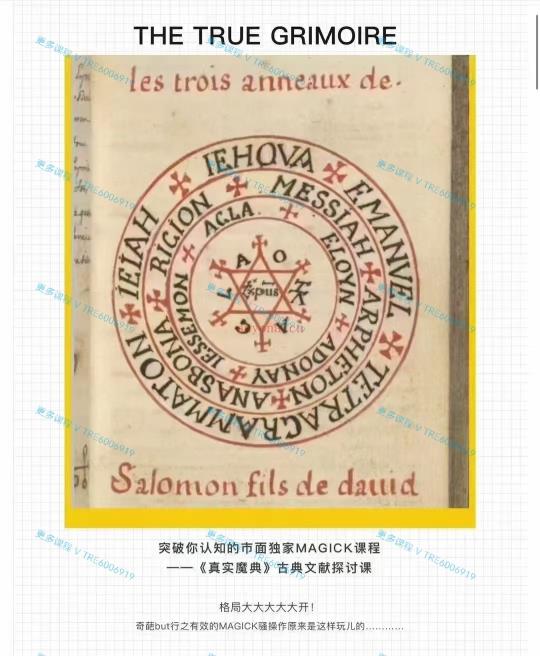
Original Course Images


Who This Resource Is For
This resource is for readers or learners who can use Chinese-language materials and want a named resource on Magic & Witchcraft Foundations. Compare the stated scope and previews before ordering; a fixed level of prior experience is not assumed unless the source directory says so.
Learning Format and Digital Delivery
Chinese-language online course described as parts 1 and 2; exact lesson count unconfirmed Virtual and downloadable; there is no physical shipment. Price: USD 9.00. A file link is not yet attached to this product. Please contact Karma Kismet before ordering to confirm delivery arrangements; immediate automated access is not promised.
Frequently Asked Questions
Is the full material in English?
No English edition, recording or subtitle track is confirmed. The source material is Chinese-language.
Is a personal consultation included?
No individual consultation is listed with this resource.
Does this resource guarantee an outcome?
No. It is for educational and cultural study, not a guaranteed result or substitute for professional advice.
Editorial Note
Karma Kismet translated and organized the course facts and original previews for English readers. Lesson counts and formats follow the available source listing; unspecified contents, certificates and instructor credentials are not asserted.
Related Courses
Browse Magic & Witchcraft Foundations and read digital delivery information.
Reading this resource closely
The useful starting point for this two-part resource is its stated interest in integration, sequence, detail and historical context. Those ideas invite a structured reading approach. They do not establish the historical truth of every narrative or demonstrate supernatural effects.
Integration and difference
Treat integration as a question about how ideas are connected. A symbol may have one meaning in a philosophical explanation and another in a ritual description. Preserve those differences before proposing a shared framework.
An integration map should show relationships rather than a collection of impressive terms. Put a concept at the center and connect it to the passages that define it, illustrate it or disagree about it. Label the connections with verbs such as explains, borrows or contrasts. An unlabeled line can hide a leap in reasoning. If one part of the resource uses historical narrative and another uses personal recollection, mark the different kinds of connection. The map can then reveal what the course brings together while still showing that the parts have distinct evidential status. A useful result might be discovering that two apparently identical terms do different jobs. That finding is more informative than declaring that everything belongs to one universal system.
Question for review: Which connection is explicitly explained, and which connection did I supply?
Historical context
Separate a dated text, a remembered tradition and a contemporary explanation. A historical story can illuminate how a community understands itself without proving that the story happened exactly as narrated.
Historical reading benefits from a timeline with an extra column for the status of each entry. Use categories such as identified publication, attributed account and undated narrative. These categories do not prejudge whether an account is valuable; they clarify what the reader knows about it. A tradition’s explanation of its own origin may communicate its ideals, authority and sense of continuity. Those functions deserve attention even when a date cannot be corroborated. When the material mentions philosophy, anthropology or a lineage, ask whether it gives a particular reference or only a broad label. Keep the exact reference if one exists. If none is supplied, formulate a research question instead of expanding the label into an invented historical account.
Question for review: What kind of evidence supports this historical account?
Two-part reading
The listing names parts one and two but gives no dependable complete lesson directory. Build your own index only after viewing the available files. Avoid treating the second part as a formally certified advanced qualification.
A two-part course can be approached with a bridge note between the parts. Before moving on, summarize three concepts from the first part in ordinary language. During the second part, record where each is revisited, altered or assumed without explanation. This will help you distinguish genuine development from repetition. It also prevents the temptation to describe the parts as beginner and expert levels simply because there are two of them. If the available file order is unclear, maintain separate lists for the sequence verified by the recording and the order imposed by the folder. Learning can proceed with a provisional route, provided its provisional character remains explicit and you do not claim that it is the original syllabus.
Question for review: What earlier concept does this later passage assume?
Vocabulary and translation
Keep the original Chinese term beside a provisional English gloss. Words translated as energy, spirit or correspondence may carry different meanings in different passages. A glossary should record context rather than force one universal translation.
Translation work should include examples, not just definitions. For an unfamiliar word, collect a short phrase containing it and describe the action or argument around that phrase. Then test an English gloss against a second occurrence. If the gloss produces a different idea in the second passage, narrow it or preserve more than one translation. This is particularly useful when a broad English word seems to explain several Chinese expressions. A reader who can consult the Chinese recordings can use the glossary as a retrieval tool. A reader who cannot do so should avoid assuming that the English product description provides access to every nuance of the underlying instruction. The brief listing and the full material have different functions.
Question for review: Does this English word preserve the distinction in the original passage?
Experience and interpretation
Personal experience described by a presenter is a report within the teaching. It is not independently verified evidence of a general mechanism. Record what is reported separately from the interpretation placed upon it.
A presenter’s anecdote can be analyzed with four questions: what situation is described, what action is reported, what happened afterward and why the presenter connects the two. The last question matters because sequence alone does not demonstrate causation. An ordinary event may have several explanations that a short account does not discuss. At the same time, the story can still reveal how the presenter understands ritual, learning or continuity. Record that interpretive role directly. A sentence such as the anecdote is used to illustrate a correspondence is more defensible than the anecdote proves that the correspondence works. This approach neither requires accepting the claim nor erasing the story’s place in the teaching. It keeps interpretation and evidence available for separate discussion.
Question for review: What was observed, and what explanation was added?
A foundation portfolio
A useful foundation portfolio contains a glossary, a relationship map and unresolved questions. Judge progress by whether you can explain the map clearly and identify its limits, rather than by an imagined acquisition of powers.
For a final portfolio, choose one central concept and explain how the two-part presentation helps you examine it. Include a glossary entry, one source passage, one relationship diagram and a paragraph explaining a limitation. These four pieces should support each other. If the diagram introduces a relationship absent from the passage, either provide another source location or identify it as your hypothesis. If the glossary entry is too broad to explain the passage, refine it. A foundation portfolio is successful when it is understandable and traceable. It does not need a dramatic claim of transformation. A good next study question can emerge from an unresolved difference in the material, allowing further reading to be guided by a concrete issue rather than by the urge to collect more titles.
Question for review: Can another reader follow the route from quotation to conclusion?