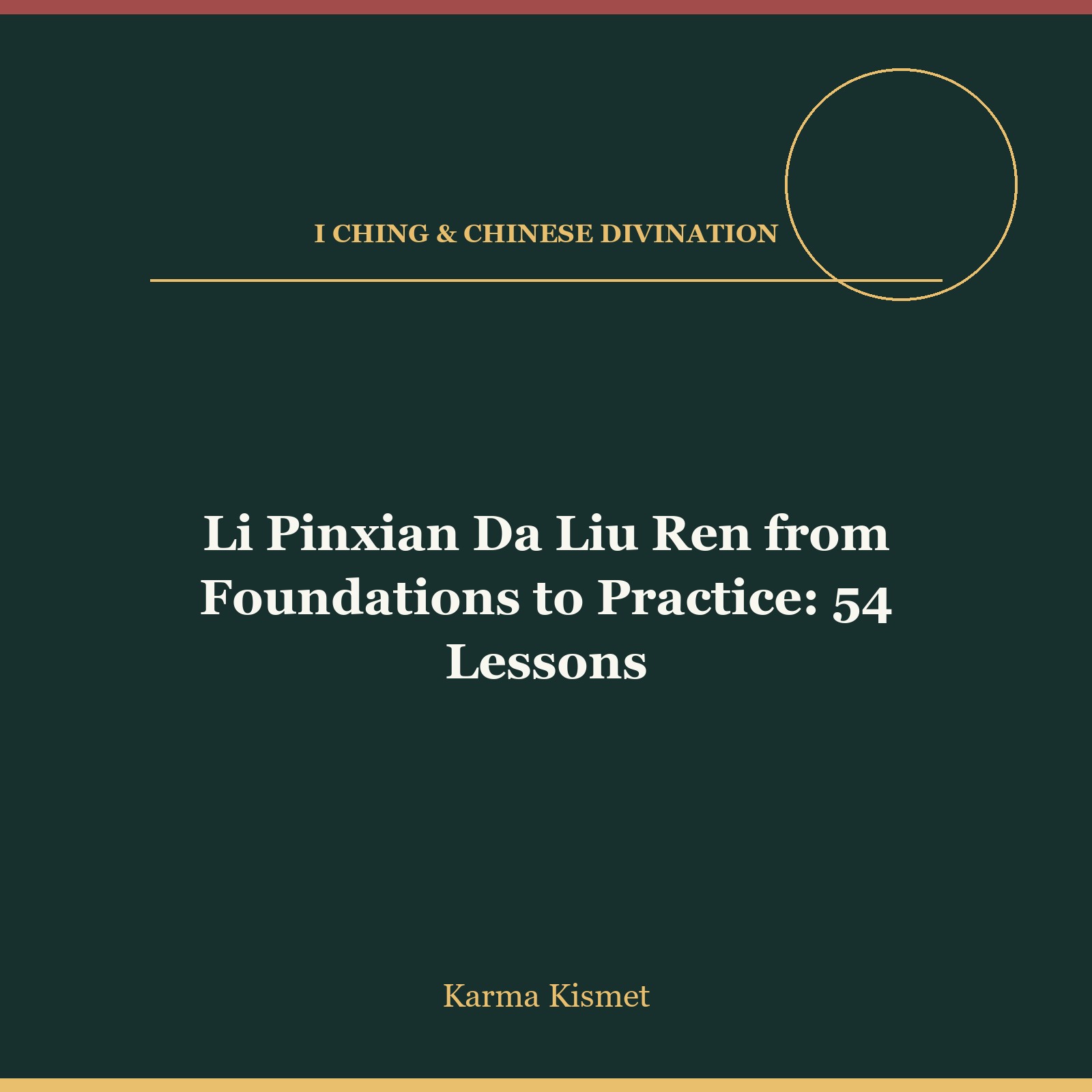
A 54-video Da Liu Ren course by Li Pinxian, presented as an entry-to-practice sequence with examples of traditional divination readings.
Course at a Glance
This digital learning resource presents the course named above. Its original lessons and study materials are in Chinese; this English page helps readers understand the subject and listed scope before choosing to study it. No physical item is shipped.
What the Course Covers
- Da Liu Ren introductory terminology
- Building a traditional reading step by step
- Reviewing example judgments in the later lessons
How to Study This Material
Begin with the terminology, then follow the source lesson sequence and compare each worked example with the method being taught. Keep a record of the symbols, assumptions and steps used in each interpretation. Traditional divination is presented here as a cultural study method, not as a guaranteed prediction or substitute for professional advice.
Original Course Preview Images
The following images are retained from the original course listing.

Before You Buy
This is a virtual learning product. The page describes the course or reference material; the original video or PDF content is not translated into English. Review the lesson count and format in the title and description. Digital delivery details are provided with your order; no physical shipment is included.
Related Learning
Explore the Liu Ren Divination Courses collection, all I Ching and divination resources, or contact Karma Kismet with course questions.
Related Courses
- Da Liu Ren Foundations: 20 Video Lessons
- Jiang Zhiyuan Jin Kou Jue Accelerated Course Collection
- Xingchen Applied I Ching Course: 93 Videos and Five Study Texts
Following the Route from Da Liu Ren Basics to Case Study
Li Pinxian’s 54-lesson collection is arranged around a useful distinction: learning the language of Da Liu Ren and then watching that language applied to examples. The source listing begins with introductory lessons, moves into a group of cases, and continues through examples organized by the kinds of questions people have traditionally brought to this system. That structure gives a learner a way to ask, at each stage, whether a conclusion actually follows from the symbols and procedure shown. The examples are best treated as demonstrations of an interpretive tradition, not evidence that a reading can establish future events.
Build a working vocabulary first
Da Liu Ren has its own terms, arrangements, and conventions. A newcomer can lose the thread of a case when an unfamiliar symbol is introduced and immediately used in a judgment. In the introductory portion, make a small glossary in your own words. For every term, record where it appears in the lesson, what role the instructor assigns it, and one example of its use. Keep uncertain definitions marked as uncertain. A term that seems obvious in one case may be used more narrowly in another.
It also helps to distinguish a procedure from an interpretation. A procedure tells you what the instructor places, identifies, or compares. An interpretation explains why those observations matter for the question at hand. Write these in separate columns in your notes. This simple division makes later case work much easier to review, especially when two examples start similarly but end with different emphases. If you cannot reproduce the procedural steps from your notes, revisit that passage before trying to assess the judgment.
Read the case sequence by question type
The source lesson list names cases involving travel, housing, work, historical disputes, absent people, relationships, examinations, money, lost objects, pregnancy, and burial-site questions. These labels describe the examples in the collection; they do not turn the method into reliable advice for those subjects. Each question type brings a different interpretation problem. A travel example may focus attention on timing or movement, while a lost-object example may direct attention toward place and description. The important learning task is to identify which features of the traditional reading the instructor selects and which possible features are left aside.
Before viewing a worked case, write down its question in neutral terms. Afterward, summarize the instructor’s reasoning in three parts: the initial observations, the rule or association invoked, and the stated interpretation. Avoid copying a conclusion without its supporting steps. Where the lesson provides a known outcome, consider whether the explanation was stated before the outcome or adjusted in retrospect. That distinction matters when evaluating any interpretive example, including one presented as a success.
A practical way to pace 54 lessons
-
Use the opening lessons to collect terms and reconstruct the demonstrated setup. Do not rush to memorize judgments.
-
Choose one early case and pause before the explanation. List the features you notice, then compare your list with the instructor’s.
-
Group later examples by their named topic. Compare cases within a group before comparing travel, housing, work, and other groups with one another.
-
Keep a question log. Record the point where a rule was unclear, a symbol was unfamiliar, or a conclusion appeared to require an unstated assumption.
-
Return to the same case after studying several others. Explain its reasoning again without looking at your first notes, then identify what changed in your understanding.
This pace is particularly useful because the listing changes from introductory material to many specific applications. Watching the entire sequence without notes may leave a strong impression of familiarity while making it difficult to explain a single reading. Reconstructing a few cases carefully can provide a better basis for study than collecting many unexplained conclusions.
What the range of examples can and cannot show
The variety of topics makes the collection useful for observing how one tradition handles different kinds of questions. It also creates a risk of treating every topic as equally answerable. A lesson about an examination or employment question can be studied for its symbolic reasoning, but actual educational and work decisions require direct evidence, preparation, and ordinary communication. A lesson that refers to pregnancy cannot establish medical facts; health questions belong with qualified health professionals. Financial examples, including market or lottery questions named in the source list, should never be treated as investment guidance or a way to improve the odds of a wager.
Historical dispute examples raise a different issue. They may show how a traditional text or instructor frames a case, but the interpretation is not a legal finding. It is useful to ask what information was available to the reader at the time, what was learned afterward, and whether the account leaves anything out. The aim is to study an argument in its context while keeping its limits visible.
Who may find this collection useful
A beginner interested in Da Liu Ren may appreciate the stated movement from introductory lessons into worked cases. A reader with some background in Chinese divination may be more interested in comparing the instructor’s choices across topics. Someone studying the history of interpretation can use the case labels to observe how traditional categories of questions are organized. In every case, the original lessons are in Chinese. Comfort with spoken Chinese and the relevant vocabulary will matter more than familiarity with the English title alone.
The large lesson count does not by itself indicate depth in every topic. Some listed cases receive several lessons, while others appear once. Select the collection for its particular subject and case range rather than assuming that each named area receives equal treatment. The course title describes a path from foundations to practice; it should not be read as a promise of professional competence after viewing.
Questions About Studying This Da Liu Ren Collection
Should I start with the travel or housing examples?
Start with the introductory sequence if the terminology is new. The travel and housing cases will be more meaningful once you can identify the setup and follow the reason given for each interpretive move. If you already know the basics, choose one case from each topic and compare how the instructor changes focus.
Does a worked reading prove the method predicts an outcome?
No. A worked reading shows how a conclusion is reached within a traditional framework. Assess the clarity and consistency of the explanation, but do not treat an example as proof of predictive reliability. Decisions about health, money, law, work, or relationships need appropriate evidence and human judgment beyond a divination lesson.
How should I use the later topic-specific lessons?
Use them as a comparison library. For each topic, note the question, the selected symbols, the reasoning, and any uncertainties. Compare two cases on the same topic before drawing a general rule. This is especially helpful when the source list presents several lessons on one kind of question.
What would count as progress in studying the 54 lessons?
A useful sign is the ability to describe a demonstrated setup, trace an interpretation back to stated observations, and explain where the instructor’s judgment depends on convention or choice. Remembering a striking outcome is less useful than being able to reconstruct the path taken to reach it.