A 42-video introductory and advanced number-divination workshop by Xuanqing, described as covering numerical patterns and worked examples.
Course at a Glance
This digital learning resource presents the course named above. Its original lessons and study materials are in Chinese; this English page helps readers understand the subject and listed scope before choosing to study it. No physical item is shipped.
What the Course Covers
- Number symbolism and course foundations
- The Nine Heaven number system and Triangle Law
- Studying worked cases while separating interpretation from fact
How to Study This Material
Begin with the terminology, then follow the source lesson sequence and compare each worked example with the method being taught. Keep a record of the symbols, assumptions and steps used in each interpretation. Traditional divination is presented here as a cultural study method, not as a guaranteed prediction or substitute for professional advice.
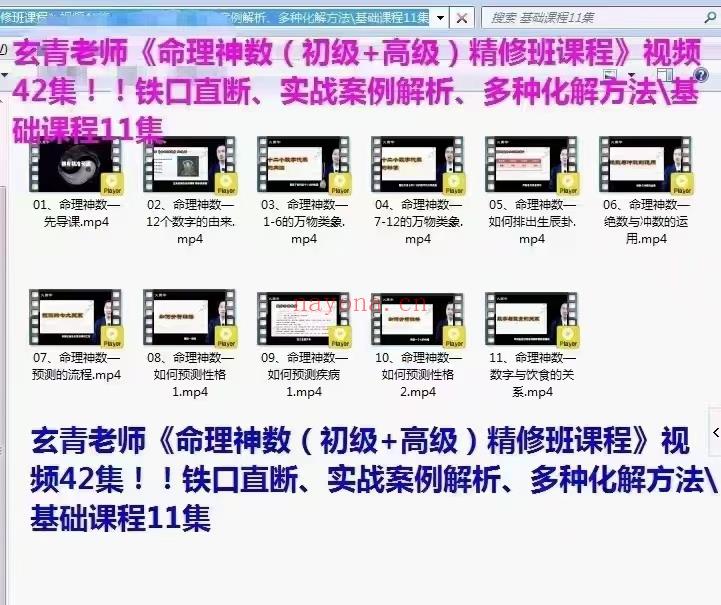
Original Course Preview Images
The following images are retained from the original course listing.
Before You Buy
This is a virtual learning product. The page describes the course or reference material; the original video or PDF content is not translated into English. Review the lesson count and format in the title and description. Digital delivery details are provided with your order; no physical shipment is included.
Related Learning
Explore the Life Numbers & Triangle Law collection, all I Ching and divination resources, or contact Karma Kismet with course questions.
Related Courses
- Triangle Law and Life Number Patterns: Advanced Video Course
- Yang Zhongyi Bagua Image-Number Prediction: 18 Lessons
- Bao Shuanglong External Response and Date Selection: 22 Lessons
Reading the Workshop as a Numerical System
Xuanqing’s 42-video workshop is described in the source listing as an introductory group of 11 lessons followed by an advanced group of 31. Its central subject is a traditional number-divination framework associated in the listing with life numbers and Triangle Law. The course outline moves from the origin and symbolic associations of twelve numbers to arranging a birth-related hexagram, applying named number relationships, examining an interpretation process, and reviewing cases. That sequence makes the workshop suitable for studying how a set of defined inputs becomes a symbolic reading.
The word number can suggest calculation alone, but the listed topics involve classification and interpretation as well. A calculation may produce a value; the tradition then assigns that value a role or association. Students should keep those stages separate. If a conclusion sounds convincing, ask whether the calculation was performed consistently, whether the association was stated in the lesson, and whether the final interpretation goes beyond the information provided.
The twelve-number vocabulary
The introductory outline names the origins of twelve numbers and divides their symbolic associations into groups from one through six and seven through twelve. That suggests a useful first task: make a glossary with one entry for each number. Record only the meanings actually explained in the class. Leave space for a second meaning if an advanced lesson uses the same number in a different context. A single label may be too broad to capture how an association works within a particular example.
Consider making a separate note for the difference between a number as an input, a number as the result of a calculation, and a number as a symbol. These can appear identical on the page while serving different purposes in the method. If a worked example changes from one role to another without explanation, that is precisely the point to revisit. Careful notation makes a complex lesson easier to inspect.
Birth-related arrangements and the named number relationships
The outline refers to arranging a birth hexagram and using relationships translated in the listing as absolute numbers and opposing numbers. Those names identify subjects for study; they do not by themselves provide a complete rule. Follow the course’s own steps when reproducing an example. Write the starting information, each transformation, and the resulting arrangement on separate lines. This reduces the chance that a remembered conclusion will replace the actual procedure.
Because birth-related information is personal, use your own information only if you are comfortable doing so. For practice, an invented example can help test whether you understand the arithmetic and order of operations. It should be clearly labeled as an exercise, not as a reading about a real person. Do not publish someone else’s personal details simply to demonstrate a method.
How to Work Through the Introductory and Advanced Parts
The introductory lessons list a prediction process, character readings, a topic involving illness, and associations between numbers and diet. The advanced list repeats several foundations before moving into additional subjects, including finances, relatives, marriage, housing, fixed phrases associated with numbers, direct readings, case analyses, and methods described as remedies. Repetition in the outline can be useful: compare an early explanation with its later treatment and note what becomes more detailed or more conditional.
-
Start by mapping the 11 introductory topics. Write a one-sentence question for each lesson, such as which input is being classified or what operation is being demonstrated.
-
For every worked calculation, reproduce the steps before listening to the interpretation. If your result differs, find the first point of divergence rather than adjusting the final answer.
-
When the advanced section revisits an introductory topic, compare the stated rules. Record a new condition only when the lesson makes it explicit.
-
In the case-analysis lessons, divide your notes into inputs, operations, symbolic associations, and the speaker’s conclusion. This prevents a vivid case narrative from hiding a weak or missing step.
-
Review the remedy-related material as a description of traditional responses to an interpretation. Assess any proposed action by ordinary standards of cost, safety, consent, and evidence.
The listing also uses a phrase equivalent to direct or emphatic pronouncement. Such language may describe a presentation style, but confidence of delivery does not establish accuracy. A useful exercise is to rewrite an emphatic statement as a conditional claim. Ask what would count as a clear example, what would count against it, and what information was available before the statement was made.
Case studies without hindsight
Five case-analysis topics appear near the end of the advanced outline. A case is easiest to learn from when its chronology is clear. Mark what the interpreter knew at the outset and what was supplied after an interpretation. If a story reveals a result before explaining the method, cover that result and try to reconstruct the steps independently. This is a study technique, not a claim that the system can forecast events.
Multiple interpretations may fit the same broad symbol. To understand a case, ask why the presented interpretation was chosen over another available one. Where the lesson does not give a reason, leave a question mark in your notes. A good study record should show uncertainty plainly. It should not make the method appear more precise than the example supports.
Appropriate Expectations
This workshop may appeal to readers who enjoy structured symbolic systems, repeated calculations, and comparisons between beginner and advanced presentations of the same material. It may be especially interesting to someone already familiar with Chinese divination terminology. A learner seeking only a quick description of number symbolism may find the 42-video sequence more detailed than necessary. The source outline indicates many topics, but it does not establish that every topic receives equal time or depth.
Several listed applications concern sensitive matters. A numerical reading cannot diagnose illness, set a diet, determine another person’s character, predict a child’s sex, evaluate a marriage, or make a financial decision reliable. Treat those examples as part of the tradition being studied. For real health questions, use medical evidence and qualified care; for financial decisions, use sound information and appropriate advice. Keep personal judgments about other people open to their own accounts and consent.
A claim about housing or an accident can also affect behavior. Do not let a symbolic result displace practical safety checks, building information, or responsible planning. If the course offers a proposed remedy, examine what it actually asks someone to do. A harmless reflective practice and a costly or risky intervention call for different levels of scrutiny. The numerical framework can be studied without accepting every application as a factual claim.
Questions About the Life Numbers Workshop
Why does the advanced outline repeat introductory subjects?
The listing shows repeated headings, but it does not explain the editorial reason. In study, use the repetition to compare how the same concept is introduced and later developed. Avoid assuming that a repeated title means the recordings are identical.
Is Triangle Law just a mathematical formula?
The listing associates the workshop with Triangle Law and a broader system of numerical symbols. It does not provide a full English definition or a complete formula. Follow the rule as the instructor states it, and separate any calculation from the interpretation attached to its result.
How should I handle the lessons on illness or money?
Read them as examples of traditional interpretation. They are unsuitable as a basis for diagnosis, treatment, investment, or other consequential choices. Record the course’s reasoning while using independent, relevant evidence for real decisions.
What is a reasonable study outcome?
A reasonable aim is to understand the vocabulary, reproduce the demonstrated steps, identify where interpretation enters, and explain the limits of a case. Understanding a method does not require claiming that its predictions are reliable.