San He Feng Shui Course: Documented Scope
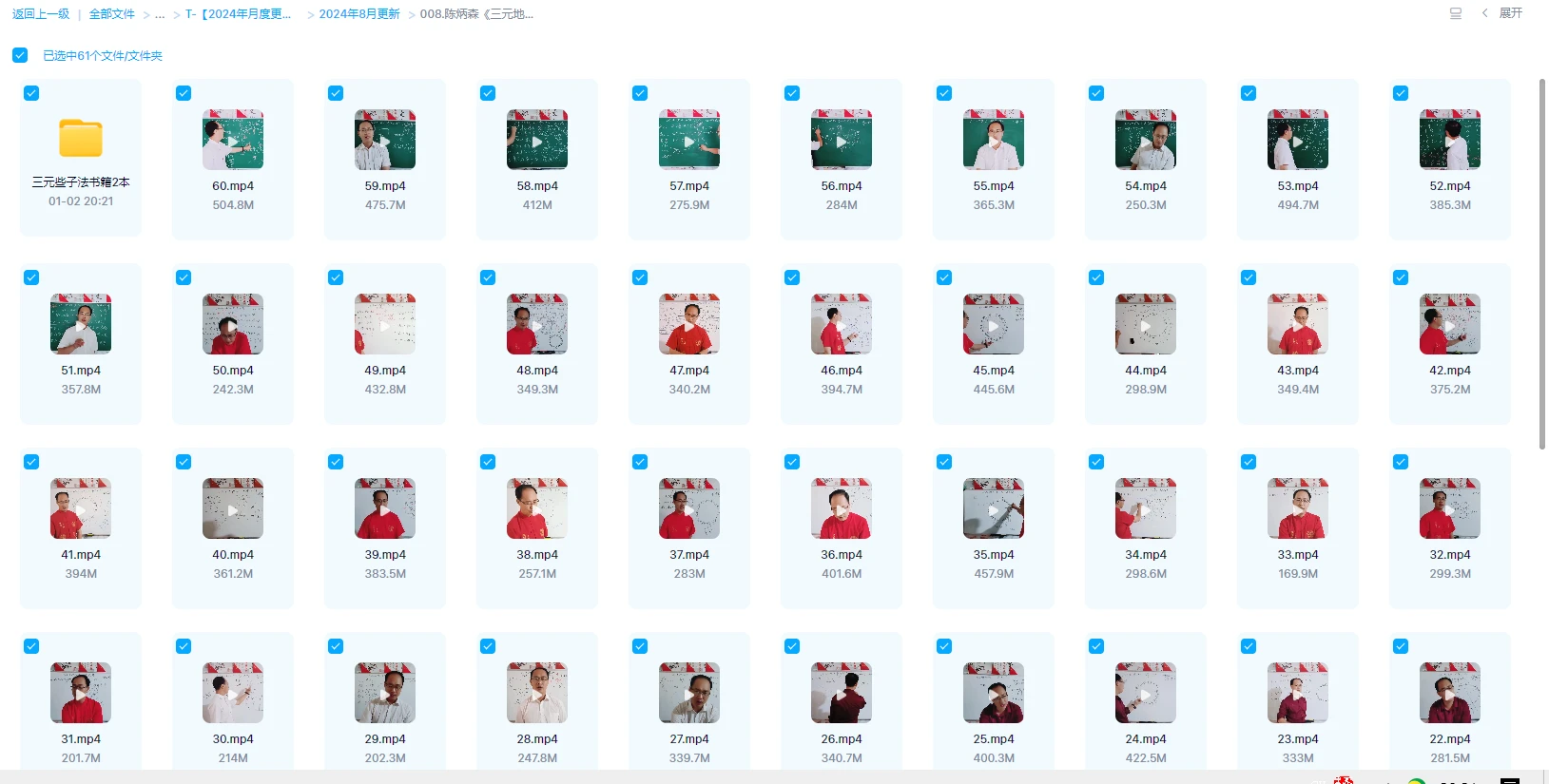
Chen Bingsen’s San He course is listed as 66 MP4 videos, with a source-reported total size of 15.6 GB. Its curriculum includes the four elemental configurations, landform assessment, compass divisions, orientation and traditional water-method terminology. The original recordings are Chinese-language; this English guide is not a translated audio track.
This series is separate from the same instructor’s San Yuan Xie Zi Fa course. The curriculum below translates all 66 recorded file entries in their displayed order. Some entries have split numbering or no descriptive subtitle, so their names are retained without inventing missing content or presenting them as a newly numbered 66-stage syllabus.
Recorded Course Directory: 66 Video Entries
- Traditional San He 48 Configurations
- Traditional San He 48 Configurations: Fire Configuration
- San He Summary and Chen Bingsen Practice Reflections
- San He Landforms
- Jiu Pin Water Method Explanation, Part 1 [traditional title]
- Jiu Pin Water Method Explanation, Part 2 [traditional title]
- Jiu Pin Water Method Explanation, Part 3 [traditional title]
- Jiu Pin Water Method Explanation, Part 4 [traditional title]
- Lesson 01: Fire Configuration
- Lesson 02: Water Configuration
- Lesson 03: Metal Configuration
- Lesson 04: Wood Configuration
- Lesson 05: Combined-Facing Rules
- Lesson 06: Facing Directions That Cannot Be Combined
- Lesson 07: No Further Subtitle Listed
- Lesson 08: Ten Essentials of Dragon Methods
- Lesson 09: Ming Tang
- Lesson 10: Mountain-Dragon Entry and Form Identification
- Lesson 11: Introduction to Ten Essentials of Dragon Methods
- Lesson 12: Detailed Landform Explanation
- Lesson 13: Locating the Xue Site
- Lesson 14: Detailed Landform Explanation
- Lesson 15: Ren Pan Central Needle and Sha Assessment
- Lesson 16: Orientation and Fen Jin Rules and Applications
- Lesson 17: Fifty-Two Fen Jin Lines
- Lesson 18: Tian Pan, Di Pan and Ren Pan
- Lesson 19: Seventy-Two Chuan Shan Dragons and Fen Jin
- Lesson 20: Sixty Tou Di Dragons
- Lesson 21: Summary of 120 Fen Jin Divisions
- Lesson 22-1: Xu Sitting and Chen Facing Water Method
- Lesson 22-2: Yi Sitting and Xin Facing Water Method
- Lesson 23: No Further Subtitle Listed
- Lesson 24: No Further Subtitle Listed
- Lesson 25: Coordinating Dragon and Water in the Four Configurations
- Lesson 26: Water Configuration Orientation
- Lesson 27: Metal Configuration Orientation
- Lesson 28: Wood Configuration Dragon, Water and Orientation
- Lesson 29: Four-Configuration Water and Orientation Formulas
- Lesson 30: No Further Subtitle Listed
- Lesson 31: Jue Facing and Jue Exit Water Method
- Lesson 32: Jue, Tai and Mu Orientation and Flow Terms
- Lesson 33: Variations of the Four Configurations
- Lesson 34: Yi-Bing Combination and Xu Orientation
- Lesson 35: Metal and Wood Configuration Coordination
- Lesson 36: Detailed Jiu Pin Water Method
- Lesson 37: Da Huang Quan and Si Ku Huang Quan Water Terms
- Lesson 38: San He Water-Method Mnemonics
- Lesson 39: Luopan Orientation Methods
- Lesson 40: Four Configurations and Twelve Growth Stages
- Lesson 41: Facing Five-Element Interpretation
- Lesson 42: Nine-Palace Water Method and Yuan Guan Tong Qiao
- Lesson 43: Bai Hu and Earthly-Branch Huang Quan Methods
- Lesson 44: Eight-Route and Four-Route Huang Quan
- Lesson 45: Forty-Eight Orientations in the Four Configurations
- Lesson 46: Thirty-Four Water Forms
- Lesson 47: Practical Experience Sharing
- Lesson 48: Thirty-Six Burial Methods
- Lesson 49: Yang Gong Nine-Star Site Methods
- Lesson 50: Site Location and Alignment
- Lesson 51: Landforms and Form Sha
- Additional Lesson Nine: Dragon and Sha Assessment, Opening and Gorge Passages
- Huang Quan Water Explanation, Part 1
- Huang Quan Water Explanation, Part 2
- Huang Quan Water Explanation, Part 3
- Huang Quan Water Explanation, Part 4
- Wu Gui Yun Cai Arrangement, Part 2 [traditional title]
Traditional labels are translated for identification, not as guarantees of wealth, health or a specific outcome. Where a filename has no further subtitle, that limitation is stated explicitly.
This Chen Bingsen course is explicitly devoted to San He Feng Shui and is listed as 66 videos. It is separate from his San Yuan Xie Zi Fa series, which is linked as a related resource rather than merged into this product.
Course Overview
Chen Bingsen San He Feng Shui: 66 Videos is a digital study resource in the San He Feng Shui collection. This English product guide explains the listed material; the original recordings and documents are in Chinese. English subtitles or translated full lessons are not included unless separately stated.
Course Contents and Learning Focus
- San He course-specific terminology
- The 66-video recorded series
- Original instructional previews
- Keeping San He and San Yuan reasoning distinct
What You Will Learn
Use the listed topics to identify the scope of this resource, follow its recorded sequence and compare the original diagrams with your study notes. Where individual lesson names are not supplied, the preview images are provided instead of an invented syllabus.
Original Course Previews


Who This Course Is For
For learners who can follow Chinese-language material and want to study San He Feng Shui. Check the format and previews before buying. Intermediate or continuation courses assume familiarity with the relevant foundations and do not imply that prerequisite courses are included.
Learning Format and Digital Delivery
Format: 66 recorded video lessons. Price: USD 9.00. This is a virtual, downloadable product; no physical shipment is required. The download link has not yet been attached to this listing and will be added by the store. Contact us before ordering if you need to confirm delivery timing; immediate automatic file access is not promised.
Frequently Asked Questions
Is the course taught in English?
No English-language recording or subtitle track is confirmed. This description is in English; the underlying course material is Chinese.
What is included?
66 recorded video lessons. Review the course contents and original previews for the stated scope.
Will a physical item be shipped?
No. This is a digital learning resource.
Is a certificate or personal consultation included?
No certificate, accreditation or individual consultation is promised by this listing.
Editorial Note and Disclaimer
Karma Kismet has organized the course listing and available directory into this English guide. Lesson counts refer to the supplied listing, not an independent review of every recording. For traditional and cultural study, not guaranteed predictions, financial advice or assured personal outcomes.
Related Courses
- Yi Qinglan Form School Feng Shui: 45 Video Lessons
- Teacher Liu Yuan Xing Form School Feng Shui: 56 Videos
- Qingyuan Eight Mansions Feng Shui: 12 Lessons
- Huo Yixun Eight Mansions Feng Shui: 10 Videos
- Wang Yajun San He Feng Shui: 47 Videos
- Chen Bingsen San Yuan Xie Zi Fa: 60 Videos
Browse San He Feng Shui, review course and delivery questions, or learn about Karma Kismet.
A detailed route through Chen Bingsen’s San He material
This 66-video listing belongs to the San He Feng Shui category. Its source directory provides more than a general label: it names four phase groups, classical grid descriptions, landform, compass plates, orientation and several water-method topics. That breadth makes the series suitable for careful comparison of terms across lessons. It also makes selective viewing risky. A phrase introduced in an early explanation may carry an important condition when it reappears much later.
The directory includes sections labeled fire, water, metal and wood groups. It also names the relationship among landform, water and the chosen facing direction. These are elements of a traditional interpretive framework. They should be read as the course’s subject matter, rather than as tested claims that an arrangement will alter a person’s circumstances. The original previews can help a learner track what a speaker points to, but a still image may omit the verbal conditions attached to it.
Start with the categories the directory actually names
An effective first pass is to map the titles into a few clusters without rewriting them into an invented syllabus. One cluster concerns the four groups and their orientation language. Another concerns visible terrain, including the approach of a landform, an open area and a selected point. A third concerns compass terms such as the earth, human and heaven plates and various divisions. Water-method titles form another cluster. The source also lists reflective or experience-based segments. This map is a study aid, not a claim about the order or completeness of any lesson.
The entry on the classical 48 patterns is worth treating as a vocabulary exercise. Write down the exact Chinese term, the English rendering you choose and the diagram or example that supports your note. If the series gives several names for similar-looking arrangements, do not collapse them merely because the translations sound alike. The distinction may depend on direction, an assumed reference point or another rule stated in the recording.
Landform and orientation in the same example
Several titles address longtou, the open space often called mingtang, and the identification of landform. Others address choosing direction and degrees of subdivision on a compass. A learner can ask three separate questions of each example: What is visibly drawn or described? What coordinate or compass language is being applied? What judgment does the speaker then make within the tradition? Keeping those questions separate makes it easier to understand the reasoning without treating the resulting judgment as a verified fact about a site.
The directory’s compass discussions include the three plates and multiple fine divisions. Those terms can be challenging even for readers familiar with a simple north arrow. Pause at each diagram and mark the reference line before recording any named direction. If you cannot identify the reference line from the supplied view, leave the measurement unresolved. Guessing a direction to complete a neat set of notes can hide the exact point at which understanding broke down.
A title about compatible and incompatible orientations invites close reading. It is tempting to turn it into a quick checklist. First determine which definitions and conditions the lesson uses. Then compare it with the later discussion of landform and water. The record of a traditional rule is useful for understanding the school; it is not a substitute for an architect’s, surveyor’s or other qualified professional’s assessment when a real property decision is involved.
How to study the water-method sections
The listed water-method material uses names that may sound dramatic in translation. Record those names faithfully as historical terminology, while avoiding literal claims about danger or benefit. Trace the direction or pathway shown in an example, note the stated orientation and identify which of the four groups the speaker is discussing. A simple drawing of the relationship can be more informative than memorizing a phrase alone.
- Make one page for the vocabulary shared across water-method lessons.
- Add a separate page for each named group, leaving space for exceptions and variations.
- Copy the example’s visible geometry before adding its traditional interpretation.
- Mark unclear labels as questions to revisit rather than supplying an answer from another school.
- After finishing a cluster, explain one example aloud using only terms you can define.
This process is especially useful with a long series because it exposes gaps in your notes while the relevant recording is still easy to locate. It also limits confusion between a water feature shown in a diagram and a broad claim about personal outcomes.
Using the 66 videos responsibly
Chen Bingsen’s San He collection is listed separately from his San Yuan Xie Zi Fa series. The distinction matters when a learner searches for a technique by name. Do not assume that a topic from the San Yuan package is contained in these 66 recordings, or that a similar word has the same role in both. If comparing the two collections, cite the particular lesson and school in your notes.
The source directory mentions practical examples and experience. Examples show how a teacher presents a method; they do not establish general reliability. For a contemporary home or workplace, basic observations about maintenance, light, ventilation, drainage and accessibility have their own evidence and practical importance. This course can be studied as a cultural and intellectual tradition while those ordinary concerns are handled on their own terms.
The material may suit learners who can follow Chinese recordings and already have, or are willing to build, a glossary of traditional directional terms. A reader seeking a quick answer for a purchase or renovation may find the amount of terminology demanding. There is also no reason to infer a credential, a consultation or a validated predictive method from the fact that the listing contains 66 videos.
Questions specific to this San He series
Does the classical 48-pattern title mean there are 48 separate lessons?
No such count follows from the title. It identifies a subject named in the directory. The product’s stated format is a 66-video series.
Are the three compass plates interchangeable?
The directory treats earth, human and heaven plates as distinct topics. Learn the function assigned to each in the recording before using a label from one in a note about another.
Can I combine the San He and San Yuan collections into one set of rules?
You can compare them as traditions, but preserve their names and assumptions. Similar terminology alone does not establish that two methods use an identical rule.
What should I do with a dramatic name in a water-method lesson?
Write it as traditional terminology and look at the definition and diagram provided. Avoid reading the name as evidence of a real-world threat or a promised result.