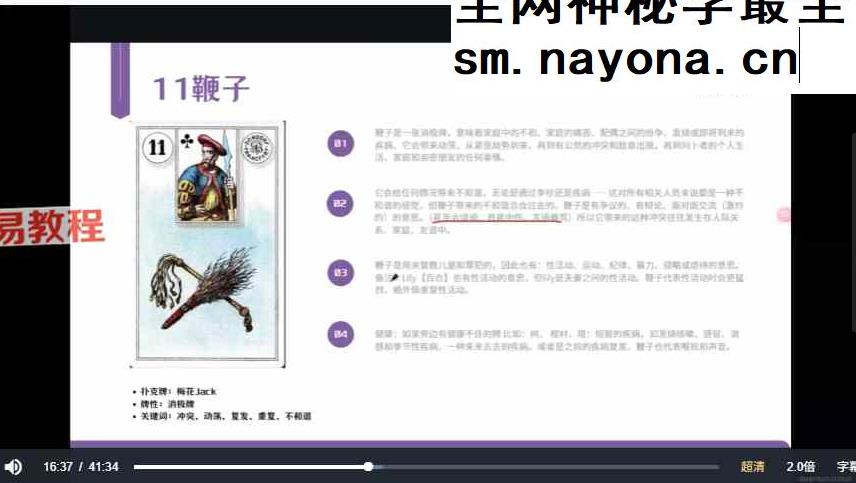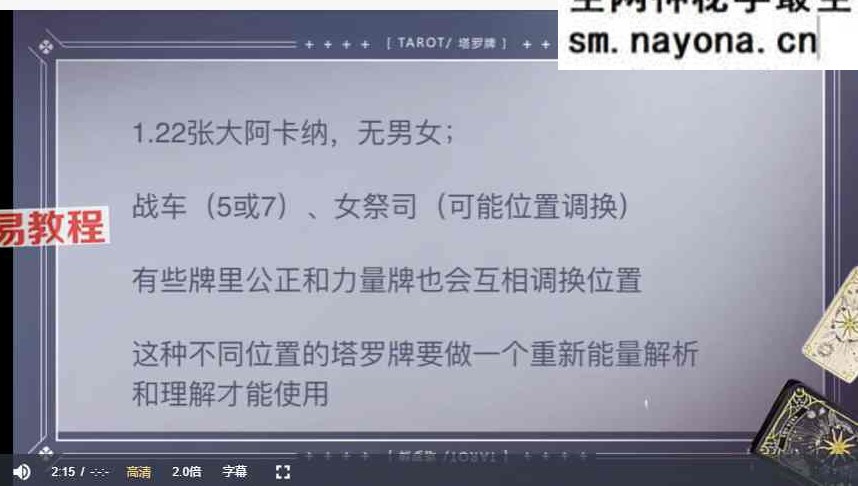
A 25-video card-meaning series for the Cat Six Tarot deck. The source identifies the deck and lesson count but does not provide a complete verified file-by-file directory; this listing avoids promising coverage beyond the named card-meaning subject.
Course Overview
Cat Six Tarot Card Meanings: 25 Video Lessons is a digital learning resource about Tarot Card Meanings. The English description summarizes the available course listing; the recordings themselves are in Chinese. English narration or subtitles are not confirmed.
What You Will Learn
Use the sequence and preview material below to identify the course’s scope, terminology and teaching approach. Compare each card interpretation with the original lesson rather than treating a short listing as a complete transcript.
Course Contents
- Cat Six Tarot deck as the named teaching resource
- Card meanings and symbolic interpretation
- Applying card themes to example questions
- What the available listing does and does not confirm
Original Course Images

Who This Course Is For
This resource is for learners who can follow Chinese-language video teaching and want a named course on Tarot Card Meanings. Beginners should compare the stated lesson scope; a fixed level of prior experience is not assumed unless the source directory says so.
Learning Format and Digital Delivery
25 Chinese-language video lessons Virtual and downloadable; there is no physical shipment. Price: USD 9.00. A file link is not yet attached to this product. Please contact Karma Kismet before ordering to confirm delivery arrangements; immediate automated access is not promised.
Frequently Asked Questions
Are the videos in English?
No English recording or subtitles are confirmed. The original video lessons are Chinese-language material.
Is a personal reading included?
No individual consultation is listed with this course.
Does the course guarantee an outcome?
No. Tarot study is interpretive and educational, not a guaranteed prediction or substitute for professional advice.
Editorial Note
Karma Kismet translated and organized the course facts and original previews for English readers. Lesson counts and formats follow the available source listing; unspecified contents, certificates and instructor credentials are not asserted.
Related Courses
- Shen Xingyu Tarot for Beginners: 12 Video Lessons
- Cai Cai Tarot from Zero: 27-Lesson Video Course
- Huan Tarot Card Meanings: 42 Video Lessons
Browse Tarot Card Meanings and read digital delivery information.
Reading context and study practice
The available listing names the Cat Six Tarot deck and twenty-five card-meaning videos but does not provide a fully verified file-by-file directory. Deck-specific study should therefore focus on the images and explanations actually shown. The lesson count should not be used to infer complete coverage or an exact one-card-per-video sequence.
Identify the deck before comparing
Begin by confirming the deck shown in the recording and the card title used by the teacher. A deck-specific image may resemble a familiar tarot theme while changing important visual details. Do not assume that an interpretation from another deck transfers unchanged. Record the visible image and the explanation given in this material before comparing it with an external reference. This keeps the Cat Six subject distinct rather than using the course name as a label for generic notes. The listing names the deck, but it does not establish a complete account of every edition or related product.
Observation and interpretation
Write a short observation of a card image before attaching symbolic meanings. Describe what is actually visible: figures, objects, direction, setting, or repeated shapes. Then record the teacher’s explanation separately. This separation helps you see when an interpretation rests on the image and when it rests on a broader tarot convention. Do not invent an image feature because it would support a preferred story. A descriptive note can be checked directly against the recording, while an interpretive note remains a symbolic association. Both can be useful when their different roles are made clear.
Card titles and translations
Chinese teaching may use a card title whose English rendering varies between references. Preserve the original term when possible and identify the card shown. Do not let a translation choice introduce a new meaning that the teacher did not discuss. If the image is unclear, mark the identity as uncertain instead of assigning a familiar card based on a partial phrase. A bilingual card index can help navigate the material without implying that the recordings include English narration or subtitles. Translation notes are the learner’s aid; the available listing does not confirm a full translated edition of the course.
Meanings in a question
A card meaning becomes more specific when placed within an actual question. Record that question alongside the explanation. The same symbolic theme may be expressed differently in an example about planning, communication, or a relationship. This does not mean the card has supplied factual information about those areas. It shows how an interpretive framework is being applied. If you create your own exercise, keep it ordinary and fictional so that you can examine the procedure without making a claim about a real person. The exercise should remain distinct from examples actually taught in the twenty-five recordings.
Comparing a deck image with a familiar reference
If you already know another tarot deck, compare one identified card under three headings: shared theme, visual difference, and difference in the recorded explanation. Avoid treating the familiar deck as the unquestioned standard. A variation may be an artistic choice or a different interpretive emphasis. At the same time, do not claim that every difference has a special meaning unless the course explains it. A careful comparison respects the named deck’s imagery and the limits of the available source. It is an educational exercise in reading symbols, not evidence that one deck is more accurate.
Examples without invented coverage
The source article describes meanings and application examples in broad terms. That does not confirm which cards appear in every lesson. Build a verified index from the actual recordings, adding the card names and references as you encounter them. Leave unanswered entries blank. Do not promise coverage of all cards, reversals, advanced spreads, or a particular tradition solely because the article sounds comprehensive. The resource can still be valuable for its named subject without being expanded into an imagined curriculum. Accurate scope helps a learner decide what this series contributes to an existing study path.
From image details to sentences
When forming an interpretation, show which image detail or taught meaning supports the sentence. A phrase about movement should identify the feature or convention that led to it. A phrase about relationships should explain its connection to the question rather than assume that every figure represents a partner. This makes the interpretation easier to review. If you cannot supply the link, label the sentence as your own association. The aim is not to eliminate imagination but to distinguish imagination from instruction. Neither should be presented as verified access to someone’s thoughts or future circumstances.
Handling challenging cards
A card with a difficult image or name should not be used to frighten someone. Study how the teacher explains the symbolism and what context qualifies it. Avoid literal predictions of injury, loss, death, betrayal, or illness. Those are external claims that a card image cannot establish. A cautious educational note can discuss change, conflict, uncertainty, or limits as themes while leaving real circumstances open. If an example involves distress, the symbolic discussion should remain separate from clinical or therapeutic claims. The course is presented as cultural study and does not replace appropriate professional help.
A deck-specific notebook
Organize the notebook around verified cards rather than assumed lesson coverage. Each entry can include the card title, a description of the Cat Six image, the recorded interpretation, a question context, and a comparison note. Add a reference so the original explanation can be revisited. This personal notebook is not a file guaranteed by the listing. Its advantage is that it preserves the deck’s own teaching context while making uncertainty visible. When a new explanation conflicts with an earlier one, compare their questions and image details before deciding whether the difference is a mistake or a contextual variation.
What completion can mean here
Finishing the available recordings can mean that you have reviewed the named series and made a clearer index of its card meanings. It does not guarantee professional readiness, intuitive ability, accurate forecasts, or certification. A realistic review asks which cards you can identify, which explanations you can summarize faithfully, and which questions remain about the source’s scope. The available page confirms a Chinese-language card-meaning resource associated with the Cat Six deck. Other formats, supplementary files, personal feedback, or services should be verified separately rather than inferred from the lesson count or from promotional language in the source article.