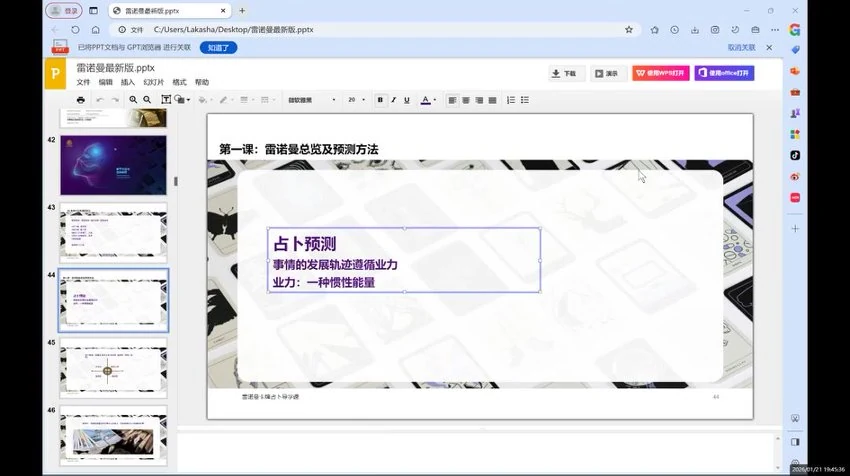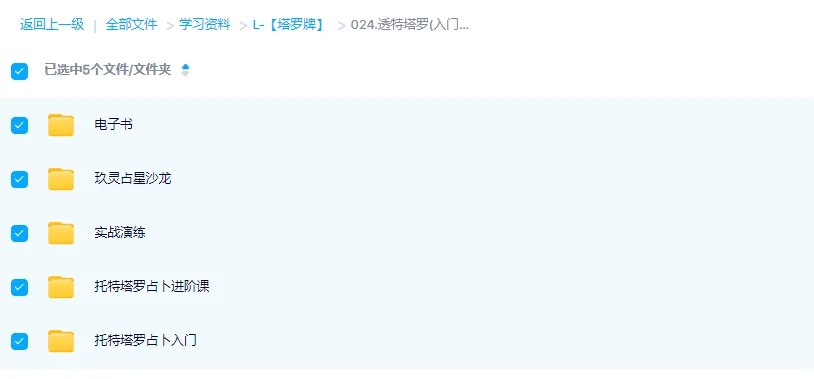
Huan's card-meaning course focuses on how individual card themes contribute to an interpretation. The source identifies 42 video lessons but does not provide a complete numbered lesson directory, so no card-by-card coverage is promised here.
Course Overview
Huan Tarot Card Meanings: 42 Video Lessons is a digital learning resource about Tarot Card Meanings. The English description summarizes the available course listing; the recordings themselves are in Chinese. English narration or subtitles are not confirmed.
What You Will Learn
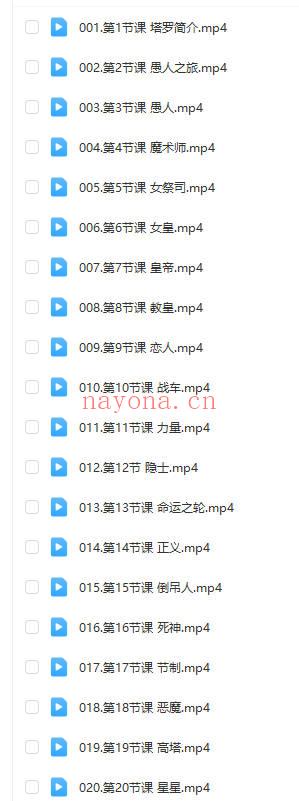
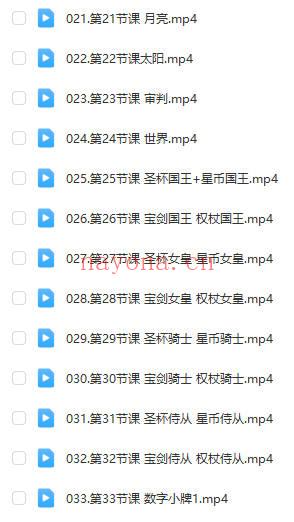
Use the sequence and preview material below to identify the course’s scope, terminology and teaching approach. Compare each card interpretation with the original lesson rather than treating a short listing as a complete transcript.
Course Contents
- Core themes of individual tarot cards
- Interpreting imagery without memorizing a fixed phrase list
- Consistency in a personal card-meaning framework
- Limits of the available source syllabus
Original Course Images


Who This Course Is For
This resource is for learners who can follow Chinese-language video teaching and want a named course on Tarot Card Meanings. Beginners should compare the stated lesson scope; a fixed level of prior experience is not assumed unless the source directory says so.
Learning Format and Digital Delivery
42 Chinese-language video lessons Virtual and downloadable; there is no physical shipment. Price: USD 9.00. A file link is not yet attached to this product. Please contact Karma Kismet before ordering to confirm delivery arrangements; immediate automated access is not promised.
Frequently Asked Questions
Are the videos in English?
No English recording or subtitles are confirmed. The original video lessons are Chinese-language material.
Is a personal reading included?
No individual consultation is listed with this course.
Does the course guarantee an outcome?
No. Tarot study is interpretive and educational, not a guaranteed prediction or substitute for professional advice.
Editorial Note
Karma Kismet translated and organized the course facts and original previews for English readers. Lesson counts and formats follow the available source listing; unspecified contents, certificates and instructor credentials are not asserted.
Related Courses
- Shen Xingyu Tarot for Beginners: 12 Video Lessons
- Cai Cai Tarot from Zero: 27-Lesson Video Course
- Cat Six Tarot Card Meanings: 25 Video Lessons
Browse Tarot Card Meanings and read digital delivery information.
Reading context and study practice
The source identifies Huan’s forty-two-video card-meaning course and emphasizes developing a coherent personal understanding of meanings rather than merely stacking memorized phrases. The available description does not establish a verified card-by-card file directory. The following guidance explores that stated interpretive emphasis without inventing the coverage of individual recordings.
A meaning database with references
The source asks whether the reader has an understood and personally coherent collection of card meanings. A useful study database can begin with the actual explanations in the recordings. For each entry, preserve the card name, the source reference, the central theme, a contextual example, and any qualification. Keep your own association in a separate field. This prevents the database from becoming an undifferentiated list of copied phrases. It also shows that coherence is a writing and organizational quality. A neatly arranged database does not prove that a tarot interpretation predicts events or describes another person’s private thoughts accurately.
Stable themes and varied applications
The source distinguishes a relatively stable card theme from the many meanings it may receive in context. Study that distinction carefully. A stable theme can provide continuity across examples, while the question and position shape the wording of a particular reading. Do not treat contextual flexibility as permission to make any story fit. Record why one application was chosen and what would support an alternative. If the reasoning is not visible, mark the interpretation as an association rather than a demonstrated rule. This keeps flexibility accountable and makes it easier to compare the teacher’s approach with your own understanding.
When teachers disagree
The description acknowledges that different teachers may explain the same card in apparently contradictory ways. Before deciding that one is wrong, compare their deck references, questions, spread positions, and definitions. They may be using different conventions or discussing different contexts. If the disagreement remains, preserve it in your notes. Do not create a forced compromise that neither source actually teaches. Comparing interpretations can reveal how tarot vocabulary is constructed. It does not require believing that all explanations are equally reliable or that the most confident teacher has supplied a factual answer about a real person.
Intuition as an association
The source emphasizes intuitive awareness, but intuition should be described modestly in an educational summary. A spontaneous association can suggest a line of reflection; it is not evidence that hidden information has been detected. When an image prompts an idea, record the image feature and the idea separately. Then ask whether the idea relates to the stated question and position. This gives intuitive language a traceable place in the reading. It also prevents a learner from treating a strong feeling as a reason to make claims about illness, loyalty, financial outcomes, or someone else’s intentions.
Avoiding keyword assembly
A reading made by joining several unrelated keywords may sound detailed without explaining the spread. To review it, underline the card, position, and question reference in each sentence. If a phrase has none, ask whether it contributes anything beyond atmosphere. Replace the vague phrase with a specific link or leave it out. The source’s criticism of mere assembly can therefore become a practical editing exercise. A coherent interpretation shows why these meanings were used together. It does not become valid simply by being longer or more emotionally persuasive than a short list of card definitions.
Building an example archive
Keep examples organized by card and question type, but retain the original question rather than reducing it to a broad label such as love or career. A card used in a question about communication may have a different narrative role from the same card in a question about planning. Label fictional examples clearly. If a teaching case contains private details, summarize only the information needed for the interpretive point. An archive is most useful when it helps reconstruct the procedure. It should not become a collection of impressive stories presented as proof of predictive power.
Confidence and correction
The source asks how a reader reacts when an interpretation seems unsuccessful or when another teacher’s vocabulary creates doubt. A constructive response is to review the input, question, position, and reasoning rather than defend the interpretation at all costs. Identify what was actually said before the outcome was known. If a statement was too broad, acknowledge that breadth. If a rule was misapplied, correct the rule. Confidence can come from clear understanding and willingness to revise; it does not require treating every reading as accurate or blaming the person when the narrative does not fit.
What the lesson count confirms
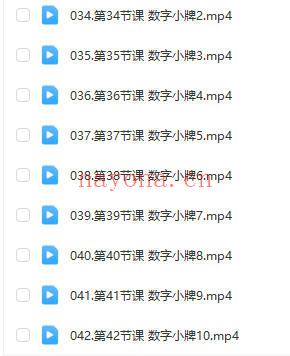
Forty-two videos is a listed format fact. It does not by itself confirm one recording per card, complete coverage of every tarot tradition, or a fixed progression from beginner to professional. Create a lesson map only after checking the recordings. If the source does not identify the content of a particular video, leave the entry open until you can verify it. This preserves the distinction between the page’s card-meaning subject and an invented curriculum. The English guide can clarify the available facts while recognizing that the underlying teaching is Chinese-language and that full English translation is not confirmed.
Language for uncertain readings
Use language that accurately represents the status of an interpretation. A sentence can say that a card suggests a theme within the chosen convention or prompts a question about a situation. It should not declare an absent person’s motives or guarantee a future result. Avoid using symbolic difficulty as a diagnosis or as an instruction to make a major decision. The course can be studied for its approach to meaning, context, and intuition without adding therapeutic claims. Clear uncertainty helps the reader understand what the interpretation contributes and what must still be learned through ordinary evidence and communication.
A coherent final entry
A finished card entry might include the stated theme, the image or rule supporting it, two contextual applications, and a note about when the explanation should not be transferred. Those applications should be drawn from verified lessons or clearly labeled personal exercises. Add a question if a conflicting source uses a different definition. This creates a reference that is useful precisely because its limits are visible. The purpose is to understand Huan’s named card-meaning approach, not to claim that the course supplies a certified qualification, individualized consultation, downloadable database template, or guaranteed interpretive results.