A mixed Thoth Tarot foundation, advanced and practice collection with 23 listed videos and three e-books. The source directory includes replay lessons and named reference texts; the exact contents should be checked against the supplied list.
Resource Overview
Thoth Tarot Practice Collection: 23 Videos and Three E-Books is a digital learning resource about Tarot Case Studies. The English description summarizes the available source listing; the underlying recordings or books are in Chinese. An English translation of the full material is not confirmed.
What You Will Learn
Use the sequence and preview material below to identify the course’s scope, terminology and teaching approach. Compare each card interpretation with the original lesson rather than treating a short listing as a complete transcript.
Course Contents
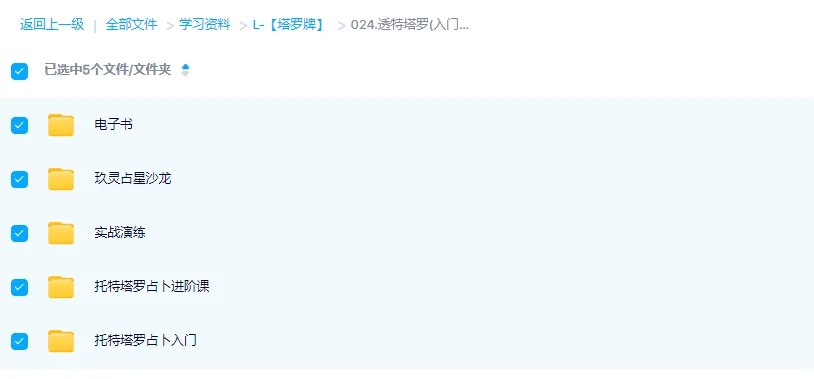
- Thoth Tarot foundation and advanced study
- Practice and replay lesson sequence
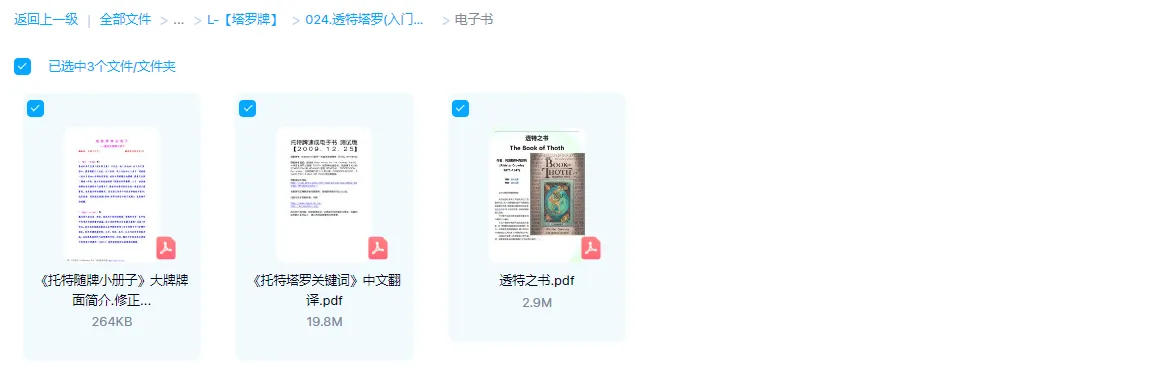
- Three listed e-books as reference material
- Distinguishing Thoth terminology from other deck traditions
Original Course Images
Who This Resource Is For
This resource is for readers or learners who can use Chinese-language materials and want a named resource on Tarot Case Studies. Compare the stated scope and previews before ordering; a fixed level of prior experience is not assumed unless the source directory says so.
Learning Format and Digital Delivery
The source lists 23 Chinese-language videos and three Chinese-language e-books Virtual and downloadable; there is no physical shipment. Price: USD 9.00. A file link is not yet attached to this product. Please contact Karma Kismet before ordering to confirm delivery arrangements; immediate automated access is not promised.
Frequently Asked Questions
Is the full material in English?
No English edition, recording or subtitle track is confirmed. The source material is Chinese-language.
Is a personal consultation included?
No individual consultation is listed with this resource.
Does this resource guarantee an outcome?
No. It is for educational and cultural study, not a guaranteed result or substitute for professional advice.
Editorial Note
Karma Kismet translated and organized the course facts and original previews for English readers. Lesson counts and formats follow the available source listing; unspecified contents, certificates and instructor credentials are not asserted.
Related Courses
- Long Nu Tarot Spreads and Reading Examples: 15 Videos
- Green Tarot Spread Methods: 10 Video Lessons
- Star Heart Tarot Practical Reading Class: 21 Videos
- Mindful Tarot Advanced Camp: Relationship and Career Spreads
- Latte Relationship Tarot Special Course
- Chen Qingqing Tarot Consultation Training: 122 Videos
- Gui Gui Tarot Training Camp, Fifth Cohort: 61 Videos
- Ya Ta 2026 Lenormand System Course: Nine Videos
- Ju Zi Complete Lenormand Course: 19 Videos
- Osho Zen Tarot Card Practice: 20 Videos
- Oracle Card Growth Series: 19 Videos
Browse Tarot Case Studies and read digital delivery information.
Reading the Thoth collection as a connected set
The distinguishing feature of this collection is its combination of recorded study and written reference material. The source directory separates introductory Thoth recordings, advanced replay sessions, practice demonstrations and an astrology salon. It also lists three electronic books. That arrangement matters more than the total number alone: a learner can encounter terminology in a recording, consult a written reference and then observe how the same vocabulary is used in a spread. The description does not establish that every recording follows one continuous syllabus, so it is sensible to treat the folders as related resources rather than interchangeable chapters.
The practice filenames provide more detail than a broad claim of beginner and advanced instruction. They name background and learning attitude, introductory astrological knowledge, groups of major cards, numbered minor cards, court cards and two parts of spread interpretation. These are directory labels, not a transcript of everything the instructor says. They support a practical distinction between learning the components of the deck and watching those components interpreted together. Someone mainly looking for examples should still identify the vocabulary used in the foundation material before borrowing an interpretation from a later recording.
Keeping Thoth terminology consistent
A useful first notebook page is a deck vocabulary map. Write the printed name of a card, the Chinese term used in the recording, the English wording used in the reference book and a short description of the visible image. Leave room for differences rather than forcing every term into a familiar equivalent from another deck. A change of name may carry a change of emphasis. Even when two decks share an apparent counterpart, their imagery and interpretive conventions should be compared directly rather than assumed to be identical.
The source specifically divides court-card practice into Knight and Queen material and Prince and Princess material. Preserve those labels while following the recording. Replacing them automatically with another deck's ranks can obscure the explanation. For personal study, first describe what a court figure is doing and how the lesson connects that image to a role, attitude or relationship. Then note whether the interpretation is tied to the question or presented as a general association. Neither a court title nor a visual resemblance establishes facts about an actual person's character.
Using the three books alongside video
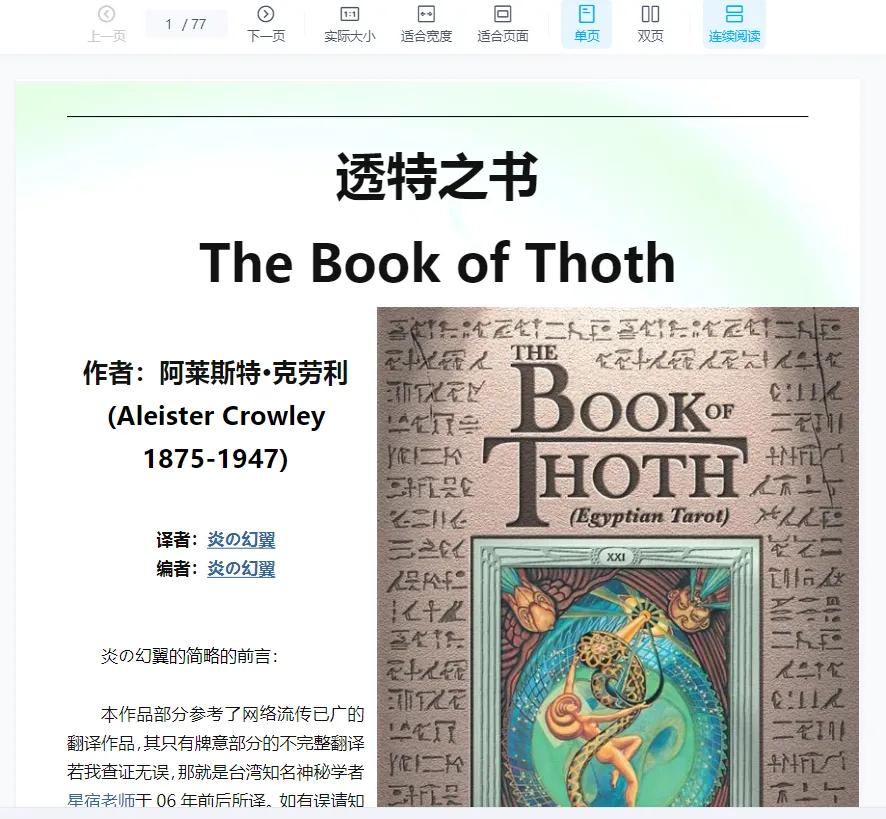
The listed written resources include a short major-card reference, a Thoth book and a Chinese keyword translation. Their filenames make them potentially useful reference points, but filenames alone do not verify editions, translators or completeness. Before relying on a passage, check the title page and any available publication information in the supplied file. Keep the page number in your notes. A keyword list and a longer explanation serve different purposes: the first can support recall, while the second may provide reasoning and context that a single word omits.
After watching one card discussion, try writing its explanation without looking at the keyword document. Return to the document afterward and mark which words you understood and which you simply recognized. This makes the reference a checking tool rather than a substitute for observation. If the recording and a book appear to disagree, record both positions with their locations. The difference may concern translation, interpretive emphasis or a separate teaching tradition. It is more useful to identify that difference clearly than to erase it in pursuit of one universal definition.
From numbered cards to a whole reading
The practice directory separates lower numbered minor cards from later numbered cards. That suggests a manageable way to organize independent review, without claiming a particular lesson sequence beyond the files. Compare two cards within one suit before comparing the same number across suits. Describe shared visual features, differences in arrangement and the language used by the teacher. A structured comparison prevents a learner from collecting disconnected phrases that become difficult to use once several cards appear together.
For a spread exercise, record the question and each position before adding interpretations. Choose a low-stakes reflective topic, such as how to prepare for a study session. Explain each card in relation to its assigned position, then write a separate paragraph about the relationship between cards. If your conclusion could have been written without looking at any card, return to the images and specify what actually informed it. This exercise is an editorial study suggestion, not an additional included lesson or evidence that a spread can predict an outcome.
Placing the astrology salon in context
The three listed astrology-salon replays broaden the collection beyond card-by-card instruction. They should not be mistaken for a complete independent astrology qualification. Where astrological terms occur in a Thoth discussion, note the exact term and its role in that explanation. Separate a symbolic correspondence from a statement about astronomical position and from a claim about personal events. These are different kinds of statement, even when a speaker moves between them quickly. The ability to identify the difference is useful when comparing written material with a recorded demonstration.
A learner unfamiliar with astrology can maintain a small glossary rather than interrupting every recording to research an entire system. Add terms only when they recur or affect the reading being discussed. Include the timestamp and a question for later review. This keeps the immediate task focused: understanding the collection's use of Thoth symbolism. It also avoids presenting an isolated correspondence as a universal rule across every Tarot school or importing an unrelated interpretation simply because the vocabulary sounds similar.
A realistic way to review progress
After a few sessions, select one previously studied card and one short spread. Explain the card in your own words, identify the source of your explanation and describe one alternative interpretation. For the spread, distinguish the visible arrangement from your personal response to it. Progress is easier to assess through clearer reasoning and more accurate references than through claims of certainty. A recorded example may be engaging without proving the reliability of its conclusion, particularly when the surrounding circumstances are unknown.
This collection is most relevant to someone who wants to compare foundation explanations, practice recordings and Chinese written references within the same Thoth-focused study project. Its mixed structure rewards careful indexing. Keep the original filenames, label replay material accurately and record which book supported a particular note. The result can be a useful personal reference library while remaining honest about the limits of a product directory. Digital files do not by themselves establish live supervision, personal feedback or an English-language edition of the underlying instruction.