Ju Zi's Lenormand course is listed as 19 videos. The published file list names numbered lessons, including split parts, rather than a full English syllabus; this guide keeps the stated scope precise.
Resource Overview
Ju Zi Complete Lenormand Course: 19 Videos is a digital learning resource about Lenormand Studies. The English description summarizes the available source listing; the underlying recordings or books are in Chinese. An English translation of the full material is not confirmed.
What You Will Learn
Use the sequence and preview material below to identify the course’s scope, terminology and teaching approach. Compare each card interpretation with the original lesson rather than treating a short listing as a complete transcript.
Course Contents
- Lenormand as a distinct card system
- Sequential video lessons and split parts
- Card combination practice
- Limits of the available public syllabus
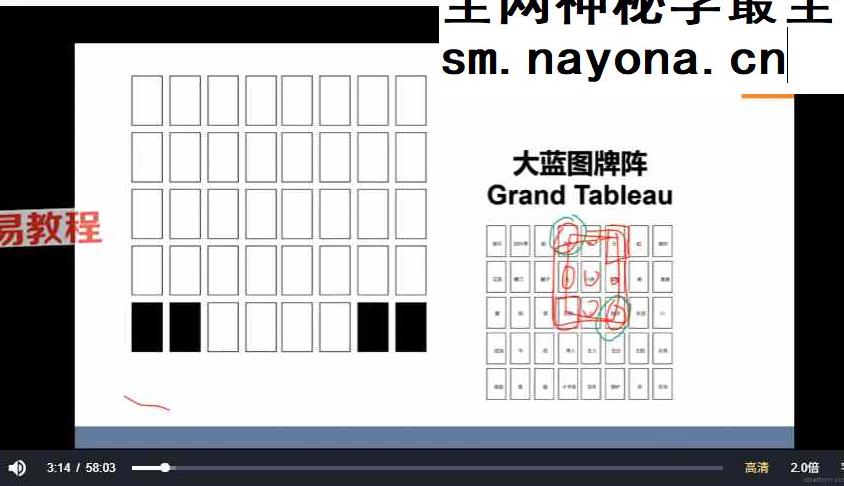
Original Course Images
Who This Resource Is For
This resource is for readers or learners who can use Chinese-language materials and want a named resource on Lenormand Studies. Compare the stated scope and previews before ordering; a fixed level of prior experience is not assumed unless the source directory says so.
Learning Format and Digital Delivery
19 Chinese-language video files Virtual and downloadable; there is no physical shipment. Price: USD 9.00. A file link is not yet attached to this product. Please contact Karma Kismet before ordering to confirm delivery arrangements; immediate automated access is not promised.
Frequently Asked Questions
Is the full material in English?
No English edition, recording or subtitle track is confirmed. The source material is Chinese-language.
Is a personal consultation included?
No individual consultation is listed with this resource.
Does this resource guarantee an outcome?
No. It is for educational and cultural study, not a guaranteed result or substitute for professional advice.
Editorial Note
Karma Kismet translated and organized the course facts and original previews for English readers. Lesson counts and formats follow the available source listing; unspecified contents, certificates and instructor credentials are not asserted.
Related Courses
- Long Nu Tarot Spreads and Reading Examples: 15 Videos
- Green Tarot Spread Methods: 10 Video Lessons
- Star Heart Tarot Practical Reading Class: 21 Videos
- Thoth Tarot Practice Collection: 23 Videos and Three E-Books
- Mindful Tarot Advanced Camp: Relationship and Career Spreads
- Latte Relationship Tarot Special Course
- Chen Qingqing Tarot Consultation Training: 122 Videos
- Gui Gui Tarot Training Camp, Fifth Cohort: 61 Videos
- Ya Ta 2026 Lenormand System Course: Nine Videos
- Osho Zen Tarot Card Practice: 20 Videos
- Oracle Card Growth Series: 19 Videos
Browse Lenormand Studies and read digital delivery information.
What the Nineteen Video Directory Establishes
Ju Zi’s course is listed with nineteen video files, and the directory offers more detail than the phrase complete course alone. It begins with lesson one, divides lesson two into two parts, continues with lesson three, divides lesson four into two parts, and then lists lessons five through seven. Lesson eight appears as a case class and a second case segment. Lesson nine has three parts, followed by lesson ten. The remaining files are two GT case recordings and two recordings labeled as extensions of traditional German interpretation. These labels provide a useful map without supplying a full transcript.
File count and lesson count are not interchangeable here. A learner who watches nineteen files has not necessarily watched nineteen distinct numbered lessons, because several lesson numbers span multiple recordings. Preserve the original order when organizing your own notes. In particular, separating the second half of a lesson from the first may obscure an explanation that continues across files. The directory’s case and tradition labels can help you decide where to return for review, while the unspecific numbered titles require direct viewing to identify their detailed subjects.
Building a Record of This Course’s Conventions
Lenormand study becomes more useful when the learner records conventions explicitly. As you watch, note how Ju Zi defines a card, how surrounding cards affect an interpretation, and whether a position has a specific function. These are questions to investigate in the recordings, not promises about particular lessons. Keep a separate entry for terms used in Chinese that do not have an obvious one word English equivalent. A provisional translation can be revised after several examples, provided the original term and the relevant file reference remain in your notebook.
Do not replace a course definition automatically with an explanation remembered from Tarot or another oracle system. Similar pictures can serve different interpretive roles. A careful note might distinguish the card’s visible subject, the teacher’s stated meaning, the meaning chosen in a specific example, and your own alternative. That separation lets you compare approaches fairly. It also prevents an attractive personal association from being presented later as a rule taught in the course when the recording did not actually establish it.
Studying the Lesson Eight Case Pair
The two lesson eight files are explicitly marked as case material. Their paired form is a reason to study them together before drawing conclusions about the demonstration. A case may introduce a question in one segment and develop the interpretation in another. Start your notes with the question as presented, including any time frame or contextual information. Then record the layout and the explanation in sequence. If the recording gives an outcome or a later comment, place that information after the initial reasoning rather than using it to rewrite the starting interpretation.
An independent review can focus on which choices were necessary to reach the answer. Did a meaning depend on the subject of the question, on a neighboring card, or on a position? Did the reader explain an alternative before choosing one interpretation? If those details are absent or unclear, label the gap honestly. The purpose of case study is to examine a method, not to manufacture a flawless explanation for every example. A useful summary should make it possible to identify both what you understood and what still requires another viewing.
Approaching the GT Case Recordings
The directory uses the letters GT for two later case files. Keep that original label when indexing the resource, and verify its meaning within the recordings rather than assuming that the brief filename supplies all details of the method. Before studying these examples, review any earlier explanations that the teacher relies on. A larger or more complex demonstration can be difficult to follow if its vocabulary and reading sequence are unfamiliar. Breaking the example into stages can make it easier to see how separate observations contribute to a broader interpretation.
For a complex layout, draw a simple diagram in your personal notes and mark the path followed by the explanation. Use arrows or numbered observations if they help, but preserve the layout as shown. Avoid rearranging cards to make your own account sound clearer. When you summarize, distinguish the information supplied by the question from the interpretations drawn from the cards. This creates a more faithful record and helps you notice when a conclusion rests primarily on context rather than on a particular symbolic relationship.
Comparing the Traditional German Extensions
The final two filenames specifically refer to traditional German interpretation extensions. This is a source supported feature of the collection and a useful point of comparison with the earlier numbered lessons. It does not establish that every part of the course follows one historical school, or that the directory documents the historical origin of every convention. Treat the tradition label as an invitation to record what the teacher actually differentiates. Note any changed emphasis, additional meanings, or altered relationships only when they can be identified in the recording.
A comparison notebook can place an earlier explanation beside a later extension and ask whether they address the same question. Two meanings may differ because the question differs, rather than because the teacher has changed systems. Where the course explicitly identifies a convention as traditional, retain that attribution. Where you are making your own comparison, label it as your analysis. This gives a reader a clear boundary between the teaching being studied and conclusions developed through independent reflection, which is especially important when translating specialized material into English.
A Study Rhythm for Split Lessons
Instead of setting a target based only on file count, organize review around connected lesson groups. Watch both parts of lesson two before writing a consolidated summary, and do the same for lesson four and the three parts of lesson nine. Reserve a separate page for the case recordings, where the question and sequence of interpretation deserve more space than a vocabulary entry. This is a suggested learning arrangement rather than a supplied course schedule. It can be adapted to your language level and available time without changing the original resource order.
At the end of each group, write a short explanation in plain English using only ideas you can locate in that group. If a sentence depends on an assumption, underline it in your notes and decide whether to remove it or seek clarification in a later recording. This exercise can reveal translation difficulties as well as conceptual gaps. It is more informative than simply copying a long list of keywords, because it asks you to explain how meanings are selected and connected in an actual interpretive task.
Keeping Examples Within Their Limits
The word complete in the product title should not be read as a guarantee of expertise or predictive success. The concrete offer described here is a Chinese language video collection with numbered lessons, cases, and named extensions. Studying it can give you material for comparing symbolic conventions and communication choices. It cannot prove what another person thinks or establish a future event. When applying an idea independently, use questions that allow uncertainty, document your initial reasoning, and compare any later observations without discarding the parts that did not fit your interpretation.