A 19-video oracle-card growth series. The source directory includes questions and answers, communication examples and Life Purpose card references; claims about any card system are presented as interpretive, not verified outcomes.
Resource Overview
Oracle Card Growth Series: 19 Videos is a digital learning resource about Oracle Card Studies. The English description summarizes the available source listing; the underlying recordings or books are in Chinese. An English translation of the full material is not confirmed.
What You Will Learn
Use the sequence and preview material below to identify the course’s scope, terminology and teaching approach. Compare each card interpretation with the original lesson rather than treating a short listing as a complete transcript.
Course Contents
- Oracle-card question framing
- Communication and reflective examples
- Life Purpose card references in the directory
- Responsible interpretation without guarantees
Original Course Images




Who This Resource Is For
This resource is for readers or learners who can use Chinese-language materials and want a named resource on Oracle Card Studies. Compare the stated scope and previews before ordering; a fixed level of prior experience is not assumed unless the source directory says so.
Learning Format and Digital Delivery
19 Chinese-language video lessons Virtual and downloadable; there is no physical shipment. Price: USD 9.00. A file link is not yet attached to this product. Please contact Karma Kismet before ordering to confirm delivery arrangements; immediate automated access is not promised.
Frequently Asked Questions
Is the full material in English?
No English edition, recording or subtitle track is confirmed. The source material is Chinese-language.
Is a personal consultation included?
No individual consultation is listed with this resource.
Does this resource guarantee an outcome?
No. It is for educational and cultural study, not a guaranteed result or substitute for professional advice.
Editorial Note
Karma Kismet translated and organized the course facts and original previews for English readers. Lesson counts and formats follow the available source listing; unspecified contents, certificates and instructor credentials are not asserted.
Related Courses
- Long Nu Tarot Spreads and Reading Examples: 15 Videos
- Green Tarot Spread Methods: 10 Video Lessons
- Star Heart Tarot Practical Reading Class: 21 Videos
- Thoth Tarot Practice Collection: 23 Videos and Three E-Books
- Mindful Tarot Advanced Camp: Relationship and Career Spreads
- Latte Relationship Tarot Special Course
- Chen Qingqing Tarot Consultation Training: 122 Videos
- Gui Gui Tarot Training Camp, Fifth Cohort: 61 Videos
- Ya Ta 2026 Lenormand System Course: Nine Videos
- Ju Zi Complete Lenormand Course: 19 Videos
- Osho Zen Tarot Card Practice: 20 Videos
Browse Oracle Card Studies and read digital delivery information.
Reading the Growth Series Through Its File Labels
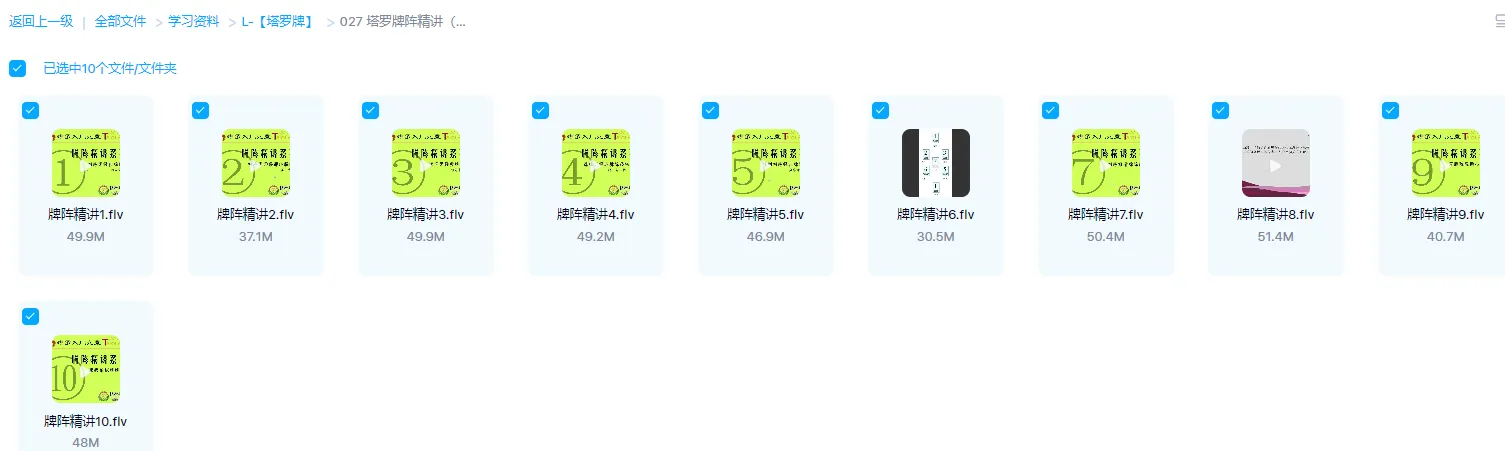
This oracle card collection is listed as nineteen videos. Its directory contains a main class and eighteen supplementary files with a mixture of demonstrations, questions, communication topics, and conversational subjects. The numbered filenames include a common questions session, an eight case recording, an example about interpersonal concerns, a past life card topic, multiple interpretations of one card, and a lesson about connecting separate points into a line. Other labels mention atmosphere, a reserved client, reversed card examples, mermaid cards, Life Purpose cards, White Light cards, and handling a reading that goes wrong.
These labels are more informative than a general promise of growth, but they are still brief filenames. They do not establish the exact deck edition, every card shown, the duration of a teaching segment, or an approved sequence for a new learner. The main class is a useful starting reference when trying to understand the terminology used in the supplements. The file listing is displayed partly in alphabetical order, so file ten appears before file two. Preserve the numeric labels in your own index rather than treating the displayed order as a pedagogical instruction.
One Image Can Support Several Interpretations
The filename about multiple interpretations of one card, with a butterfly girl reference, offers a specific focus for study. It points toward a question that often matters in oracle reading: how an image can lead to more than one account. While watching, note what details are being selected and how the question affects the explanation. If the same card appears in another recording, compare the contexts before deciding that the meanings conflict. A flexible symbolic practice may allow different associations, but flexibility also makes it necessary to explain why a particular association was chosen.
A personal study exercise can use three columns: visible details, possible associations, and relevance to the question. This keeps an interpretation from floating free of both the image and the situation. It also makes room for uncertainty. A reader may see an image as suggesting a transition, while another reader experiences it as suggesting hesitation. Those are interpretive responses. Neither response alone establishes that a transition or hesitation is a fact in another person’s life. The exercise is about making the reasoning visible, not proving that only one story is correct.
Connecting Points Without Inventing a Narrative
The directory explicitly names a practical topic about connecting points into a line. When studying that recording, look for the way individual observations become a connected explanation. A coherent story can be persuasive even when several links are assumptions. Record which connections are stated in the lesson and which you add yourself. If an explanation uses information supplied by a participant, mark that information separately from card symbolism. This distinction helps you understand the demonstration and avoids attributing every relevant detail to the cards.
For independent practice, choose an ordinary reflective question and write the sequence of your reasoning in a few sentences. Then check whether every sentence has a clear relationship to the question. Remove details introduced only to make the story more dramatic. A simple account that honestly identifies an uncertainty is often easier to discuss than an elaborate story about hidden forces. If you revisit the account later, preserve the original version so that you can see what you actually said before receiving new information.
Communication Topics in the Supplementary Files
Two directory labels explicitly concern communication: one discusses mermaid cards and communication techniques, while another asks what to do with a reserved or unresponsive client. These files can be studied as examples of how a reader addresses participation, pace, and interpretation. A person’s silence does not necessarily indicate resistance, agreement, or a hidden emotional problem. They may simply be thinking, unfamiliar with the process, or uninterested in a particular explanation. When taking notes, avoid turning a communication difficulty into a claim that the cards have diagnosed the participant.
A learner can use these topics to reflect on consent and clarity in their own conversations. Explain that a card interpretation is an invitation to consider an idea, allow the other person to disagree, and do not pressure them to provide intimate information. If a question becomes uncomfortable, it is reasonable to pause or change the focus. These are independent communication considerations, rather than a guarantee of what the instructor recommends. They are especially relevant to a collection whose filenames include both client interaction and examples of unsuccessful readings.
Life Purpose and White Light References
The directory names a Life Purpose recommendation and case sharing file, and a White Light file associated with cause and development analysis. These references support mentioning those names as part of the listed material. They do not verify which physical decks are supplied, and this digital course listing does not establish that any deck is included. If you wish to follow a demonstration using a matching deck, first identify the deck within the recording. A generic oracle deck may have different artwork, keywords, and conventions, so it cannot be assumed to provide the same example.
Life purpose language can be used as a personal reflection topic, but it should not become a statement that a card determines your occupation or a fixed destiny. Similarly, an interpretive account of a cause is not an investigation establishing why an event occurred. A useful notebook records the question, the card reference, the explanation, and the facts that remain unknown. This allows you to study how the teacher constructs meaning while retaining room for ordinary evidence, practical choices, and the participant’s own account of their situation.
Past Life and Out of Body Conversation
The filenames include a past life card lesson and a conversational file mentioning past lives and out of body experiences. These are spiritual or interpretive topics in the directory. Their presence does not provide evidence that past lives can be identified or that a card reading confirms an out of body event. If you are interested in these subjects, keep notes on the language and assumptions used, and distinguish belief based discussion from an observable claim. Avoid treating an imaginative story as a recovered memory or as an explanation of another person’s present difficulties.
Learning From an Interpretation That Does Not Fit
The file about what to do when a reading goes wrong gives the collection a useful practical point of inquiry. Study how disagreement or a mismatch is addressed, and record any explanation without automatically adopting it. In independent practice, a participant’s disagreement is information to respect. It should not be reinterpreted automatically as proof that the reading is secretly accurate. Keeping an honest record of what did not fit can make your study more thoughtful. It also supports a conversational approach in which symbolic prompts remain optional and personal conclusions remain open to revision.