
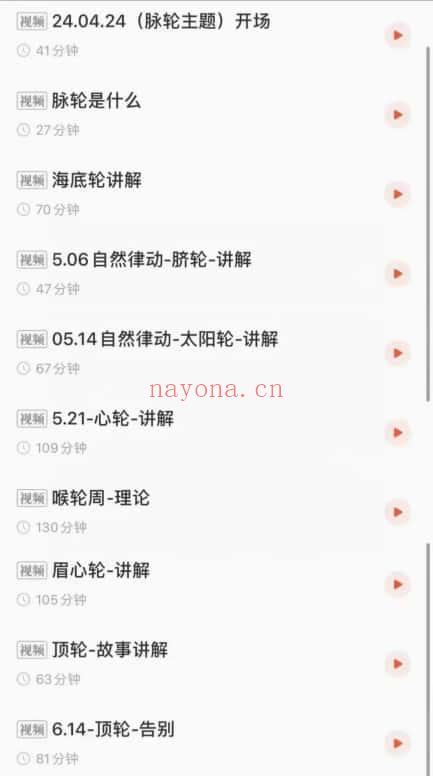
A ten-part video introduction to the seven-chakra model. The published directory names an opening, an explanation of the model, the seven named chakras and a closing lesson.
Resource Overview
Seven Chakras in Depth: Ten Video Lessons is a digital learning resource about Chakra Studies. The English description summarizes the available source listing; the underlying recordings or books are in Chinese. An English translation of the full material is not confirmed.
What You Will Learn
Use the sequence and preview material below to identify the course’s scope, terminology and teaching approach. Check each topic against the original lesson rather than treating a short listing as a complete transcript.
Course Contents
- What the chakra model means in this course
- Root through crown chakra topics
- Opening and closing lessons
Original Course Images


Who This Resource Is For
This resource is for readers or learners who can use Chinese-language materials and want a named resource on Chakra Studies. Compare the stated scope and previews before ordering; a fixed level of prior experience is not assumed unless the source directory says so.
Learning Format and Digital Delivery
Ten Chinese-language videos; the source lists about 12 hours 24 minutes Virtual and downloadable; there is no physical shipment. Price: USD 9.00. A file link is not yet attached to this product. Please contact Karma Kismet before ordering to confirm delivery arrangements; immediate automated access is not promised.
Frequently Asked Questions
Is the full material in English?
No English edition, recording or subtitle track is confirmed. The source material is Chinese-language.
Is a personal consultation included?
No individual consultation is listed with this resource.
Does this resource guarantee an outcome?
No. It is for educational and cultural study, not a guaranteed result or substitute for professional advice.
Editorial Note
Karma Kismet translated and organized the course facts and original previews for English readers. Lesson counts and formats follow the available source listing; unspecified contents, certificates and instructor credentials are not asserted.
Related Courses
- Guo Heren Taishang Kunlun Contemplation: Four Videos
- Awakening Through Contemplation: 305 Video Collection
- Yingxin Seven Chakras: 22 Lessons and Audio Practices
- Violet Flame Reiki: Six-Part Video Course
- Wuzi Studio Western Reiki: 15 Videos
- Energy Reflection Cards: 23 Video Lessons
- Li Yan Inner-Energy Reflection: Five Videos
- Casey Akashic Reading Course 2025: 45 Videos
- Guo Xuhui Akashic Records Reading: 22 Lessons
- Li Linhao Breathing and Relaxation Practice: Nine Videos
- Zhan Tangning 21-Day Breathing Meditation: 30 Videos
Browse Chakra Studies and read digital delivery information.
Ten recordings around a seven-part model
The visible description of Seven Chakras in Depth identifies ten recordings: an opening, an explanation of the model, seven named chakra discussions and a closing lesson. This is a concrete structure to preserve. The seven-chakra model is approached here as symbolic and contemplative vocabulary, not as verified anatomy or a diagnostic system. The opening and closing recordings should not be mistaken for additional chakras. These editorial reading suggestions help a learner examine the model without inventing a detailed English syllabus or promising an outcome from the series.
Opening, model and closing
Make an index that separates the opening, model explanation, individual discussions and closing. A ten-file series can have several roles within it, and an accurate index makes those roles visible. Record the actual topic of each recording only after inspection. A heading in the directory does not establish its complete content.
The model explanation is a useful place to locate definitions that later discussions may assume. Keep a source location for each definition. The closing recording may summarize or add a perspective, but its role should likewise be verified rather than guessed. A reader can compare the opening and closing to ask whether a term is revisited or qualified. This is more useful than describing all ten files as identical units or treating the count as evidence of a standardized qualification.
Symbolic locations and qualities
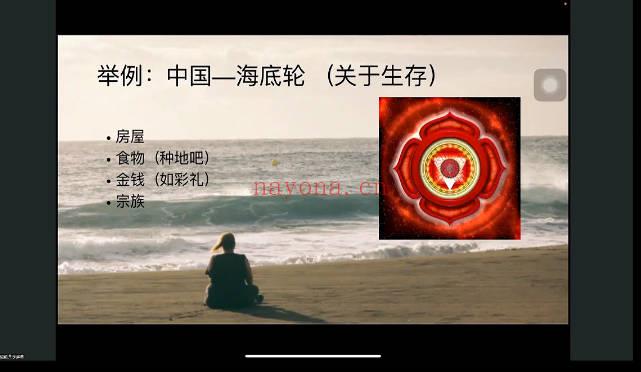
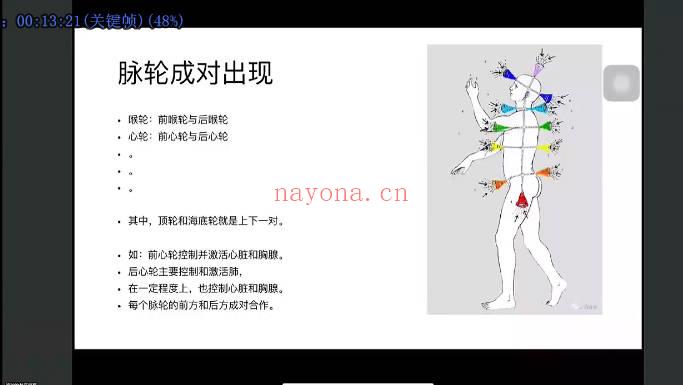
For each named chakra, preserve the location and qualities assigned by the source as features of its framework. Do not translate a symbolic location automatically into an organ or a measurable structure. The model can organize meaning without being an anatomical map.
A useful diagram contains the source label, the association actually supplied and the passage explaining it. Leave missing colors or meanings open rather than filling them from a familiar chart. Different resources may use different conventions. Your diagram should identify this teaching’s account. If you add a personal association, keep it in a separate field. This allows a reader to distinguish the resource’s model from your response and prevents a visually complete chart from giving uncertain information the appearance of established fact.
Compare discussions one pair at a time
Choose two of the named discussions and compare how they define their subject. Do they use the same kinds of explanation, examples or imagery? Record the features that actually appear rather than imposing identical fields on both passages. A difference may show that the model uses several kinds of reasoning.
Then identify one relationship the source explicitly draws between the two. If no relationship is stated, keep that as a limit. A connected seven-part model does not mean every pair has an explained connection in every recording. This comparison can clarify the teaching’s structure without claiming that you have inspected all possible relationships. It also helps avoid the assumption that a concern associated with one symbolic category must have a single hidden energetic cause.
Experience and interpretation
If the recordings invite attention to sensations or emotions, record the experience in ordinary descriptive language before assigning a chakra interpretation. A feeling of warmth, distraction or comfort can be described as such. The explanation that a particular chakra caused it adds another claim and should be attributed separately.
The same discipline applies when no notable sensation occurs. Absence of an expected feeling is not evidence of a blockage or failure. The product listing does not establish a standard experience for every learner. A textual study remains valid even without participation in an exercise. Keeping experience and interpretation separate makes the material easier to discuss with readers who have different beliefs, because the record does not demand that they accept a cause before understanding what was observed.
Reflective themes without fixed identities
A symbolic quality can become a question rather than a label imposed on a person. If a passage connects a chakra with expression, for example, an editorial reflection might ask about a recent communication choice. Use the association actually present in the material, not an imported complete personality chart.
Write a specific situation and consider several explanations for it. A difficulty communicating does not prove that a chakra is unbalanced, just as a confident moment does not prove that a chakra is open. Avoid using the model to assign another person a fixed condition or to infer private motives. The framework can prompt reflection while the actual situation remains complex. A modest question about choices, assumptions or boundaries is a useful learning activity without becoming a diagnosis.
Practices remain optional
Inspect the actual instruction before describing any practice in the recordings. The listing identifies discussions but does not establish every exercise, duration or breathing method. Do not invent those details. If a reader participates independently, comfort and freedom to pause should remain basic considerations.
There is no need to pursue an intense sensation to demonstrate understanding. A practice can be analyzed through its wording, imagery and stated purpose. If the source uses healing or energy language, preserve that language as the source’s account rather than an editorial assurance. The material should not be presented as a substitute for appropriate support with health concerns. The educational focus is the model and how it is explained, not the promise that following a sequence will reliably produce a physical or psychological result.
A glossary across the series
Keep original Chinese terms alongside provisional English glosses. Check a gloss against more than one passage before treating it as settled. A word may function differently in a general explanation and a particular chakra discussion. The English-facing product description does not establish a complete translated edition of the recordings.
Each glossary entry can contain a definition location, one example and an uncertainty note. This is enough to make it useful for retrieval and comparison. If a later discussion changes your understanding, revise the gloss and preserve the reason. A good glossary grows through inspection rather than through a desire to complete every field. It should help the learner explain the source’s account clearly while keeping symbolic, experiential and factual statements distinguishable.
Closing with a bounded summary
After inspecting selected recordings, summarize only what those recordings support. Identify a definition clarified, a relationship explained and a question left open. Do not claim complete review of the series if your study was selective.
The ten-recording structure gives a manageable way to return to the model and its seven named discussions. Its value can lie in cultural understanding and careful reflection. Claims about anatomical structures, diagnosis, guaranteed balance or therapeutic effects remain beyond what the listing establishes. A traceable summary makes that limit visible while retaining the resource’s subject and the learner’s freedom to interpret it.